
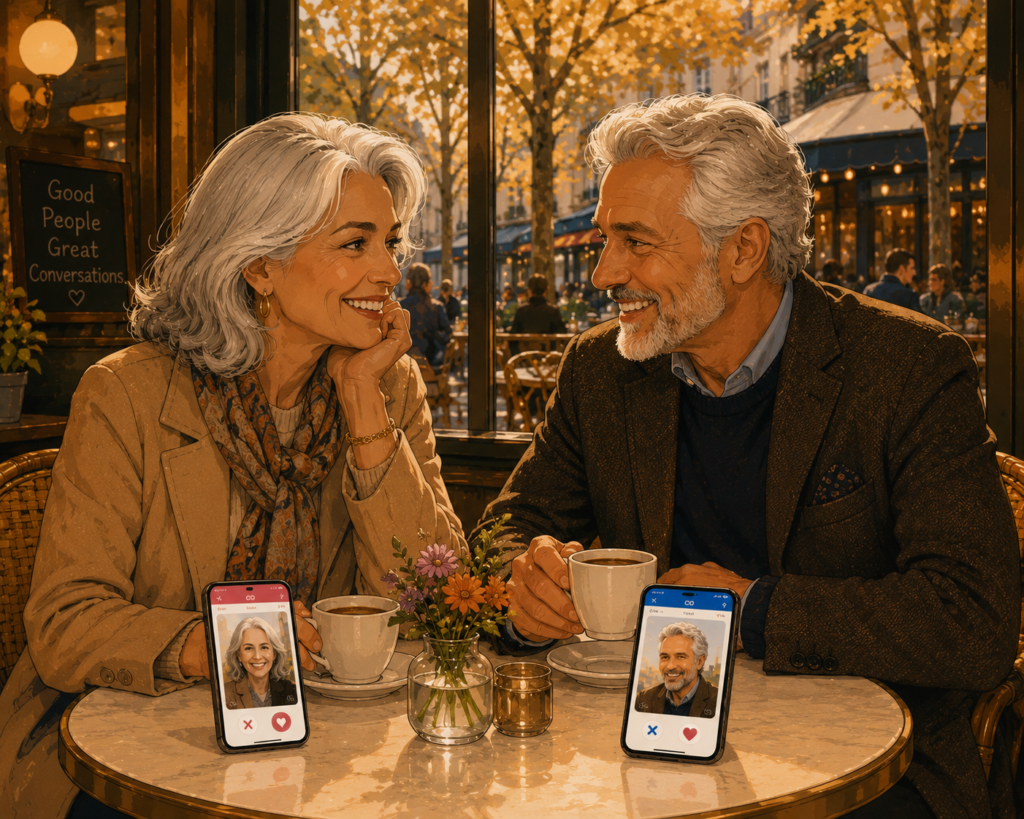
Dating apps for seniors over 60 have improved dramatically in recent years — and the assumption that online dating is primarily for younger people has been thoroughly disproved by the numbers.
According to data from Pew Research Center, adults over 55 are one of the fastest-growing demographic groups on dating platforms — and the reasons are straightforward. Divorce rates in the over-60 demographic have risen consistently over the past two decades. Life expectancy has increased. And the social infrastructure that previous generations relied on for meeting people — church communities, workplace social life, neighbourhood connections — has weakened in ways that make intentional digital connection more relevant than ever.
This guide explores the best dating apps for seniors over 60 in 2026, highlighting which platforms are worth your time, which ones to avoid, how to create a profile that reflects who you are today, and how to navigate the unique realities of dating later in life.
Find the Right Platform for Your Age and Location
💡 The best dating app for seniors over 60 depends significantly on where you live — user base density matters more than features at this demographic.
This tool matches you with the top-rated dating platform available in your specific location — updated for 2026.
Find Your Best Dating App →
Why Dating After 60 Is Different — and Often Better
Before getting into specific platforms, it’s worth naming the ways that dating after 60 differs from dating at earlier life stages — because these differences shape which platforms work and how to use them effectively.
You Know What You Want
One of the genuine advantages of dating after 60 is the clarity that comes from experience. Most people in this demographic have been through significant relationships — marriages, long partnerships, losses. They know, with a specificity that younger daters often lack, what they actually need in a partnership, what they can tolerate, and what they cannot.
This clarity is a genuine asset that the best dating profiles for seniors communicate directly — and it’s one of the primary reasons that connections made in the over-60 demographic often have a directness and intentionality that earlier-stage dating frequently lacks.
The Stakes Are Different
Dating after 60 involves different stakes than dating at 30. Children, career decisions, geographic moves for a relationship — these factors carry different weight. For many over-60 daters, the question is not “should I rearrange my life for this person?” but “does this person enhance the life I’ve already built?”
This is a fundamentally different and often healthier question — and it produces fundamentally different dating behavior.
The Social Context Has Changed
Meeting people organically — through work, through mutual friends, through the natural social infrastructure of earlier life — becomes more challenging after 60. Retirement removes the workplace social structure. Children leave home. Friend circles shift. The social conditions that made meeting people effortless in earlier decades no longer operate in the same way.
Dating apps fill a genuine gap in the over-60 social landscape in a way they don’t quite do for younger demographics — because the alternatives are thinner.
Grief and Previous Loss Are Often Present
Many people dating after 60 have experienced significant loss — the death of a spouse, a long marriage ending in divorce, the grief of losing a partner after decades together. This context shapes the emotional landscape of dating in ways that are worth acknowledging and navigating honestly.
The best approach to dating after loss is neither rushing the process nor treating readiness as an indefinite future state. Our guide on ready to date again after a breakup covers the specific signs of genuine emotional readiness — which apply equally after divorce or bereavement.
The Best Dating Apps for Seniors Over 60 in 2026
1. Match.com — Best Overall for the 60+ Demographic
Match.com is the strongest overall platform for seniors over 60 — and the reasons are specific rather than generic.
User base depth in this demographic: Match has been part of the dating landscape since 1995 — and its longevity means that older demographics, who discovered it in earlier decades and have continued to trust it, are significantly better represented here than on newer platforms. The 55+ user base on Match is substantially deeper than on any other major platform.
Geographic reach: Match has the broadest geographic coverage of any serious-relationship platform — including smaller cities, suburban areas, and rural communities where newer platforms have virtually no user base. For over-60 daters who are not in major metropolitan areas — which is the majority — this reach is genuinely decisive.
The search-based model: Match allows you to search specifically by age, location, relationship goals, and detailed preferences rather than receiving algorithmic suggestions over which you have limited control. For over-60 daters who know specifically what they want, this browsing control is more useful than a curated-match system.
Relationship intent: Match’s explicitly relationship-focused positioning attracts users who are looking for committed connection — which aligns naturally with the intentions of most over-60 daters.
Pricing: Match’s subscription model — approximately $22–35 per month depending on plan length — is reasonable relative to the user base depth it provides in this demographic.
Tips for seniors on Match: Use the detailed search filters deliberately. Set specific age ranges, geographic radius, and relationship goals. Read profiles thoroughly — Match profiles tend to be more detailed than swipe-based apps. And use the “Favorites” feature to indicate interest before committing to a full message.
2. eHarmony — Best for Compatibility-Based Serious Relationships
eHarmony’s compatibility questionnaire approach — where daily curated matches are generated based on detailed personality and values data — is particularly well-suited to the over-60 demographic for several reasons.
The questionnaire does useful work: The detailed personality assessment that eHarmony requires produces more genuinely compatibility-screened matches than photo-based browsing. For over-60 daters who are specifically looking for long-term compatible partnership, this filtering is genuinely valuable.
The user base skews older: eHarmony’s fully paid model and its explicitly serious-relationship positioning produce a user base that is significantly older on average than any swipe-based platform. The over-55 demographic is well-represented relative to the broader market.
No browsing required: The curated daily match system suits over-60 daters who prefer a more considered, less exhausting approach to online dating than the browse-and-swipe model. Three to seven thoughtful suggestions per day requires very different time and energy than scrolling through hundreds of profiles.
Limitation: eHarmony is expensive — $35–65 per month depending on plan — and the interface is less modern than newer platforms. But for users who are specifically serious about finding a long-term compatible relationship and are willing to invest in the process, the user base quality justifies the price.
For a full comparison of eHarmony and its closest competitor, our guide on eHarmony vs Match.com covers both platforms across every relevant dimension.
3. OurTime — Built Specifically for Singles Over 50
OurTime is the only major dating platform specifically designed for the over-50 demographic — and its specificity produces a user base that is genuinely different from the broader platforms.
Why the demographic specificity matters: Everyone on OurTime is over 50. This means the match pool is entirely composed of people at a similar life stage — with similar experiences, similar priorities, and similar approaches to what they want from connection. The absence of twenty-somethings navigating casual dating alongside serious relationship seekers changes the entire character of the platform.
Simplified interface: OurTime’s interface is deliberately more accessible than platforms designed for younger, more digitally fluent users. Larger text, simpler navigation, and a more intuitive layout make it significantly easier to use for people who are less comfortable with smartphone-native design.
Features worth using: OurTime’s “Flirt” feature allows expressing interest with a single tap — useful for indicating interest without the commitment of a full message. The “Mutual Match” feature shows you people who have already expressed interest in your profile.
Limitation: OurTime’s user base is smaller than Match or eHarmony in most markets — which can mean a thinner pool particularly outside major metropolitan areas. It works best as a supplement to Match rather than as a primary platform.
4. SilverSingles — Best for Education-Filtered Over-50 Dating
SilverSingles is specifically designed for singles over 50 and uses a personality test to generate curated daily matches — similar in philosophy to eHarmony but with an explicitly over-50 focus.
Why it works for seniors: The over-50 exclusivity means a genuinely peer-appropriate user base. The personality assessment produces more compatibility-filtered matches than photo-based browsing. And the platform’s positioning as a premium, serious-relationship-focused service attracts users with genuine relationship intent.
User base: SilverSingles has its strongest user bases in the US, UK, Canada, and Australia — with meaningful coverage in major metropolitan areas and reasonable coverage in suburban markets.
Pricing: Similar to eHarmony — premium pricing that reflects the curated, serious-relationship positioning.
Best for: Over-60 daters in major metropolitan areas who want compatibility-based matching from a peer-specific platform.
5. Hinge — Surprisingly Effective for Active Over-60 Users in Cities
Hinge’s reputation as a platform for younger users obscures an important reality: in major metropolitan areas, Hinge has a meaningful and growing 50+ user base — and its prompt-based profile system is particularly well-suited to over-60 daters who have more to say about who they actually are than a photo alone can convey.
Why it works for over-60 users: The prompt system rewards life experience. Someone who has genuinely lived — who has opinions, stories, and a specific point of view — creates a significantly more compelling Hinge profile than generic younger-user content. The depth available through prompts is directly proportional to the richness of the life being described.
Geographic limitation: Hinge’s 50+ user base is meaningful in New York, London, Los Angeles, Chicago, Toronto, and Sydney — and significantly thinner almost everywhere else. Outside major cities, Hinge is not a viable primary platform for seniors.
Best for: Over-60 daters in major metropolitan areas who want the conversational depth that Hinge’s prompt system produces and are comfortable with a more tech-forward interface.
6. Facebook Dating — Underrated and Genuinely Useful
Facebook Dating — built into the Facebook app — is one of the most underused and most genuinely useful dating options for the over-60 demographic.
Why it works for seniors: Facebook’s user base in the over-60 demographic is enormous relative to any dedicated dating app. The integration with an existing platform that most over-60 users already use removes the friction of learning a new application. And the “Secret Crush” feature — which matches you with existing Facebook friends who have also expressed interest — leverages existing social networks in a way no other platform does.
The profile advantage: Facebook Dating uses your existing Facebook profile as a foundation — which means over-60 users who have been active on Facebook have rich profile material available without building from scratch.
Privacy: Facebook Dating is not visible to your Facebook friends unless there is mutual interest — which addresses one of the primary concerns that older users have about dating app visibility.
Best for: Over-60 users who are already active on Facebook and want a low-friction entry into digital dating.
7. Bumble — Best for Women Over 60 Who Want Inbox Control
Bumble’s women-first mechanic — where women initiate all heterosexual conversations — provides a specific and genuine advantage for over-60 women who want control over their inbox and their interactions.
Why it works for over-60 women: The quality-over-volume experience that Bumble’s mechanic produces is particularly valuable for women in this demographic who want thoughtful, substantive engagement rather than high-volume contact management.
Limitation: Bumble’s over-60 user base is thinner than Match or eHarmony — concentrated primarily in major cities among the more active and tech-comfortable segment of the over-60 population. In smaller cities and rural areas, the user base may be insufficient.
Best for: Over-60 women in major cities who want inbox control and a more selective interaction model.
Platform Comparison for Seniors Over 60
| Platform | Best For | User Base 60+ | Geographic Reach | Price |
|---|---|---|---|---|
| Match.com | Overall, broad reach | ⭐⭐⭐⭐⭐ | ⭐⭐⭐⭐⭐ | $22–35/mo |
| eHarmony | Compatibility-based serious relationships | ⭐⭐⭐⭐ | ⭐⭐⭐⭐ | $35–65/mo |
| OurTime | Peer-specific dating | ⭐⭐⭐⭐ | ⭐⭐⭐ | $20–30/mo |
| SilverSingles | Personality-based over-50 | ⭐⭐⭐⭐ | ⭐⭐⭐ | $30–40/mo |
| Facebook Dating | Low friction, existing network | ⭐⭐⭐⭐ | ⭐⭐⭐⭐ | Free |
| Hinge | Major cities, conversational depth | ⭐⭐ | ⭐⭐ | Free/paid |
| Bumble | Women who want inbox control | ⭐⭐⭐ | ⭐⭐⭐ | Free/paid |
How to Build a Dating Profile That Works After 60
Lead With Who You Actually Are Now
The most common profile mistake made by over-60 daters is describing who they were rather than who they are. Career histories, past achievements, what their life used to look like — these are less useful than a clear, specific picture of what their current daily life actually contains.
How do you usually spend your time these days? What’s been capturing your interest lately? Is there anything you’re especially looking forward to? And if you could describe an ideal week right now, what would it include?
These present-tense questions produce more compelling profiles than biographical summaries — and they give potential matches something real and immediate to respond to.
Be Specific About What You’re Looking For
Over-60 daters have typically earned the right to be clear about what they want — and the most effective profiles use that clarity explicitly.
“Looking for someone to travel with, laugh with, and see where things go” is generic. “I’m looking for a genuine companion — someone who enjoys good food, values their independence, and is interested in building something real rather than filling time” is specific. The first attracts everyone and no one in particular. The second attracts exactly the right people.
Show Your Life Rather Than Describing It
A photo at a family gathering, at a favourite travel destination, pursuing a hobby, or in a context that reveals something about your actual current life is significantly more compelling than a formal portrait.
The goal of your photos is to make a potential match feel like they can visualise spending time with you — which requires photos that show you in contexts that reflect your actual life.
For comprehensive guidance on what makes dating profile photos work, our guide on Bumble photo tips covers the specific lighting and composition decisions that apply across all platforms.
Be Honest About Your Situation
Widowed, divorced, children, grandchildren, geographic ties — these are real parts of your life, and honesty about them is both respectful to potential matches and efficient for your own process. Discovering significant situational incompatibility early — before emotional investment has developed — saves significant time and emotional energy for both people.
Specific Challenges of Dating After 60 — and How to Navigate Them
Technology Confidence
Some over-60 daters are entirely comfortable with smartphones and apps. Others find the technology genuinely challenging — and platforms that are designed without this demographic in mind can feel overwhelming.
Practical recommendation: Start with one platform rather than several. Match.com or Facebook Dating — both of which have relatively accessible interfaces for less tech-native users — are good starting points. Spend time getting comfortable with the interface before evaluating results.
Safety and Scam Awareness
Over-60 daters are specifically targeted by romance scammers — and the financial losses can be significant. According to the Federal Trade Commission, adults over 60 report higher median losses from romance scams than any other age group.
The specific warning signs: anyone who cannot or will not video call, whose biographical details are inconsistent, whose communication is unusually intense very quickly, or who eventually introduces a financial need.
The absolute rule: Never send money to someone you have not met in person — regardless of how established the connection feels or how compelling the story is. For comprehensive guidance on identifying and avoiding scams, our guide on dating app scammers covers every type of fraud targeting online daters.
Navigating the Grief of Previous Loss
For daters who are widowed or who have ended long marriages — the emotional complexity of new dating is genuinely significant. Guilt, comparison to a previous partner, uncertainty about what you actually want — all of these are normal and deserve honest acknowledgment.
The most important practical principle: honesty with yourself about where you actually are emotionally is more important than moving at any particular pace. Some people are ready for new connection within months of a significant loss. Others need years. Neither timeline is wrong.
Children and Family Complexity
Adult children can have strong opinions about a parent dating — and navigating those opinions while also pursuing your own genuine needs requires some thought.
The most effective approach is usually clear communication with family — not seeking permission, but sharing your intentions and allowing time for adjustment. Adult children’s initial resistance to a parent dating often diminishes significantly once they see that the parent is genuinely happy and that their relationship with their family is not being threatened.
What Over-60 Daters Are Actually Looking For
Research consistently shows that what over-60 daters want differs significantly from what younger daters prioritize.
According to research published by AARP, over-60 daters most commonly report wanting: genuine companionship, intellectual engagement, shared activities and interests, emotional honesty, and — in many but not all cases — physical affection and intimacy.
What they less commonly report wanting: dramatic romantic intensity, the performance of youth, financial entanglement, or the premature merging of lives that earlier-life partnership often involves.
The “Living Apart Together” model — where two people maintain a genuine, committed relationship while keeping separate residences — is significantly more common in the over-60 demographic than in younger groups. This model suits people who have established independent lives and want genuine connection without the full domestic merger that cohabitation involves.
Understanding that this model exists — and that it’s genuinely what many over-60 daters want — removes the pressure to follow a relationship trajectory designed for earlier life stages.
Offline Options for Meeting People After 60
Dating apps are genuinely useful — but they’re not the only path, and for many over-60 daters they’re not even the primary one.
Adult education and continuing learning: Universities and community colleges offering continuing education programs create environments of shared intellectual interest — one of the most powerful bases for genuine connection.
Volunteer communities: Volunteering — with food banks, literacy programs, environmental organizations, hospitals — creates shared purpose and repeated contact with engaged, community-oriented people.
Travel groups for singles: Companies like Road Scholar and solo travel groups specifically for over-60 singles create contexts where meeting compatible people is built into the structure of the experience.
Interest-based clubs: Photography clubs, book clubs, hiking groups, gardening societies, choir groups — any recurring activity with a consistent membership creates the repeated contact that genuine connection requires.
Senior centers (reconsidered): Senior centers have modernized significantly — many now offer fitness programs, arts and crafts, social events, and travel that attract active, socially engaged over-60 adults rather than only the very elderly demographic the name might suggest.
Dating After 60: The Honest Emotional Reality
Dating after 60 involves a specific emotional complexity that younger-skewing dating advice rarely acknowledges honestly.
The combination of clarity about what you want, genuine grief about what has been lost, uncertainty about what a new relationship would even look like at this stage, and the vulnerability of putting yourself forward after a long period outside the dating world — all of these coexist in most over-60 daters’ experience simultaneously.
The most useful frame is one that acknowledges all of this without letting any single element dominate. You’re allowed to be honest about what you want. You’re allowed to grieve what you’ve lost while remaining open to what the future might hold. And you’re allowed to move forward at the pace that feels right for you. And you are allowed to enjoy new connection without it needing to resolve everything.
Dating after 60 is not a consolation prize for what came before. It is a genuine opportunity — shaped by everything you’ve experienced and everything you know about yourself — for something that fits who you actually are now.
Find the Right Platform for Your Situation
💡 The best dating app for seniors over 60 depends on where you live and what you’re looking for.
Find the top-rated platform available in your specific location — updated for 2026.
Find Your Best Dating App →
Final Thoughts
Dating apps for seniors over 60 have never been better — and the over-60 demographic has never been better positioned to use them effectively.
Match.com for broad reach and the deepest 60+ user base. eHarmony for compatibility-based serious relationships. OurTime and SilverSingles for peer-specific environments. Facebook Dating for low-friction entry using existing social infrastructure. Hinge for major city users who want conversational depth.
Beyond the apps: adult education, volunteer communities, interest-based clubs, and travel groups all produce genuine connection in ways that complement digital platforms.
The specific advantages that come with dating after 60 — clarity about what you want, the earned ability to recognize compatibility quickly, and the freedom from the performance pressures of younger-life dating — are real. Use them.