
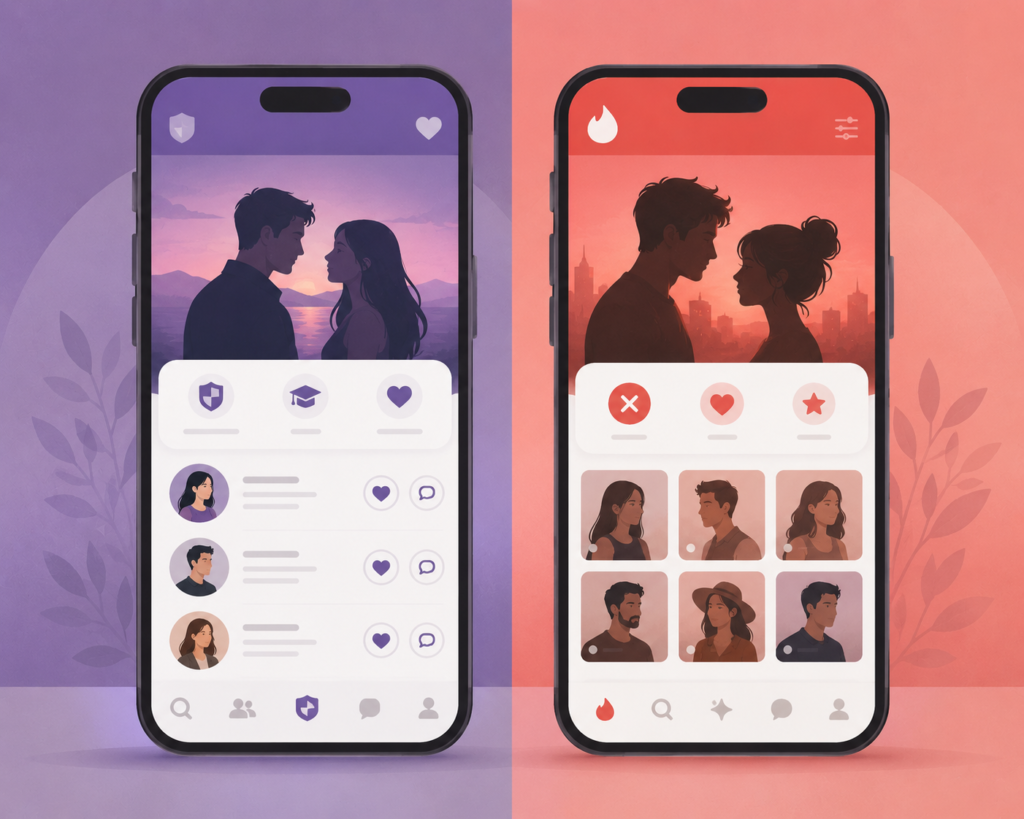
If you’ve decided that casual dating apps aren’t working for you — that you want something more intentional, more structured, and more likely to produce a real relationship — you’ve probably landed on the same two names.
eHarmony and Match.com are the two most established serious-relationship platforms in the English-speaking world. Both have been around for decades. Both are explicitly oriented toward helping people find committed, long-term relationships. Both cost money — which immediately filters the user base toward people who are genuinely motivated.
But they work very differently. Their matching philosophies, user experiences, and ideal users are distinct enough that choosing between them actually matters.
This guide breaks down eHarmony vs Match.com across every dimension that’s relevant to someone looking for a serious relationship in 2026 — honestly, without the marketing language.
The Core Philosophy: How Each App Thinks About Matching
Before getting into specifics, the fundamental difference between these two platforms comes down to one question: do you want the algorithm to decide who you see, or do you want to decide yourself?
eHarmony believes compatibility can be measured. Its entire system is built around a detailed personality and values questionnaire — one of the most extensive in online dating — and uses your answers to generate matches it believes are genuinely compatible with you. You don’t search. You receive.
Match.com believes you know what you want better than an algorithm does. It gives you a large pool of profiles and sophisticated search and filter tools to find people yourself — while also offering algorithmic suggestions you can take or leave.
Neither approach is objectively superior. The right one depends entirely on how much you trust your own ability to identify compatibility versus how much you want structured help doing it.
Sign-Up Process: How Each Platform Onboards You
eHarmony
Signing up for eHarmony takes time — and that’s deliberate.
The compatibility questionnaire covers personality traits, values, relationship goals, communication style, and what you’re looking for in a partner. Completing it honestly takes 20–40 minutes.
This extended onboarding serves two purposes. First, it generates the data eHarmony uses to match you. Second, it filters out people who aren’t serious enough to complete it — which immediately improves the quality of the user base you’re entering.
By the time you’re done, eHarmony has a detailed picture of who you are and what you’re looking for. The matches you receive reflect that picture — sometimes uncomfortably accurately.
Match.com
Match’s onboarding is significantly faster — 10–15 minutes to complete a profile and basic preferences. You can start browsing almost immediately.
The profile setup is more conventional: photos, a bio, basic preferences around age, location, and relationship goals. The platform gives you tools to find people rather than generating a curated list of compatible matches.
Which is better: eHarmony’s longer process produces more targeted matches. Match’s faster setup gives you more immediate access to a larger pool. If you’re impatient, Match feels more satisfying early. If you’re serious about compatibility over volume, eHarmony’s onboarding investment pays off.
Matching System: How Each Platform Decides Who You See
eHarmony’s Compatibility Matching
eHarmony’s proprietary algorithm — built around decades of relationship research — generates a daily selection of compatible matches. You don’t search for people. You review the matches eHarmony sends you and indicate interest.
The matches are based on deep compatibility factors: personality, values, relationship goals, communication preferences, and lifestyle factors. eHarmony’s research — cited by platforms including Psychology Today — suggests that couples matched through compatibility-based systems have higher relationship satisfaction and lower divorce rates than those who self-select based on surface-level attraction.
The limitation: you have less control. If eHarmony’s algorithm isn’t producing people you find attractive or interesting, your options are limited. You can adjust your preferences, but you can’t browse freely.
Match.com’s Search-Based System
Match gives you a large database of profiles and robust tools to search through it yourself — by age, location, interests, relationship goals, physical characteristics, and more.
Match also offers algorithmic suggestions — profiles it thinks you might like based on your behavior on the platform. But these are suggestions, not the primary mechanism. You’re in the driver’s seat.
Which is better: eHarmony for compatibility depth. Match for autonomy and volume. If you want someone to do the heavy lifting, eHarmony. If you want to run the search yourself, Match.
User Base: Who Is Actually on Each Platform
This is one of the most important factors — and one that’s rarely addressed honestly in platform comparisons.
eHarmony
eHarmony’s user base is older and more relationship-focused than virtually any other major dating platform. The demographic skews 30–55, with strong representation in the 35–50 range.
The user base is self-selected toward serious relationship intent — the combination of the detailed questionnaire, the subscription cost, and the platform’s explicit positioning means that almost everyone on eHarmony is there for the same reason: a committed, long-term relationship.
Geographic coverage in the US, UK, Canada, and Australia is strong. Outside these markets, the user base thins considerably.
Match.com
Match has a larger overall user base than eHarmony — and a broader demographic range. The platform covers ages from mid-20s to 60s, with particularly strong representation in the 30–50 range.
Match’s user base is relationship-focused — but less uniformly so than eHarmony’s. The platform’s broader positioning means you’ll encounter more variation in what people are looking for, even among paid subscribers.
Match has stronger geographic coverage in smaller cities and rural areas than eHarmony — which matters if you’re not in a major metropolitan area.
Which is better: eHarmony for consistency of serious relationship intent. Match for larger pool and broader geographic coverage. If you’re in a major city, eHarmony’s depth is sufficient. If you’re in a smaller area, Match’s larger pool may be more practical.
Profile Quality: How Much Can You Learn About Someone Before Matching?
eHarmony
eHarmony profiles are generated partly from your questionnaire answers — which means they reflect genuine personality data rather than just carefully curated self-presentation.
You see compatibility scores that reflect specific dimensions — emotional temperament, communication style, values alignment — rather than just a photo and a bio. This gives you genuinely useful information about why a particular match was suggested.
The photos tend to be fewer and less polished than on image-forward apps — which some people see as a limitation and others see as a feature (less performance, more authenticity).
Match.com
Match profiles are more conventional — photos, a bio, basic information about lifestyle and preferences. The quality of a profile depends entirely on how much effort the person put into it, which varies considerably.
Match does allow more detailed profile information than most apps — information about religion, politics, family plans, drinking and smoking habits — which helps you filter for genuine compatibility factors beyond the basics.
Which is better: eHarmony for depth of compatibility information. Match for conventional browsability. eHarmony tells you more about who someone is. Match tells you more about what they look like and how they present themselves.
Communication: How You Actually Connect With Matches
eHarmony
eHarmony has simplified its communication system significantly over the years. Matches can now message each other directly — the older, more structured “guided communication” process that eHarmony was historically known for has been largely replaced by direct messaging.
One distinctive feature: eHarmony shows you your compatibility breakdown with each match — specific dimensions where you’re well-aligned and areas where you differ. This gives conversations a built-in starting point that goes deeper than most dating app interactions.
Match.com
Match uses straightforward messaging — you can send a message to any profile you’re interested in, regardless of whether they’ve indicated interest in you first. This is a meaningful difference from apps that require mutual matching before communication.
Match also has a “likes” system where you can indicate interest before committing to a full message — which gives you a sense of who’s reciprocally interested before investing in a conversation.
Which is better: Match for communication freedom and volume. eHarmony for structured, compatibility-informed conversation starters. If you want to message anyone you find interesting, Match. If you want conversations that start with real substance, eHarmony.
Pricing: What Does It Actually Cost?
This is where both platforms face legitimate criticism — and where honest comparison matters.
eHarmony Pricing (approximate, 2026)
- 6-month plan: ~$35–45/month
- 12-month plan: ~$20–30/month
- 24-month plan: ~$15–20/month
eHarmony has no meaningful free tier. You can sign up and see your matches — but you cannot read or send messages without a paid subscription. This is a significant barrier that simultaneously filters for motivated users and frustrates people who want to try before committing.
Match.com Pricing (approximate, 2026)
- Standard (6 months): ~$20–25/month
- Premium (6 months): ~$30–35/month
Match has a limited free tier that allows profile creation and browsing but restricts messaging. The paid tier unlocks full communication and additional features.
Which is better on price: Match is generally less expensive and has a slightly more useful free tier. eHarmony’s higher price reflects its more intensive matching system — but it’s a real cost consideration for anyone not ready to commit to a multi-month subscription.
Honest advice: Both platforms offer significantly discounted rates through promotional periods — particularly around Valentine’s Day, New Year, and summer. If you’re not in a rush to start immediately, waiting for a promotion can reduce the cost substantially.
Success Rates: Which Platform Actually Produces Relationships?
Both eHarmony and Match make bold claims about their success rates. Both cite statistics that are difficult to verify independently. Here’s what can be said honestly.
eHarmony has decades of research behind its compatibility model and regularly cites statistics about the number of couples who have married through the platform. Its compatibility-based approach has genuine academic support — research consistently shows that value alignment and personality compatibility are stronger predictors of relationship satisfaction than initial physical attraction.
Match has produced an enormous number of relationships and marriages over its 30-year history — more in absolute numbers than any other platform, largely because of its size. Its success rate in percentage terms is harder to isolate because the user base is more diverse in intentions.
The honest assessment: For serious relationship outcomes specifically, eHarmony’s compatibility-focused approach produces more consistent results among users who complete the process honestly. Match produces more relationships in absolute numbers but with more variance in quality and commitment level.
For women over 30 specifically looking for serious relationship outcomes, our guide on best dating apps for women over 30 provides additional context on how both platforms compare to newer alternatives like Hinge and Bumble.
eHarmony vs Match.com: Which Is Better for Your Specific Situation?
If You Want Maximum Compatibility Depth
→ eHarmony. The personality questionnaire and compatibility matching system produce more genuinely compatible suggestions than any search-based alternative.
If You Want More Control Over Who You See
→ Match. The search-based system lets you set your own criteria and browse freely rather than waiting for algorithmic suggestions.
If You’re Outside a Major City
→ Match. Its larger user base provides more options in areas where eHarmony’s pool is thin.
If You’re 35–55 and Seriously Ready for a Committed Relationship
→ eHarmony. This is precisely the demographic the platform is designed for, and the user base reflects it.
If You’re Dating After Divorce or a Long-Term Relationship
→ Either, depending on your needs. eHarmony’s structured process is helpful if you want guidance. Match’s larger pool is useful if you want more options while you find your footing.
If Budget Is a Consideration
→ Match. It’s generally less expensive and has a more useful free tier.
If You Want to Try Both
Run them simultaneously for two to three months and track which produces better conversations and actual dates. The right answer often becomes clear quickly when you’re comparing real-world results rather than theoretical features.
Common Mistakes People Make on Both Platforms
Regardless of which platform you choose, the same avoidable mistakes consistently undermine results.
Incomplete or dishonest questionnaire answers (eHarmony). The compatibility matching is only as good as the data you provide. Answering what you think sounds good rather than what’s actually true produces poorly matched suggestions.
Generic profiles (both platforms). A profile that could belong to anyone will attract no one in particular. Specific, genuine self-presentation consistently outperforms carefully curated impressiveness. For detailed guidance on what makes a profile work, read our guide on how to write a dating profile that gets matches.
Passive use. Both platforms reward active engagement. Waiting for matches to come to you — on either platform — produces worse results than actively initiating conversations and following up consistently.
Treating matches as inventory. The tendency to keep browsing rather than investing in promising conversations is one of the most common ways people undermine their own results on both platforms.
Not moving toward dates efficiently. Extended message exchanges that never result in actual meetings are a significant time drain. When a conversation is going well, suggest meeting. Our guide on how to ask someone out online covers exactly how to make that transition naturally.
What to Expect on a First Date From Either Platform
First dates from serious relationship platforms feel different from first dates organized through casual apps — and knowing what to expect helps.
People from eHarmony and Match tend to be more explicit about their relationship goals from the start. The conversation often goes deeper faster. There’s less ambiguity about intentions.
This is mostly a feature — it eliminates a lot of the ambiguity and mixed-signal dynamics that plague more casual dating environments. For perspective on reading first date signals clearly, our guide on signs your first date went well gives you a reliable framework regardless of which platform you met through.
And if you’re returning to dating after a significant gap — whether after a long relationship, a difficult period, or simply time away from it — our guide on how to overcome fear before the first date offers practical advice on managing the nerves that come with re-entry.
The Honest Limitation of Both Platforms
Both eHarmony and Match.com are genuinely useful tools for finding serious relationships. But both share a limitation worth naming honestly.
Neither can replace the organic, natural development of connection that happens through shared experience over time. The best they can do — and it’s genuinely valuable — is expand your access to compatible, motivated people and give you structured opportunities to connect.
What happens after the match is entirely up to you. The quality of your conversations, the effort you invest in showing up well, the clarity you bring about what you want — these factors determine outcomes more than the platform does.
Both platforms work. Neither works without genuine engagement.
Find the Best Dating Platform for Your Location
💡 Not sure which serious relationship platform is most active in your area? This tool matches you with the top-rated dating platform available in your location — updated for 2026. Find Your Best Match Platform →
Final Thoughts
eHarmony vs Match.com is not a question with one universal answer — it’s a question with the right answer for your specific situation.
Choose eHarmony if: you want maximum compatibility depth, you’re 35–55 and seriously ready for commitment, you’re willing to pay more for a more curated experience, and you’re in a major city with a sufficient eHarmony user base.
Choose Match if: you want more control over who you see, you’re in a smaller city or rural area, budget matters, or you want a larger pool with more demographic diversity.
Use both if: you have the time to manage two platforms simultaneously and want to compare real-world results.
The most important thing is not which platform you choose — it’s how honestly and actively you engage with it. Both platforms have produced thousands of genuine, lasting relationships. Neither will produce one without your genuine investment.
Explore more on LoveFinder: first date rules for men and women, dating after 30 in the USA, dating after 30 in Europe, and how to find love online and offline.