
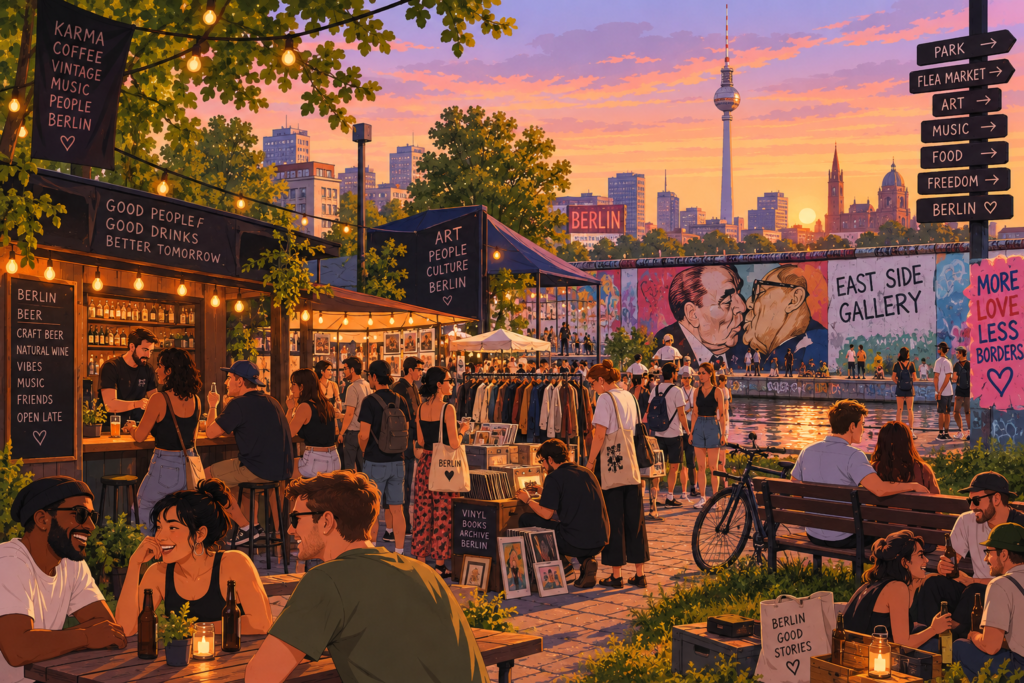
Berlin is unlike any other city in Europe for meeting people — and understanding why requires understanding what Berlin actually is.
Where to meet people in Berlin is a question that has a genuinely different answer from where to meet people in London, Paris, or any other major European capital — because Berlin’s social culture, its history, its specific demographic composition, and its relationship with nightlife and community create conditions for human connection that are unique to this specific city.
Berlin has approximately 3.7 million people, over 800,000 of whom were born outside Germany. It’s home to one of the largest expat communities in Europe, a massive international creative industry, a tech sector that draws young professionals from across the continent, and a nightlife culture that is globally renowned and locally embedded in ways that shape how people actually connect here.
This guide covers where to meet people in Berlin in 2026 — the apps that work, the neighbourhoods that matter, the venues that actually produce genuine connection, and the specific social dynamics of a city that operates by its own rules.
Find Active Singles in Your Part of Berlin Right Now
💡 Berlin’s dating app scene is uniquely international — knowing which platform is most active in your neighbourhood matters.
This tool matches you with the top-rated dating platform available in your specific location — updated for 2026.
Find Your Best Match in Berlin →
Why Berlin Is Different From Every Other European City
The Freedom Culture
Berlin’s history — divided, reunified, reinvented — has produced a specific social culture that is more explicitly free, more tolerant of difference, and more resistant to convention than almost any other major city in the world.
This has direct implications for dating and social connection. Berlin is a city where people are unusually honest about what they want, unusually accepting of unconventional relationship structures, and unusually resistant to the social performance that characterizes dating in more status-conscious cities.
You are less likely to encounter the image-management and social positioning that defines dating in London or Paris. You are more likely to encounter directness, genuine expression, and a specific kind of social openness that can feel startling if you’re not used to it.
The International Layer
Berlin’s expat community is one of the largest and most established in Europe — and it has created a social layer that runs parallel to and intersects with local German social life.
English is widely spoken in Berlin’s international districts — Mitte, Prenzlauer Berg, Friedrichshain, Neukölln — to a degree that makes it genuinely possible to build a rich social life here without German fluency. This is not true of most German cities and is one of the primary reasons Berlin attracts such a large international population.
The result is a dating pool that is genuinely global — particularly in the creative, tech, and arts communities — in ways that no other German city replicates.
The Nightlife Is Not Optional
Berlin’s nightlife is not a weekend bonus — it’s a central organizing structure of the city’s social life. The clubs, the bars, the late-night culture that extends into Sunday morning — these are not optional extras for people who like going out. They’re part of how Berlin works, how communities form, and how people connect.
Understanding this — and being willing to participate in it to some degree — is genuinely important for anyone trying to meet people in Berlin. The social infrastructure is built around it.
Dating Apps: Where to Meet People in Berlin Digitally
1. Hinge — Best for Serious Connections in International Berlin
Hinge has one of its strongest German user bases in Berlin — and in the international districts, it has become the default platform for people specifically looking for something more intentional than casual connection.
Why it works in Berlin: The international, educated professional demographic that concentrates in Mitte, Prenzlauer Berg, and Friedrichshain is almost exactly Hinge’s global core demographic. The prompt-based system rewards the genuine personality expression that Berlin’s culture values.
Profile tip for Berlin: Reference your actual Berlin experience specifically — your neighbourhood, something you love about the city, what brought you here. “Living in Neukölln and still discovering new favourite spots every week” creates immediate common ground with the large population of fellow internationals who understand exactly what that experience is like.
For a full breakdown of how Hinge performs, our Hinge review 2026 covers everything in depth.
Best neighbourhoods for Hinge: Mitte, Prenzlauer Berg, Friedrichshain, Kreuzberg, Neukölln.
2. Tinder — Largest Volume Across All of Berlin
Tinder has the largest active user base in Berlin of any platform — and the city’s international population means that English-language Tinder is particularly effective here compared to other German cities.
Why it works in Berlin: The volume advantage is real and particularly valuable in a city where the demographic diversity is so high. The broad range of intentions on Tinder — from casual to serious — also suits Berlin’s social culture, which is less judgmental about what people are looking for than most other cities.
Profile tip for Berlin: Showing genuine engagement with Berlin’s culture — the neighbourhoods, the food scene, the music, the markets — consistently outperforms generic profiles. Berliners and Berlin-based internationals both respond better to people who are actually here and engaged rather than simply passing through.
Best for: Anyone who wants maximum reach across all of Berlin’s demographics and intentions.
3. OkCupid — Best for Values-Based Matching in Progressive Berlin
OkCupid has a loyal and active user base in Berlin’s more progressive communities — and the city’s strongly progressive social culture makes the compatibility question system particularly relevant here.
Why it works in Berlin: Berlin is one of the most politically engaged, socially progressive cities in Europe. Values alignment — around politics, lifestyle, relationship structures, and social attitudes — is genuinely important to a significant proportion of Berlin’s population. OkCupid’s filtering for these dimensions is more useful here than in almost any other major city.
Best for: The Kreuzberg, Neukölln, and Friedrichshain communities where progressive values are most pronounced.
4. Bumble — Best for Women in Berlin’s Professional Scene
Bumble has a meaningful and active Berlin user base — particularly among the professional demographic that concentrates in Mitte and Prenzlauer Berg.
Why it works in Berlin: Berlin’s progressive gender culture means that Bumble’s women-first mechanic is received positively — it aligns with the city’s broadly feminist social culture rather than feeling unusual or radical.
For a detailed comparison of how Bumble and Hinge differ across all relevant dimensions, our Bumble vs Hinge guide covers everything.
5. Feeld — For Berlin’s Open-Minded Community
Feeld has one of its strongest European user bases in Berlin — which makes complete sense given the city’s explicit culture of sexual and relationship freedom.
Why it works in Berlin: Berlin’s acceptance of non-conventional relationship structures — polyamory, open relationships, ethical non-monogamy — is more deeply embedded here than in any other major European city. Feeld’s culture of explicit honesty about intentions and desires aligns naturally with Berlin’s broader social values.
Best for: Anyone looking for a judgment-free environment with clear communication about what they want.
Where to Meet People in Berlin: The Neighbourhood Guide
Prenzlauer Berg — The International Family and Creative Hub
Prenzlauer Berg is Berlin’s most established international neighbourhood — gentrified, beautiful, and populated primarily by creative professionals, young families, and long-term expats who have settled into Berlin life rather than passing through it.
The social culture here is warm but not immediately open — the Prenzlauer Berg crowd tends to socialize within established friend groups rather than being particularly receptive to cold social approaches. The best path in is through recurring social contexts — the coffee shop you go to every morning, the yoga class, the parent community if relevant.
Specific venues worth knowing:
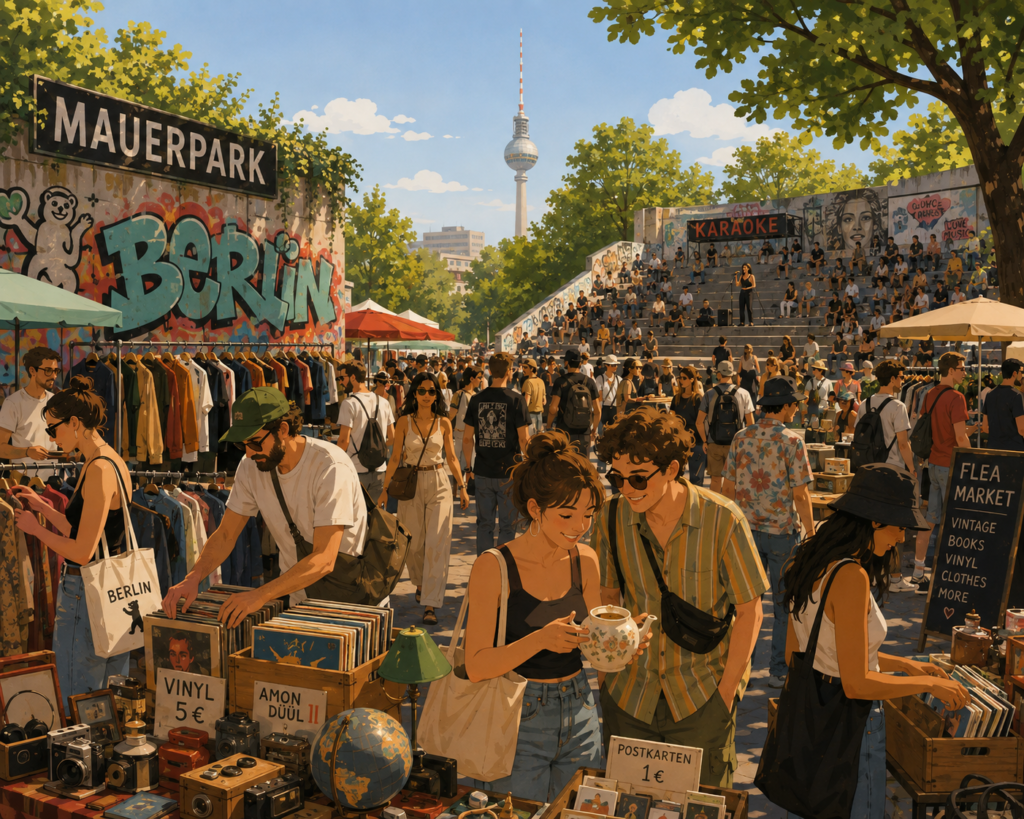
Mauerpark — particularly on Sunday mornings when the flea market operates. One of Berlin’s most genuinely social public spaces, where the combination of the market, the karaoke, and the park creates an unusually open and diverse social environment.
Prater Garten — Berlin’s oldest beer garden, open in summer. The communal table format makes conversation natural.
Helmholtzplatz — the square that anchors the neighbourhood’s social life, particularly in warmer months.
Friedrichshain — Young, International, Club-Adjacent
Friedrichshain is younger and more transient than Prenzlauer Berg — populated by students, recent arrivals, and people in their mid-20s to early 30s who are here for the creative and nightlife culture.
The social energy here is higher and more immediately open than Prenzlauer Berg — people are more receptive to spontaneous social interaction, more likely to be in social settings specifically to meet people, and more embedded in the club culture that defines this part of Berlin.
Specific venues worth knowing:
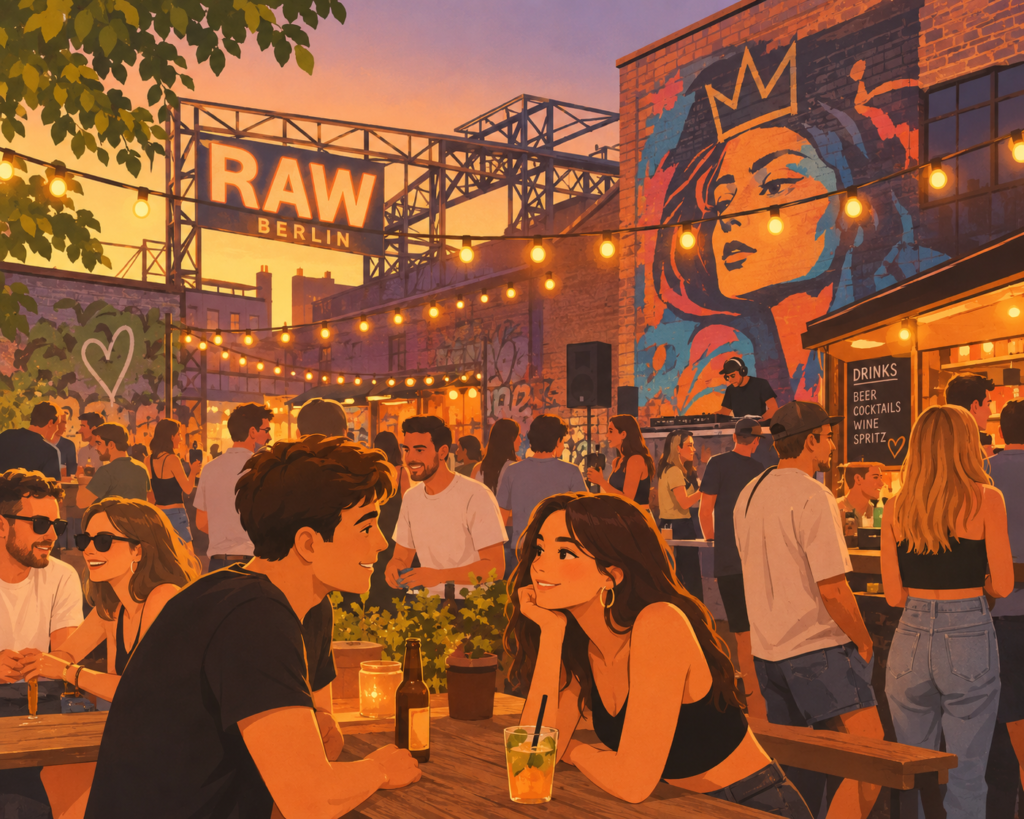
RAW Gelände — a former railway maintenance yard converted into a permanent cultural venue with bars, clubs, and outdoor spaces. One of Berlin’s most socially alive environments.
Boxhagener Platz — the square that anchors Friedrichshain’s community life, with a weekend flea market and surrounding café culture.
Simon-Dach-Straße — the street with the highest concentration of bars in the neighbourhood and one of Berlin’s most reliably social evening environments.
Neukölln — The Most Genuinely International Neighbourhood
Neukölln — particularly its northern part around Schillerkiez and Reuterkiez — has become the most genuinely diverse and internationally mixed neighbourhood in Berlin over the past decade.
The social culture here is more immediately warm than Prenzlauer Berg and more community-oriented than Friedrichshain. The mixture of long-term Turkish-German community, creative expats, artists, and young professionals creates a social environment that is distinctive and genuinely welcoming to newcomers.
Specific venues worth knowing:
Rixdorf — a historic village within Neukölln that feels like a different city. The cobblestone squares and traditional buildings create social environments that are unusually intimate for a major metropolitan area.
Herrfurthplatz — the square around which much of Neukölln’s community social life organizes.
Weserstraße — the street with the highest concentration of independent bars and venues in the neighbourhood.
Klunkerkranich — a rooftop bar on top of a shopping centre with extraordinary views and one of Berlin’s most diverse and socially open crowds.
Kreuzberg — Counter-Culture, Community, and the Best Food Scene
Kreuzberg is Berlin’s most politically charged neighbourhood — the historic heart of West Berlin’s counter-culture and still the most explicitly activist, progressive, and community-oriented area of the city.
The social culture here rewards genuine engagement with the community rather than tourist-level surface contact. People in Kreuzberg are generally warm to newcomers who are here because they actually care about the neighbourhood — and noticeably less warm to people who are treating it as a backdrop.
Specific venues worth knowing:
Markthalle Neun — a 19th-century market hall hosting regular food markets, street food events, and community gatherings. The Thursday Street Food market is one of the best social environments in Berlin.
Görlitzer Park — the neighbourhood’s social hub, particularly on weekends in warmer weather.
Paul-Lincke-Ufer — the canal-side promenade with outdoor seating and one of Berlin’s most genuinely pleasant social environments in summer.
Mitte — International, Professional, App-Heavy
Mitte is Berlin’s central district — government buildings, tourist infrastructure, major cultural institutions, and a high concentration of the international professional community.
The social culture in Mitte is more transactional and less community-oriented than the neighbourhoods above — it’s where people work and pass through more than where they put down roots. Apps work particularly well here precisely because the population is mobile and digitally comfortable.
Specific venues worth knowing:
Hackescher Markt — the square and surrounding courtyards that anchor Mitte’s social life.
Rosenthaler Straße — the street with the highest concentration of bars and restaurants in the neighbourhood.
Where to Meet People in Berlin: Beyond Bars and Apps
Berlin’s Club Culture as Social Infrastructure
This deserves direct attention because it’s genuinely different from how nightlife functions in other cities — and ignoring it means missing one of Berlin’s primary social mechanisms.
Berlin’s clubs — Berghain, Tresor, Watergate, Sisyphos, Klunkerkranich, and dozens of others — are not primarily places to meet romantic partners. They’re places where communities form, where people with shared values and aesthetics congregate, and where the specific shared experience of a long night of music creates genuine bonds between strangers.
For newcomers to Berlin who want to understand the city’s social fabric, engaging with club culture — even occasionally, even not being a committed club person — provides access to communities and social networks that are inaccessible through other routes.
The practical point: going to a club or a smaller music venue in Berlin with genuine openness to the experience, rather than as a strategic social move, is one of the most effective ways to become embedded in Berlin’s actual social world.
Language Exchanges
Berlin has a thriving language exchange community — particularly for German-English exchange — and these events specifically attract internationally-minded people who are curious about other cultures and open to meeting strangers.
Speakeasy Berlin — regular language exchange events at various venues.
Meetup.com language groups — dozens of active groups organizing German-English and multilingual exchanges.
Coworking Communities
Berlin has one of the strongest coworking cultures in Europe — and the social dimension of Berlin’s coworking spaces is particularly well-developed compared to most cities.
Betahaus (Kreuzberg) — one of Berlin’s original and most established coworking communities with strong social programming.
Factory Berlin (Mitte and Görlitzer Park) — the most startup-focused coworking community in Berlin with regular events.
Roam and various neighbourhood coworking spaces — many organize regular social events specifically for their communities.
Markets
Berlin’s market culture is one of the city’s great social assets — and certain markets specifically function as social gathering points rather than simply commercial spaces.
Mauerpark Flea Market (Prenzlauer Berg, Sundays) — one of Europe’s best flea markets and one of Berlin’s most genuinely social outdoor environments. The karaoke in the amphitheatre creates a specific collective energy that makes spontaneous social interaction feel natural.
Markthalle Neun (Kreuzberg, Thursdays) — the Thursday Street Food market is the best food event in Berlin and one of the most socially rich environments in the city.
Nowkoelln Flowmarkt (Neukölln canal, biweekly) — a smaller, more community-oriented market with genuine neighbourhood character.
Community Events and Cultural Programming
Berlin has an extraordinary density of community events — gallery openings, film screenings, lecture series, political discussions, community dinners, skill-sharing workshops. These events specifically attract engaged, curious, socially open people — exactly the demographic worth meeting.
Kulturbrauerei (Prenzlauer Berg) — former brewery converted into a cultural venue hosting regular events across every discipline.
Volksbühne (Mitte) — the most politically engaged theatre in Berlin, with a community around it that is genuinely distinct.
Silent Green (Wedding) — a crematorium converted into a cultural centre hosting music, film, and community events with a specific social culture.
What Nobody Tells You About Dating in Berlin
People Are Friendly But Slow to Warm Up
The initial social openness of Berlin — people talk to strangers at clubs, at markets, at community events — can create the impression that deep connection is immediately available. In reality, Berliners and long-term Berlin residents tend to develop genuine close friendships slowly, over repeated contact and shared experience.
The first conversation is easy. The sustained relationship requires patience and consistent presence.
Everyone Has Been Here “For a Year” for Five Years
Berlin is famous for being a city people come to for one year and stay in for a decade. This means the population is simultaneously transient and stable — always new arrivals, but also people who came for a year in 2018 and are still here.
Understanding this dynamic helps calibrate expectations: some of the people you meet will be leaving in three months. Others are as rooted as anyone anywhere.
English Is Fine But German Opens Doors
German fluency is not required to have a full social life in Berlin. But any German — even basic, imperfect German — is received warmly by locals and opens social doors that English-only interaction can’t.
The effort of trying in German, regardless of how imperfect the result, communicates genuine commitment to the city that accelerates social integration.
The Sunday Dynamic Is Real
Berlin’s Sunday culture — the Mauerpark market, the long brunches, the Späti culture, the parks — is a specific social institution worth understanding and participating in. Sunday in Berlin is when community life happens in the most accessible and open way.
Final Thoughts
Where to meet people in Berlin in 2026 — the honest answer is both everywhere and nowhere, depending on how you approach it.
The apps that work: Hinge for genuine connections in the international professional community, Tinder for volume across all demographics, OkCupid for values-based matching in progressive neighbourhoods, Bumble for women who want inbox control, Feeld for open-minded connection.
The places that work: Mauerpark on Sunday, Markthalle Neun on Thursday, the club or music venue that matches your actual taste, the coworking space that has genuine community programming, the language exchange that puts you in a room with people who want exactly what you want — to meet someone interesting from somewhere else.
The principle that works everywhere in Berlin: genuine engagement with the city — with its culture, its communities, its specific character — creates social conditions that tourist-level surface contact never does. Be here actually. The rest follows.
Explore more on LoveFinder: dating in the UK as a foreigner, best dating apps for expats in Germany, European dating culture, and where to meet people in London.