

What to wear on a first date is a question that deserves a more honest answer than most style guides provide.
Most advice falls into one of two unhelpful categories: generic lists of outfit formulas that ignore the actual context of the date, or vague encouragements to “just be yourself” that offer no practical guidance at all.
The honest answer is more nuanced — and significantly more useful. What you wear on a first date matters not because fashion defines attraction, but because clothing communicates effort, self-awareness, and how you read a situation. Getting it right doesn’t require spending money or following trends. It requires understanding what your outfit is actually communicating and making deliberate choices that serve the impression you want to make.
Why What You Wear on a First Date Actually Matters
Before getting into specifics, it’s worth understanding why clothing matters at all — because the answer shapes how you approach the decision.
First Impressions Form in Seconds
Research from Princeton University published in Psychological Science found that people form reliable first impressions within 100 milliseconds of seeing someone. These impressions — while not always accurate — are remarkably stable and influence the entire subsequent interaction.
Clothing is the most immediately visible signal available in a first encounter. It communicates before you’ve said a word: how much effort you’ve made, how well you read the context, and — crucially — how much this specific occasion mattered to you.
It’s About Effort, Not Expense
The most important thing clothing communicates on a first date is not taste or wealth — it’s effort. Someone who has clearly thought about what they’re wearing communicates that they cared enough to think about it. Someone who has arrived in whatever they happened to be wearing communicates the opposite.
This distinction matters enormously in the first-date context — because the other person is making constant assessments about how much you value the occasion. Visible effort is one of the most reliable signals that the answer is “a lot.”
Confidence Is the Actual Goal
Ultimately, the best outfit for a first date is the one that makes you feel most like yourself — confident, comfortable, and able to focus on the conversation rather than on adjusting your clothes.
This is not a contradiction of the above points. It’s the resolution of them: choose something that demonstrates effort and contextual awareness AND that you feel genuinely good in. These two requirements together narrow the decision significantly.
The First Rule: Dress for the Venue
The single most important first-date style decision is reading the context accurately. An outfit that’s perfect for one venue is wrong for another — and showing up significantly over or under-dressed for a specific environment signals poor social reading more than any other mistake.
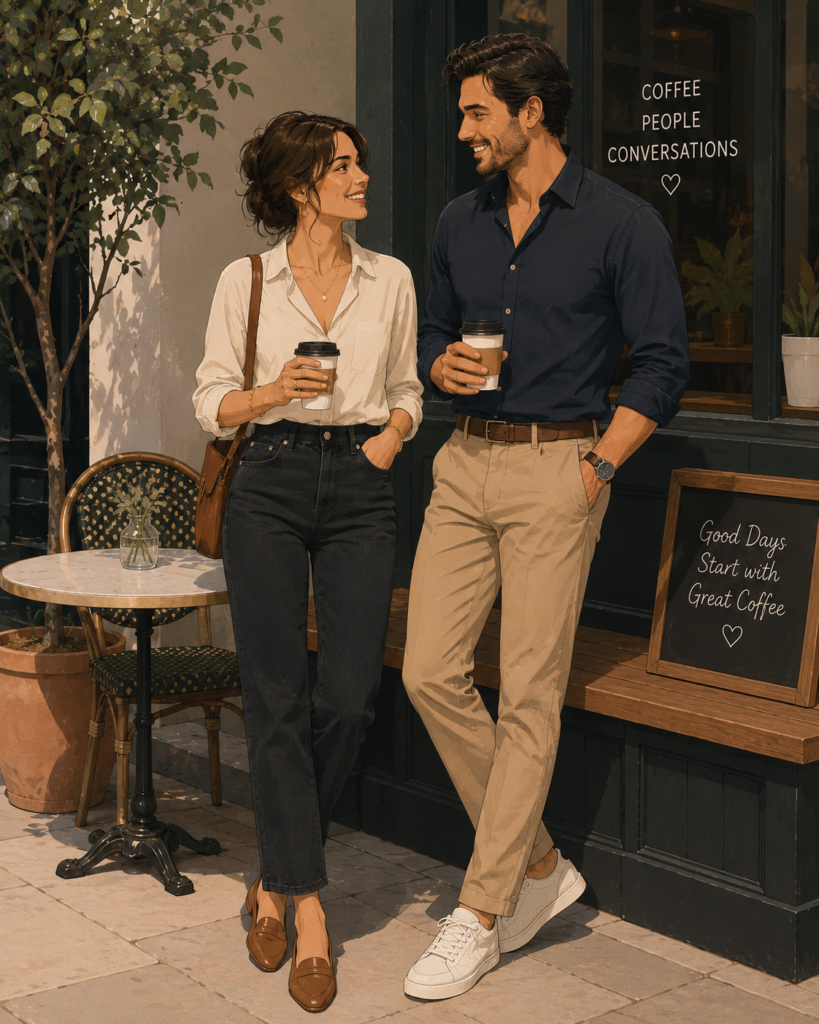
Casual Dates (Coffee, Daytime Walk, Casual Bar)
The most common first date format — and the one that most often produces outfit anxiety because the range of appropriate choices is wide.
The principle: Smart casual. Effort is visible but not overdone. You look like you thought about it without looking like you tried too hard.
What works:
- Clean, well-fitted jeans in a dark wash plus a considered top — a structured shirt, a good quality knit, a blouse that has some thought behind it
- Chinos or tailored trousers for men with a shirt or clean polo
- A simple dress or skirt-and-top combination for women that feels intentional rather than thrown together
- Clean, simple trainers if the venue genuinely warrants them — white leather trainers that are actually clean, not gym shoes
What to avoid:
- Workout clothes of any kind
- Anything visibly worn, fraying, or unwashed
- Overly formal attire — a full suit for coffee reads as unaware of the context
- Brand-new clothes you’ve never worn — they often fit differently and produce visible discomfort
Evening Bar or Restaurant
A step up from casual — but the scale of that step depends on the specific venue. A wine bar in a city centre warrants something different from a pub.
The principle: Polished but not formal. You’ve clearly made an effort. You look appropriate for the venue without looking like you’re attending a different event entirely.
What works for women:
- A midi or wrap dress in a solid colour or simple pattern
- Tailored trousers with a silk or quality top
- A blouse tucked into a skirt — deliberate and feminine without being overdressed
- Block-heeled boots or simple heels — comfortable enough to actually enjoy the evening
What works for men:
- Dark trousers or chinos with a shirt — tucked in or out depending on the formality of the venue
- A blazer adds instant polish and requires almost no other effort
- Clean leather shoes or quality leather-look trainers — not white gym shoes
- A well-fitted jumper over a collared shirt if the venue is more relaxed

What to avoid:
- Casual trainers with a smart top — the contrast reads as unconsidered
- Anything that requires constant adjusting — if you’re pulling at your dress or fidgeting with your collar, you’re not present in the conversation
- Too much fragrance — a light application is appropriate, a heavy one is not
Active or Outdoor Dates (Hiking, Mini Golf, Museum, Market)
Activity-based first dates warrant a completely different approach — and one where comfort and practicality genuinely come first.
The principle: Appropriate for the activity but still deliberately chosen. You’ve thought about what the day requires and chosen accordingly — which is itself a form of contextual awareness.
What works:
- Well-fitted casual clothes that are genuinely suitable for the activity
- Quality trainers that are clean and appropriate for the context
- A light layer that can be removed — a good denim jacket, a linen shirt over a t-shirt
- For outdoor dates: functional but not utilitarian — hiking clothes that actually fit rather than shapeless waterproofs

The key insight: Active date dressing is about looking intentional within the context — not about dressing up despite the context. A good-quality casual outfit chosen for the activity reads better than formal clothes worn to an outdoor setting.
Smart or Fine Dining
If the first date is at a genuinely upscale restaurant — a scenario that is less common for a first meeting but does happen — the outfit expectations shift significantly.
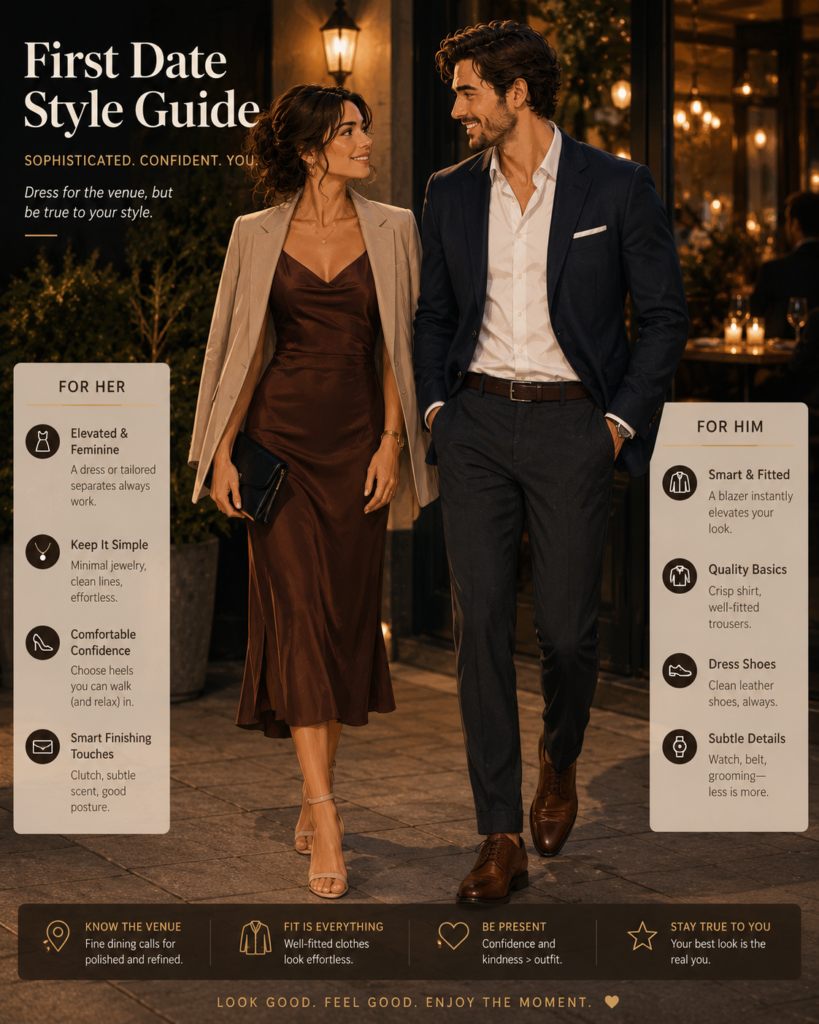
What works for women: A cocktail dress, a smart trouser suit, or a silk blouse with tailored trousers. Heels are appropriate and expected.
What works for men: A suit — or at minimum a blazer with smart trousers and leather shoes. A white or blue dress shirt, a tie if the restaurant is very formal.
What to Wear on a First Date: For Women
The Outfits That Work
Option 1 — The Classic Dress
A wrap dress or a midi dress in a solid colour or simple print is the single most versatile and reliably effective first-date outfit available. It reads as feminine and considered without being overdressed for most venues, it flatters most body types, and it requires minimal additional thought. Add a light jacket for cooler weather, simple jewelry, and clean, comfortable shoes.
Option 2 — Tailored Trousers and a Good Top
High-waisted tailored trousers — in black, navy, camel, or a simple check — with a silk or quality blouse, a tucked-in shirt, or a structured knit top. This combination reads as effortful and put-together without being overtly dressy.
Option 3 — A Good Jean and Something Considered
Dark or mid-wash straight or slim jeans — not distressed, not cropped aggressively — with a blouse, a nice knit, or a structured jacket. The key is that the top carries visible thought.
Option 4 — A Skirt and Top
A midi or knee-length skirt with a simple tucked top — this reads well across most date contexts from casual to moderately upscale.
Shoes Matter More Than Most People Realise
Shoes are the element most likely to either elevate or undermine an otherwise good outfit. The specific rule: they should be appropriate to the venue, clean, and in good condition.
For most first date contexts: block-heeled ankle boots, simple leather flats, loafers, clean white leather trainers for genuinely casual settings, or a low to mid heel for evening contexts.
What to avoid: Shoes that will cause visible discomfort before the evening is half done. A first date is not the occasion for breaking in new heels.
Colour and Print
Solid colours or simple patterns are safer choices than busy prints for a first meeting. This is not a rule about being boring — it’s a practical observation that solid-colour outfits tend to photograph better (for any dating app-era considerations), require fewer mental processing cycles from the other person, and are easier to build confidently.
If colour feels important to you — and it should if it’s part of your genuine style — one strong colour piece in an otherwise simple outfit works well. A bright top with neutral trousers, or a coloured dress with simple accessories.
Jewellery and Accessories
The most effective first-date jewellery approach is deliberate simplicity. A piece that means something to you, or that people regularly comment on, is more interesting than a full jewellery set worn to impress.
A bag that’s appropriately sized for the occasion — small enough not to dominate the table at a restaurant, practical enough for an active date — and not visibly worn or damaged.
What to Wear on a First Date: For Men
The Outfits That Work
Option 1 — The Reliable Blazer Formula
A blazer over a simple t-shirt or a well-fitted shirt — with chinos or dark trousers and clean leather or leather-look shoes — is the most reliably effective men’s first date outfit. The blazer adds instant polish to whatever is beneath it, it’s appropriate across most first-date contexts from casual bar to moderately upscale restaurant, and it signals effort without being overdressed.
Option 2 — The Smart Casual Shirt
A well-fitted shirt — in a solid colour, a subtle check, or a simple stripe — tucked into chinos or dark trousers with clean, simple shoes. The key word in all of these options is fitted — clothes that actually fit the body they’re on communicate self-awareness and effort regardless of price.
Option 3 — Dark Jeans and a Considered Top
Dark-wash straight or slim jeans with a knit, a quality polo, or a tucked-in shirt. Leather shoes or clean leather-look trainers. Works across most casual and semi-casual first date contexts.
What to avoid:
- Gym clothes or sports-branded clothing in non-active contexts
- Graphic t-shirts with prominent logos or slogans
- Visible wear, staining, or clothes that are clearly unwashed
- Clothes that are significantly too large or too small — fit matters more than brand or price
Grooming Is Part of the Outfit
For men specifically, the state of hair, beard, and general grooming carries as much weight as the clothes. A considered, appropriate outfit worn by someone who appears not to have thought about their hair or general presentation reads as only half-considered.
This is not a requirement for a specific style — it’s a requirement for visible intention. Whatever your normal approach to hair and grooming, it should be at its best version for a first date.
Shoes for Men
Men’s shoes are one of the most read signals in a first-date context — and one of the areas where visible effort or lack of it is most apparent. Clean, simple leather shoes or quality leather-look options in brown or black are appropriate across most contexts. White gym shoes work in genuinely casual settings if they’re actually clean.
What strongly to avoid: Worn, scuffed, or visibly dirty shoes with an otherwise considered outfit. The contrast is particularly noticeable.
The Things That Undermine Any Outfit
Regardless of what you’re wearing, these specific factors consistently undermine the impression an outfit creates:
Poor fit. Clothes that are visibly too large or too small communicate that you either don’t know your size or don’t care about presentation. In either case, the message is not one you want to send on a first date.
Visible uncleanliness. A stain, a strong scent, visibly unwashed fabric — any of these override whatever the outfit was communicating about effort. Clean and pressed (or at least unrumpled) is a baseline requirement.
Constant adjustment. If you’re repeatedly tugging, pulling, or adjusting what you’re wearing during a date, it signals discomfort and prevents genuine presence in the conversation. Whatever you wear should be comfortable enough to forget about.
Strong fragrance. A light application of a good fragrance is appropriate and often appreciated. Enough fragrance that the other person is aware of it from across the table is too much.
Excessive formality relative to context. Over-dressing for a casual date reads as not knowing how to read a social situation — which is a specific kind of social signal that isn’t positive.
The Night Before: A Simple Checklist
The evening before a first date is the right time to make outfit decisions — not the morning of, when anxiety often produces poor choices under time pressure.
- ✅ Is this appropriate for the specific venue and activity?
- ✅ Does it fit properly — not too large, not too small?
- ✅ Is it clean, pressed, and in good condition?
- ✅ Can I be comfortable in it for two to three hours without adjusting?
- ✅ Do I feel genuinely good in it — not just adequate?
- ✅ Are the shoes clean and appropriate to the outfit and venue?
- ✅ Have I considered fragrance — present but not overwhelming?
If the answer to all of these is yes — you’re done. Stop second-guessing.
The Most Important Thing
Style guides for first dates tend to underemphasize the most important element: your comfort and confidence in what you’re wearing matters more than the specific item.
An outfit you feel genuinely good in — that you’ve worn before, that fits, that you know works — will always outperform a theoretically “better” outfit that makes you self-conscious or uncomfortable. Confidence is visible. Discomfort is visible. Choose the outfit that produces the first rather than the second.
The date is about the conversation, the connection, and whether you want to see this person again. Your outfit is the frame — it should enhance the picture without becoming it.