

Dating as a single parent is one of the most genuinely complex versions of modern dating — not because single parents are less desirable or less capable of connection, but because the logistics, the emotional stakes, and the people involved are more numerous than in any other dating situation.
You’re not just navigating your own feelings, your own schedule, and your own readiness. You’re navigating your children’s emotional wellbeing, your time constraints, the opinions of people who care about your family, and the specific challenge of finding someone who is not just compatible with you but genuinely open to what your life actually looks like.
This guide covers how to date as a single parent honestly — the specific challenges, the practical strategies, when to introduce a new partner to your children, how to find time, which platforms work best, and how to protect both your own heart and your children’s stability through the process.
The Honest Reality of Dating as a Single Parent
Before getting into strategies and platforms, it’s worth acknowledging the specific emotional complexity of dating as a single parent — because pretending it’s simple produces poor decisions, and acknowledging it honestly produces better ones.
You’re Protecting More Than Yourself
Every decision you make in dating as a single parent affects people other than yourself. Your children are not just background context — they are central stakeholders in the outcome of your romantic life in ways that most other dating situations don’t involve.
This doesn’t mean your needs don’t matter or that you should sacrifice your happiness for your children’s preferences. It means that the decisions you make — when to introduce someone, how much time you invest in a connection, how much you share with your children about your dating life — carry weight that extends beyond your own emotional experience.
Your Time Is Genuinely Finite
Single parents have less discretionary time than almost any other demographic. The time available for dating — for apps, for dates, for developing a connection — competes directly with work, childcare, household management, and the specific demands of parenting alone.
This time constraint is not a minor inconvenience. It shapes everything from which platforms are worth using to how much messaging is realistic to how quickly or slowly a connection can develop.
You Know What You Want
One of the genuine advantages of dating as a single parent is that experience — of love, of loss, of what family life actually requires — has clarified what you need in ways that younger, less experienced daters often don’t have.
Most single parents who are dating again know, with a specificity that is genuinely useful, what they can tolerate and what they cannot. This clarity is a real asset, even when it narrows the field.
Before You Start Dating: The Readiness Question
The question of when to start dating as a single parent is one that only you can answer — and the honest answer is different for everyone.
Emotional Readiness vs. Practical Readiness
These are different things and both matter.
Emotional readiness means you’ve processed — not necessarily completed, but genuinely engaged with — the end of the relationship that produced your single-parent situation. Whether through divorce, separation, or bereavement, there is a mourning process involved that can’t be fully bypassed.
Dating before this processing has happened tends to produce specific patterns: using new connections as emotional management rather than genuine exploration, bringing unresolved grief or anger into early interactions, and making choices driven by avoidance of pain rather than genuine desire for connection.
Practical readiness means your life has enough stability and structure to absorb the time, emotional energy, and occasional disruption that dating requires. This doesn’t mean perfect stability — that may never fully arrive. It means stable enough that adding dating to the mix doesn’t destabilize everything else.
For a framework on recognizing genuine readiness to date again, our guide on ready to date again after a breakup covers the specific signs that distinguish genuine readiness from performed readiness.
Your Children’s Adjustment Timeline
Your children’s adjustment to the family’s changed circumstances is a relevant input into the readiness question — not a veto, but genuine information.
Children who are still actively destabilized by a separation or loss may be more vulnerable to the additional change that a parent’s new dating life represents. Children who have adjusted to the new family structure are generally more resilient to it.
This is not an argument for waiting until your children have fully processed something that may take years. It’s an argument for timing that accounts for their current state rather than ignoring it entirely.

Finding Time to Date as a Single Parent
Time is the primary practical constraint in single-parent dating — and solving it requires both realistic expectations and creative use of the time that does exist.
Be Honest With Yourself About Available Time
Most single parents dramatically overestimate how much time they have for dating when they first start. The realistic picture: childcare arrangements, work schedules, and the basic demands of running a household leave genuinely limited windows.
Building false expectations about availability — and then consistently failing to follow through on plans — is damaging both to your own experience and to the people you’re dating. Being honest about your time constraints from the start, including with potential matches, is both more ethical and more sustainable.
Use Existing Childcare Windows
The time when children are with the other parent, with grandparents, or otherwise cared for is often the most realistic window for dating. Planning dates around these existing arrangements rather than adding additional childcare on top of an already demanding schedule is both more practical and less stressful.
Nap Times and School Hours for Digital Dating
The digital dimension of dating — apps, messaging, building initial connections — can happen during small windows that in-person dates can’t. School hours, nap times, and the period after children are in bed are all realistic windows for the early stages of connection-building even when in-person time is limited.
Short Dates Are Real Dates
A ninety-minute coffee date is a genuine date. Not every first date needs to be a long dinner. Normalizing shorter, lower-commitment first meetings both respects your time constraints and reduces the stakes in ways that often produce more genuine, relaxed interactions.
The Best Dating Apps for Single Parents in 2026
Hinge — Best Overall for Single Parents
Hinge’s prompt-based profile system allows you to communicate your situation — including being a parent — with enough nuance and personality that the right people respond positively rather than being deterred. The relationship-focused user base aligns with what most single parents are looking for.
Practical advantage: Hinge’s limited daily interaction model suits the time constraints of single parenting — it doesn’t demand constant high-volume engagement.
Profile tip: Being clear that you’re a parent in your profile filters the match pool for you automatically. Matches who reach out knowing you’re a parent have already made a basic compatibility assessment. Matches who would have been deterred don’t reach out — which saves everyone time.
Match.com — Best for Serious Relationship Intent
Match’s explicitly relationship-focused positioning and its broader age demographic make it particularly useful for single parents who are specifically looking for a committed long-term relationship rather than casual dating.
Practical advantage: Match’s search functionality allows filtering for potential partners who are themselves parents — or who have explicitly indicated openness to dating someone with children — which reduces the discovery of fundamental incompatibility late in the process.
For a full comparison of Match and its closest competitor, our guide on eHarmony vs Match.com covers both platforms across every relevant dimension.
eHarmony — Best for Compatibility-Based Matching
eHarmony’s curated daily match model suits single parents particularly well — because the limited number of daily suggestions means the engagement required is manageable within constrained time, while the compatibility filtering means those suggestions are more likely to be worth pursuing.
Bumble — Best for Single Mothers Who Want Inbox Control
For single mothers specifically, Bumble’s women-message-first mechanic produces a significantly cleaner inbox experience — which matters when available time for dating is limited and wading through a high volume of low-quality messages is particularly costly.
💡 Not sure which platform has the most compatible users in your area?
This tool matches you with the top-rated dating app available in your location — updated for 2026.
Find Your Love
Being Honest About Your Situation on Your Profile
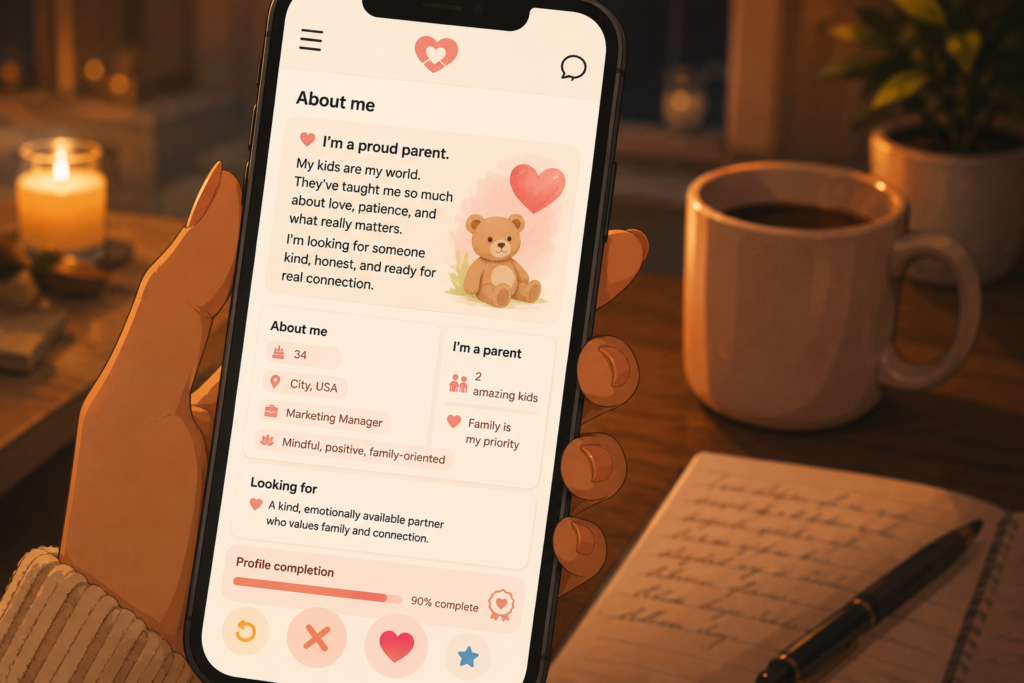
One of the most common questions for single parents entering dating apps is how and when to disclose that you have children.
The honest answer: early and clearly.
Disclosing that you’re a parent on your profile — rather than waiting until the first date or later — is both more ethical and more practical. It allows people who are not open to dating a parent to opt out before either person has invested, and it allows people who are open to it to make that choice consciously.
The concern that disclosure will reduce matches is real — it will, somewhat. But the matches it reduces are matches that would have ended in disappointment anyway once the information emerged. The matches that remain are people who have already made a positive compatibility assessment that includes your parenting situation.
How to phrase it: matter-of-fact is better than apologetic, and specific is better than vague. “I have two kids, ages 6 and 9 — they’re the best part of my life” is better than “I’m a parent” (too vague) or “I have kids but they don’t take up too much time” (apologetic and slightly dishonest).
What to Look for in a Potential Partner as a Single Parent
Dating as a single parent changes what compatibility actually requires — because your life is more complex than it was before children, and a genuinely compatible partner needs to be compatible with that complexity.
Genuine Openness to Your Children’s Existence
There’s a meaningful difference between someone who is tolerant of the fact that you have children and someone who is genuinely open to them being part of the picture.
Tolerant means they accept it as a constraint. Genuinely open means they understand that your children are a central, permanent part of who you are — and they find that acceptable or even appealing rather than just manageable.
Signs of genuine openness: asking genuine questions about your children, expressing interest in who they are rather than treating them as background complications, speaking positively about families and children generally.
Signs of mere tolerance: treating your parenting as an obstacle to navigate, expressing relief when dates happen during childcare windows, avoiding the subject of your children in conversation.
Patience With the Pace
Dating as a single parent moves more slowly than dating without children — for reasons that are entirely legitimate and not reflective of low interest. A partner who is genuinely compatible with your situation will understand and respect this pace rather than pushing against it.
If someone consistently pressures you to move faster than your situation allows — to introduce them to your children before you’re ready, to commit to more time than your schedule genuinely allows, or to prioritize the relationship over your children’s needs — that pressure tells you something important about their understanding of what your life actually requires.
Emotional Maturity
The specific emotional demands of a relationship with a single parent — the limited time, the priority that children legitimately take, the complexity of co-parenting if applicable, the potential emotional sensitivity around the children — require a level of emotional maturity that not everyone possesses.
Look for how potential partners respond to the realities of your situation, not just what they say about it. Someone who says they’re fine with you having children but becomes visibly frustrated when childcare affects a planned date has shown you something more useful than their stated position.
When to Introduce a New Partner to Your Children
This is the question that most single parents find most difficult — and the one where the stakes feel highest. The honest answer is: later than you think, and only when the relationship has demonstrated genuine stability.
The Common Mistake
The most common mistake single parents make in this area is introducing a new partner to their children before the relationship has proven itself — before enough time has passed and enough difficulty has been navigated to know that this person is genuinely going to be around.
Children form attachments. When a parent’s new partner enters their lives, children often become attached — and when that relationship ends (as many early relationships do), children experience a specific additional loss that has nothing to do with their parents’ relationship and everything to do with their own attachment.
Protecting children from this repeated loss is not about preventing all connection with new partners. It’s about ensuring that the introduction happens when there’s a genuine reason to believe the relationship is substantial enough to warrant it.
A Practical Framework
Most relationship experts and child psychologists recommend waiting until a relationship has been established for at least six months before introducing a new partner to children. This timeline is not arbitrary — it provides enough time for initial intensity to settle, for the first real difficulties to have been navigated, and for both people to have a genuine picture of whether this is lasting rather than exciting.
The introduction itself should be low-key and presented as casual — not as “meet my new partner” but as a natural social encounter that allows children to form their own impressions without pressure.

Co-Parenting and the Dating Dimension
If your children have another active parent in their lives, dating introduces an additional layer of complexity that’s worth addressing directly.
You Don’t Owe Your Ex Information About Your Dating Life
This is worth stating clearly because many single parents feel implicit or explicit pressure to keep their ex informed about or involved in their dating decisions. Unless a court order or a specific co-parenting agreement specifies otherwise, your romantic life is yours.
Your co-parent’s opinions about who you date are not your responsibility to manage, and their approval is not a requirement.
Your Children May Report Back
Children who move between two parental homes will often share information between them — including information about a parent’s new partner — without any deliberate intent to create conflict. This is normal and worth anticipating rather than trying to prevent.
The most practical approach: be consistent in how you behave and speak around your children regardless of what might be shared. Don’t ask children to keep secrets about your dating life, and don’t speak negatively about your co-parent in contexts that children might repeat.
Timing Relative to Your Children’s Two-Home Reality
Children who are adjusting to moving between two homes have specific emotional demands already in place. Introducing a new partner into this dynamic too early can increase the adjustment load in ways that affect children’s emotional stability.
This is not a reason to wait indefinitely — it’s a reason to be thoughtful about timing relative to where your children actually are in their adjustment.
Managing Guilt — The Constant Companion of Single-Parent Dating
Almost every single parent who dates experiences guilt — about taking time away from children, about introducing complexity into their lives, about wanting something for yourself in a situation that already requires so much.
This guilt is understandable. It’s also worth examining honestly.
The Oxygen Mask Principle
You cannot sustainably give from a place of depletion. A parent who has meaningful adult relationships — including potentially a romantic partnership — is generally better equipped to parent effectively than one who has sacrificed all adult connection to parenting.
This is not a rationalization for prioritizing dating over children. It’s a recognition that your emotional wellbeing is not separate from your children’s wellbeing — it’s connected to it.
Modelling Healthy Relationships
Children who see their parent in a healthy, respectful romantic relationship learn something important about what partnership can look like. This modelling has genuine positive value — and it’s one of the underacknowledged benefits of single parents who date thoughtfully.
The Distinction Between Guilt and Information
Sometimes guilt is useful — it signals that something you’re doing is genuinely incompatible with your values or your children’s wellbeing. In these cases, it deserves to be listened to.
Often, though, the guilt that single parents feel about dating is cultural rather than informative — a reflection of social messaging that positions any parental self-investment as neglect rather than a realistic assessment of harm. Learning to distinguish between guilt that signals a genuine problem and guilt that reflects an unreasonable standard is one of the more important skills in single-parent dating.

Practical Safety for Single Parents Dating Online
Single parents have additional safety considerations beyond the standard online dating precautions — because the stakes of bringing someone into their lives extend beyond themselves.
The basic precautions apply:
- Meet in public for the first several dates
- Tell a trusted friend who you’re meeting, where, and when you’ll be back
- Don’t share your home address until you’ve established significant trust — for single parents, this includes not revealing your specific neighbourhood early in a connection
Additional single-parent considerations:
- Don’t mention your children’s school, routine, or specific daily schedule to someone you haven’t yet met in person
- Be cautious about sharing photos of your children early in a connection with someone you haven’t yet established genuine trust with
- Trust your instincts about anyone who seems unusually interested in your children’s details early in a connection
For comprehensive guidance on recognizing and avoiding problematic profiles, our guide on dating app scammers covers the warning signs that apply universally.
Final Thoughts
Dating as a single parent is more complex than most dating advice acknowledges — and more possible than most single parents initially believe.
The complexity is real: limited time, children’s emotional needs to protect, the specific challenge of finding someone compatible with your actual life. These are not trivial obstacles.
But the possibility is also real. Single parents who date honestly — about their situation, their needs, their timeline, and what they’re looking for — consistently find that the right people respond positively to that honesty. The field narrows, but what remains is more genuinely compatible.
Take the time you need to be ready. Be honest about your situation from the start. Choose platforms that work with your time constraints. Don’t rush the introduction of a new partner to your children. Manage the guilt with the realistic understanding that your wellbeing and your children’s wellbeing are connected, not competing.
And know that what you have to offer — the clarity, the depth, the specific warmth that comes from loving children — is genuinely attractive to the right person.
Explore more on LoveFinder: ready to date again after a breakup, how to know if someone is serious about you, emotional availability and how to recognize if someone is ready for love, and signs your relationship is moving too fast.