
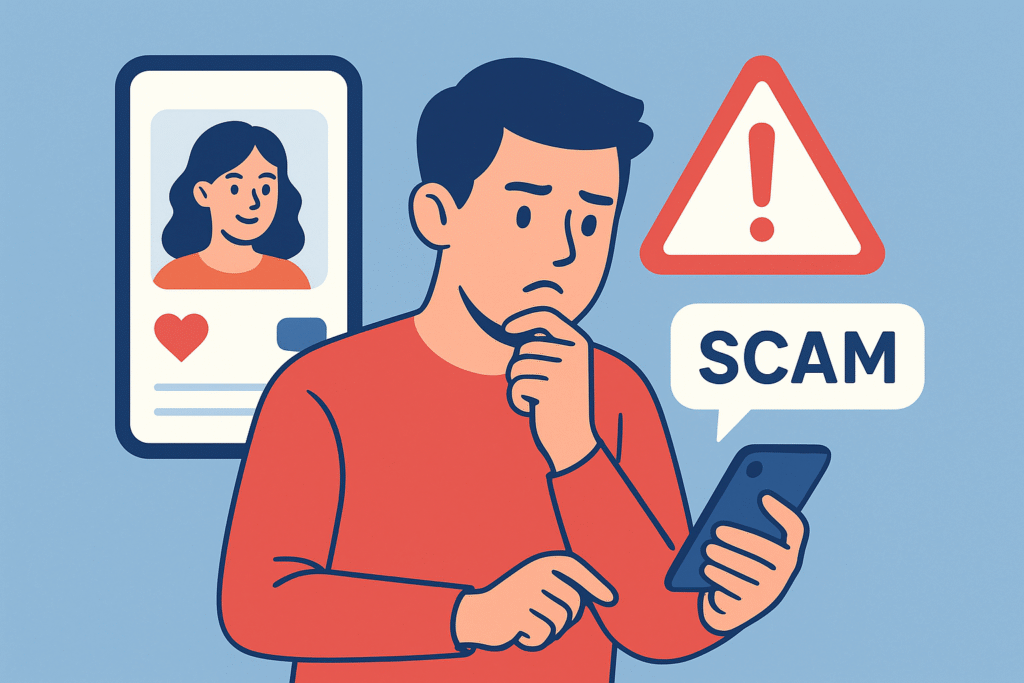
Dating app scammers are more sophisticated in 2026 than at any previous point — and the gap between what a genuine profile looks like and what a fraudulent one looks like has never been narrower.
Dating app scammers now use AI-generated photos that pass reverse image searches, maintain convincing conversation across weeks of interaction, and deploy emotionally sophisticated manipulation tactics that work even on people who consider themselves alert to online fraud. Understanding how they operate is the most reliable protection available.
This guide covers everything you need to know about dating app scammers in 2026 — the specific types, the warning signs at each stage, the psychological tactics that make scams work, and exactly what to do if you’ve been targeted.
Why Dating App Scammers Are So Effective
Before getting into specific warning signs, understanding why dating app scammers succeed — even with people who know scams exist — is the most important foundation for protection.
They Target Emotion, Not Intellect
Dating app scammers don’t succeed because their victims are unintelligent. They succeed because they target emotional systems rather than rational ones. By the time a financial request arrives, genuine attachment has been cultivated — which activates the same cognitive biases that make it difficult to see clearly in any emotionally charged situation.
The belief that “I would never fall for that” is itself one of the factors that makes people vulnerable. Overconfidence in your own scam detection reduces the vigilance that actually protects you.
The Technology Gap Has Closed
According to the Federal Trade Commission, Americans lost over $1.3 billion to romance scams in 2022 — a figure that has continued to grow as AI technology has made fraudulent profiles more convincing and fraudulent conversation more sophisticated.
AI-generated profile photos now produce faces that don’t exist — making reverse image searches less reliable than they were two years ago. AI-driven conversation can maintain consistent, warm, contextually appropriate exchanges across extended periods. The technical barriers to convincing impersonation have dropped dramatically.
They Take Their Time
The most effective dating app scams operate over weeks or months — not days. The extended timeline allows genuine emotional attachment to develop before any financial request is made. By the time the request arrives, the victim has invested significantly in the relationship and has strong psychological motivation to maintain the connection.
The Main Types of Dating App Scammers in 2026
1. Romance Scams
The most common and most financially damaging type. A romance scammer creates a compelling profile, initiates contact, and gradually builds an emotional relationship — often expressing deep feelings faster than feels entirely natural but not so fast as to be immediately obvious.
The relationship continues for weeks or months. The scammer is consistently attentive, emotionally available, and apparently deeply interested in the victim. Then a crisis emerges — a medical emergency, a business problem, a travel complication — that requires financial help. The requests often start small and escalate.
Key characteristic: The person cannot or will not meet in person or video call — there’s always a reason. They’re traveling, they’re in a remote location, their camera is broken, video calling creates anxiety for them.
2. Pig Butchering Scams (Investment Scams)
Pig butchering — named for the practice of fattening a pig before slaughter — is currently the fastest-growing category of dating app fraud. The scammer builds a genuine-feeling relationship, then introduces what appears to be a highly profitable investment opportunity — usually cryptocurrency.
Initial small investments appear to generate significant returns. The victim invests more. Eventually, when they attempt to withdraw, they discover the platform is fraudulent and their money is gone.
Key characteristic: Investment opportunities mentioned early in the relationship, usually framed as personal financial advice the scammer wants to share. Returns that seem unusually high and consistent.
3. Catfishing
Catfishing involves creating a false identity — using stolen photos and fabricated biographical details — to pursue a relationship under false pretenses. Unlike romance scammers, catfishers are not always financially motivated. Some are romantically motivated, some are curiosity-driven, some are malicious.
The financial risk of catfishing is lower than romance scams, but the emotional cost — of investing in a relationship built on false premises — can be significant.
Key characteristic: Refusal or inability to video call. Photos that appear in reverse image searches on other accounts. Biographical details that are inconsistent or difficult to verify.
4. Sextortion
Sextortion scammers build a romantic connection and then guide the interaction toward the sharing of intimate images or participation in video calls. Once they have compromising material, they threaten to share it with the victim’s contacts, family, or employer unless they pay.
Key characteristic: Unusual early interest in intimate communication. Requests for intimate images or video before any in-person meeting. Pressure that escalates quickly.
5. AI Bot Scams
The newest and fastest-growing category. AI-driven profiles can maintain conversation, respond contextually, express interest and warmth, and move a conversation through the stages of relationship development — all without human involvement.
These accounts are typically used to drive traffic to paid platforms, collect personal information, or serve as the initial contact in a larger scam operation where a human takes over once sufficient engagement has been established.
For a detailed guide to identifying AI bots specifically, our guide on AI bots on dating apps covers the specific signs that distinguish human from automated interaction.
Warning Signs at Every Stage
Early Contact — The First Week
The profile looks too good. Professional model-quality photos, an impressive biographical profile that checks every box, a life story that seems designed to be maximally appealing. Real people have flaws in their profiles — inconsistent photo quality, slightly awkward bios, ordinary backgrounds.
They express interest unusually quickly. Strong emotional engagement within the first few days of contact — declarations of being immediately drawn to you, expressions of having never met anyone like you, a sense of urgency about the connection.
They move to private communication unusually fast. Suggestions to move off the dating platform to WhatsApp, Telegram, or email within the first few exchanges — before any real connection has been established.
Their English is slightly off in a consistent pattern. Not random errors but a consistent style that suggests translation — phrases that are technically correct but idiomatically unusual, formality that doesn’t match the apparent persona.
During the Relationship — Weeks 2–8
They always have a reason they can’t video call. Camera broken, bad connection, they’re anxious about video, they’re in a location without reliable internet. Over two to three weeks, this pattern is almost always a red flag rather than a coincidence.
Their life situation is designed to explain unavailability. Working overseas, serving in the military in a remote location, working on an oil rig, traveling for an extended period — these narratives explain why they can’t meet in person while maintaining plausibility.
Their biographical details don’t hold up under gentle questioning. Stories that shift subtly, details that are inconsistent with earlier information, an inability to answer specific questions about their supposed location or profession.
They’re available at unusual times. Extremely consistent availability across time zones that don’t match their claimed location. Always online when you are, regardless of the time difference.
The Crisis Stage — When the Request Arrives
The financial request arrives during an emotional high point. Scammers are skilled at timing financial requests — they arrive when emotional investment is highest and skepticism is lowest.
The story is elaborate and emotionally compelling. Medical emergency involving a family member. Business crisis that will be resolved once temporary funds are available. Travel emergency that prevents them from accessing their own accounts. The story is designed to activate compassion rather than skepticism.
Small requests escalate. Initial requests are often relatively small — designed to test compliance and build a pattern before larger requests are made. Each successful request reduces resistance to the next.
Alternative payment methods are suggested when you hesitate. If you express hesitation about bank transfer, they’ll suggest gift cards, cryptocurrency, or wire transfer — all methods that are difficult or impossible to reverse.
The Psychology That Makes Scams Work
Understanding the psychological mechanisms that dating app scammers exploit helps you recognize when those mechanisms are being activated.
Commitment and Consistency
Once you’ve invested time and emotion in a relationship, psychological pressure to remain consistent with that investment makes it harder to accept that it might be fraudulent. The more you’ve invested, the more costly it feels to write it off.
Reciprocity
Scammers give generously in the emotional dimension — attention, affection, consistent engagement — which activates the deeply ingrained human tendency to reciprocate. A financial request from someone who has given you so much emotionally triggers the reciprocity impulse.
Social Proof and Authority
Scammers often incorporate social proof — they have friends who can speak to their character, they have professional credentials, they belong to respected institutions. These elements activate trust that isn’t warranted.
Scarcity and Urgency
Financial requests almost always come with time pressure — the emergency requires immediate action, the opportunity will disappear, waiting will make things worse. This urgency is designed to prevent the reflection that would allow skepticism to surface.
How to Protect Yourself From Dating App Scammers
Verify Early and Consistently
The most effective single protective measure is a video call early in any online connection — ideally within the first week of meaningful conversation.
A genuine person who is interested in you will have no objection to a brief video call. The specific technical problems that prevent it — repeatedly, across multiple requests — are almost always manufactured rather than real.
Video calls don’t guarantee the person is who they say they are, but they confirm that the person exists and matches their photos — which eliminates a significant proportion of fraudulent approaches immediately.
Use Reverse Image Search — But Don’t Rely on It Alone
Google Images reverse search remains useful for identifying stolen photos. Right-click any profile photo and select “Search image with Google” to check whether it appears elsewhere online.
The limitation in 2026 is that AI-generated photos don’t appear in reverse image searches — because they don’t exist anywhere else. Reverse image search confirms real stolen photos but cannot identify AI-generated ones.
TinEye is an additional reverse image search tool that sometimes finds matches that Google misses.
Keep Personal Information Compartmentalized
Never share your home address, workplace, daily routine, or financial information with someone you’ve only met online — regardless of how established the connection feels.
Use a separate email address for dating app accounts. Be thoughtful about what biographical information appears across your social media profiles that someone could use to build a convincing profile of you or to approach you with false familiarity.
Trust the Pattern, Not the Explanation
Any individual element of a potential scam has a plausible innocent explanation. The camera is broken. They really are traveling. They genuinely are anxious about video calls.
What matters is the pattern across multiple elements over time. A person who cannot video call, whose story has minor inconsistencies, who expresses unusually intense feelings unusually quickly, and who eventually has a financial emergency — each element is individually explainable. The combination is not.
Trust the pattern rather than accepting individual explanations for each element of it.
Never Send Money
This is absolute. No genuine romantic interest — however established the connection feels — should ever be asking for financial help before you have met in person and developed a relationship in the real world.
If anyone you’ve met on a dating app asks for money — for any reason, in any amount — assume it’s a scam. This assumption may occasionally be wrong. The cost of being occasionally wrong about this is the minor awkwardness of maintaining the position. The cost of not maintaining it can be catastrophic.
Gift cards, cryptocurrency, wire transfers, and peer-to-peer payment apps are all essentially irreversible once completed. Any request for these specific payment methods should be treated as an immediate disqualifying signal.
What to Do If You’ve Been Targeted
If You’ve Recognized a Scam Before Sending Money
Stop communication immediately. Block the account. Report the profile to the dating platform — your report may protect other users from the same account.
Don’t engage with their attempts to re-establish contact through other channels. Scammers sometimes attempt to reach previous targets through social media, email, or phone once blocked on the dating platform.
If You’ve Already Sent Money
Contact your bank or financial institution immediately — particularly if the transfer was recent. Some transactions can be reversed or stopped if action is taken quickly.
Report the scam to the Federal Trade Commission (US), Action Fraud (UK), or the relevant fraud reporting authority in your country. These reports contribute to investigations that may help others.
If cryptocurrency was involved, contact the exchange — though recovery is significantly less likely with crypto than with bank transfers.
Document everything — screenshots of the conversation, profile photos, any identifying information. This documentation supports any fraud investigation.
Emotional Recovery
Being targeted by a romance scammer is a genuinely painful experience — not just financially but emotionally. The relationship that was built was real on your side, even if the other person was not.
The shame that many victims feel — which often prevents them from reporting the scam or discussing it — is misplaced. Romance scammers are professional manipulators who exploit universal human psychological mechanisms. Being targeted says nothing about your intelligence or your judgment. It says something about the sophistication of the fraud.
Dating App Safety in 2026: The Platform Dimension
Different platforms have different safety features and different user base compositions — which affects your fraud exposure.
Tinder has photo verification and ID verification features in some markets. Background check partnerships are available in the US through third-party integration.
Bumble has invested heavily in safety features — photo verification, private detector for explicit images, strong report and block tools.
Hinge requires phone number verification and has strong profile reporting. Its smaller, more curated user base produces fewer fake profiles than higher-volume platforms.
Match.com offers background check integration through Garbo — one of the more robust safety features of any major platform.
Our guide on red flags in online dating covers the full spectrum of warning signs worth watching for — including those that apply to non-scam but still problematic profiles.
Find the Right Platform for Safer Dating
💡 The right platform has stronger verification and a more trustworthy user base. Find the top-rated dating app available in your location — updated for 2026. Find Your Best Dating App →
Final Thoughts
Dating app scammers in 2026 are more sophisticated than ever — but the fundamental protective measures remain consistent: verify early through video, trust patterns over individual explanations, never send money regardless of the story, and report suspicious profiles immediately.
The technology that scammers use has advanced. The human psychology they exploit has not changed — and understanding that psychology is the most reliable protection available. Emotional investment, reciprocity, and the discomfort of accepting that something wasn’t real are all mechanisms that scammers deliberately activate. Knowing they’re being activated is the first step toward not being controlled by them.
Date online confidently — but with open eyes.