
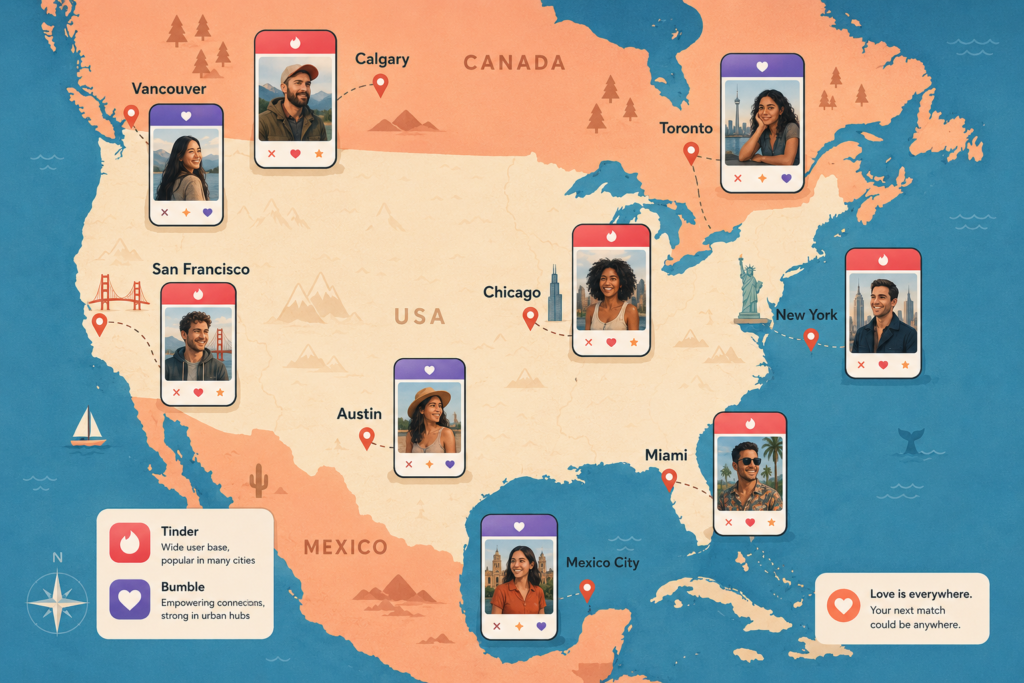
North America is one of the most active dating app markets in the world — and one of the most fragmented.
The United States, Canada, and Mexico share a continent but not a dating culture. The apps that dominate in New York perform differently in Toronto. The platforms that work in Mexico City have user bases that barely exist in Vancouver. And the overall market — worth billions of dollars and serving hundreds of millions of users — is shifting faster in 2026 than at any point since Tinder launched in 2012.
This guide covers the most popular dating apps in North America in 2026 — ranked by user base, market share, and real-world effectiveness across the USA, Canada, and Mexico — with honest assessments of what works where, and why.
The North American Dating App Market in 2026: Key Numbers
Before ranking specific apps, it helps to understand the scale of what we’re looking at.
The global dating app market generated over $6 billion in revenue in 2025 — and North America accounts for the largest single share of that figure. The United States alone is projected to generate $1.45 billion in dating app revenue in 2026, making it the world’s most valuable dating app market by a significant margin.
Over 350 million people use dating apps worldwide. In North America specifically, adoption rates are among the highest globally — approximately 30% of American adults have used a dating app at some point, with the figure rising to nearly 50% among adults aged 18–29.
Perhaps most significantly: nearly 40% of couples in the United States now report having met online — a figure that has increased every year for the past decade and shows no signs of reversing.
The market is not static. Apps that dominated five years ago have lost ground. New platforms have emerged. User behavior has shifted — away from casual swiping and toward more intentional, relationship-focused use. And artificial intelligence has entered the matching process in ways that are reshaping how people find each other across all three countries.
Most Popular Dating Apps in the USA (2026)
1. Tinder — Still #1 by Volume
Tinder remains the most downloaded and most widely used dating app in the United States in 2026 — a position it has held since its launch in 2012 and shows no immediate signs of losing.
With over 75 million active users globally, Tinder’s US user base dwarfs every competitor. The app is active across every state, every demographic, and every type of city — from New York and Los Angeles to rural markets where competing apps have virtually no presence.
Tinder’s dominance is a function of network effects more than product superiority. The app works because everyone is on it — which means everyone continues to use it.
Who uses it in the USA: The broadest demographic of any app — 18 to 45+, with particular strength in the 21–35 range. Urban and rural markets alike. Intentions range from casual to serious.
Where it performs best: Every major US city. New York, Los Angeles, Chicago, Houston, Miami, Atlanta, Seattle, Denver. Also uniquely effective in smaller cities and rural areas where competing apps have insufficient user bases.
The honest limitation: Signal-to-noise ratio. The size of Tinder’s user base includes a significant proportion of inactive profiles, bots, and users with unclear intentions. The volume of matches requires more filtering effort than more curated platforms.
2. Bumble — #1 for Women, #2 Overall
Bumble is the second most popular dating app in the United States — and for female users specifically, it’s the most preferred platform in the country.
The women-message-first mechanic has proven remarkably durable. A decade after launch, Bumble’s core differentiator continues to attract women who want more control over their inbox — particularly in urban markets where unsolicited contact volume on other apps is overwhelming.
Bumble’s US user base is concentrated in major metropolitan areas — it has significantly less penetration in smaller cities and rural markets than Tinder. In cities like New York, Los Angeles, Chicago, and Austin, however, Bumble’s user base is deep and genuinely active.
Who uses it in the USA: Women aged 22–36 predominantly, though the male user base is substantial. Educated professionals, concentrated in urban markets.
Where it performs best: New York, Los Angeles, Chicago, Austin, San Francisco, Seattle, Washington DC. Less effective in smaller metros and rural areas.
The honest limitation: Male users experience a passive waiting dynamic that can be frustrating. User base has contracted somewhat from its 2022–2023 peak as competition from Hinge has intensified.
3. Hinge — Fastest Growing, Best for Relationships
Hinge is the fastest-growing major dating app in the United States — and in major cities, it has overtaken Bumble as the preferred platform for users specifically seeking relationships.
Hinge’s positioning — designed to be deleted — attracts a user base with notably higher relationship intent than Tinder or Bumble. The prompt-based profile system produces better conversations. The algorithm improves over time. And the user base in major US cities has reached a critical mass that makes it genuinely competitive with Tinder on quality, if not on volume.
Who uses it in the USA: Professionals aged 25–38, predominantly in major metropolitan areas. Higher average education and income levels than Tinder. Strongest relationship-intent user base of any major app.
Where it performs best: New York, Los Angeles, Chicago, Boston, San Francisco, Washington DC, Austin, Seattle. User base thins considerably outside major metros.
The honest limitation: Outside major cities, Hinge’s user base is insufficient to compete with Tinder’s volume advantage. If you’re not in a major metropolitan area, Hinge may not have enough local users to be your primary platform.
4. OkCupid — Best for Values-Based Matching
OkCupid has been part of the US dating landscape longer than most apps — and its compatibility question system remains uniquely useful for users who want to filter on specific values, lifestyle factors, and relationship preferences.
The platform has lost market share to Hinge and Bumble over the past several years — but it maintains an active and distinctive user base in progressive urban markets, particularly among users for whom political alignment, religious beliefs, and family planning intentions are important compatibility factors.
Where it performs best: New York, Los Angeles, Chicago, San Francisco, Portland, Seattle, Austin. Strong among politically engaged and socially progressive users.
5. Match.com and eHarmony — Best for Serious Relationships 35+
Both platforms maintain significant US user bases in the 35–55 demographic — a segment that is underserved by younger-skewing apps like Hinge and Bumble.
Match’s larger user base gives it broader geographic reach — including smaller cities and suburban markets where Hinge and Bumble are thin. eHarmony’s compatibility-matching system produces more targeted suggestions at the cost of less user control.
For a detailed head-to-head comparison of both platforms, read our guide on eHarmony vs Match.com.
Where they perform best: Nationwide, with particular strength in suburban and smaller-city markets. Strong in the 35–55 demographic across all geographies.
Most Popular Dating Apps in Canada (2026)
Canada’s dating app market closely mirrors the United States — with some meaningful differences driven by the country’s geography, demographics, and cultural dynamics.
1. Tinder — Dominant Nationally
Tinder is the most widely used dating app in Canada — across Toronto, Vancouver, Montreal, Calgary, Edmonton, and most smaller cities. The user base is sufficient to make Tinder viable even in mid-sized Canadian cities where competing apps struggle.
2. Bumble — Strong in Major Cities
Bumble has a strong and active user base in Canada’s major urban centers — particularly Toronto and Vancouver. The educated professional demographic that drives Bumble’s success in the US is equally well-represented in Canadian cities.
3. Hinge — Best for Relationships in Toronto and Vancouver
Hinge has grown significantly in Canada over the past two years — with its strongest Canadian presence in Toronto, where it has become the preferred platform for users specifically seeking serious relationships.
Toronto’s large, educated professional population is precisely the demographic Hinge performs best with. For a detailed breakdown of how Hinge and other apps perform specifically in Canada’s largest city, read our guide on best dating apps in Toronto.
4. Coffee Meets Bagel — Niche but Active
Coffee Meets Bagel has a loyal user base among Canadian professionals — particularly in Toronto and Vancouver — who prefer a curated, lower-volume approach to matching. Its format suits the busy professional demographic that both cities produce in abundance.
Canada vs USA: Key Differences
Geographic spread matters more. Canada’s population is concentrated in a handful of urban centers with enormous geographic distances between them. This makes user base density in specific cities more important than national user numbers.
Montreal is a distinct market. Quebec’s linguistic and cultural distinctiveness means that French-language platforms and features matter in Montreal in ways they don’t elsewhere in North America. Tinder and Badoo have stronger relative performance in Montreal’s French-speaking population than English-language-forward platforms.
Most Popular Dating Apps in Mexico (2026)
Mexico’s dating app market is larger, faster-growing, and more distinctive than most North American comparisons acknowledge.
1. Tinder — Dominant by a Wide Margin
Tinder is overwhelmingly the most popular dating app in Mexico — with a user base that dwarfs every competitor across Mexico City, Guadalajara, Monterrey, and most other major cities.
Mexico is one of Tinder’s strongest Latin American markets, and the app’s penetration in urban Mexico is genuinely impressive. For expats and English-speaking users in Mexico City specifically, Tinder’s large user base provides sufficient volume to find English-speaking matches — though Spanish language ability becomes increasingly important outside the most internationally-minded neighborhoods.
2. Badoo — Strong Local Alternative
Badoo has a significantly stronger position in Mexico than in the United States or Canada. The platform’s broad demographic appeal and less English-centric interface give it genuine traction among Mexican locals who find Tinder’s culture less relevant to their dating context.
In cities like Guadalajara, Monterrey, Tijuana, and secondary cities, Badoo often outperforms Hinge and Bumble — which have thinner Mexican user bases than their North American counterparts.
3. Bumble — Growing in Mexico City
Bumble has been growing in Mexico City over the past two years — particularly among educated, internationally-minded young professionals in neighborhoods like Condesa, Roma, and Polanco.
The women-message-first mechanic has particular cultural relevance in a market where unsolicited contact can be more persistent than in US or Canadian cities. Among female expats in Mexico City specifically, Bumble is increasingly the preferred platform.
4. Hinge — Limited but Growing
Hinge has a thin but growing user base in Mexico City — concentrated almost entirely in the most internationally-oriented neighborhoods. Outside Mexico City, Hinge’s Mexican user base is insufficient to be a primary platform.
Mexico vs USA and Canada: Key Differences
Language matters more. English-language bios perform well in Mexico City’s international neighborhoods but poorly elsewhere. Spanish language ability is a genuine advantage across the country.
Cultural dating norms differ significantly. Mexican dating culture places more emphasis on family, community, and traditional relationship structures than US or Canadian norms. This affects which app features resonate — and which feel culturally foreign.
The market is growing fast. Mexico’s young, urban population and rapidly increasing smartphone penetration mean the dating app market is expanding faster than in the US or Canada. Platforms that establish strong positions now are likely to benefit from significant growth through the end of the decade.
North America Dating App Rankings: Side by Side
| App | USA | Canada | Mexico |
|---|---|---|---|
| Tinder | 🥇 #1 | 🥇 #1 | 🥇 #1 |
| Bumble | 🥈 #2 | 🥈 #2 | 🥉 #3 |
| Hinge | 🥉 #3 | 🥉 #3 | #4 |
| OkCupid | #4 | #4 | Limited |
| Badoo | Limited | Limited | 🥈 #2 |
| Match.com | #5 | #5 | Limited |
| eHarmony | #6 | #6 | Limited |
| Coffee Meets Bagel | #7 | #4 (urban) | Limited |
How to Choose the Right App for Your Location
The most popular app nationally is not always the most effective app for your specific situation. Here’s how to think about platform choice across North America.
If You’re in a Major US City
Use Hinge as your primary platform and Tinder as your secondary. Hinge’s user base in New York, Los Angeles, Chicago, Boston, San Francisco, and other major metros is now deep enough to be your primary source of quality matches. Tinder adds volume.
If You’re in a Smaller US City or Rural Area
Tinder is your primary platform — potentially your only viable option. Hinge and Bumble’s user bases outside major metros are often insufficient to generate meaningful match volume. Match.com is worth adding for the 35+ demographic.
If You’re in Toronto or Vancouver
Hinge plus Tinder is the most effective combination. Toronto in particular has one of the strongest Hinge user bases in North America outside major US cities. For everything you need to know about dating apps in Canada’s largest city, read our detailed guide on best dating apps in Toronto.
If You’re in Montreal
Tinder is dominant. Badoo has stronger local penetration than in English Canada. French-language profile elements significantly improve match quality with local users.
If You’re in Mexico City
Tinder is essential. Bumble is worth adding if you’re a woman or specifically seeking internationally-minded matches. Hinge is viable in Condesa, Roma, and Polanco neighborhoods specifically.
If You’re an Expat Anywhere in North America
Your platform choice depends on whether you want to meet locals or fellow expats. Tinder provides the broadest mix. Hinge tends to attract more internationally-minded locals. Internations and Meetup are valuable supplements regardless of which apps you use.
The Trends Reshaping North American Dating Apps in 2026
AI Is Changing the Matching Process
Every major platform has integrated AI into its matching algorithm — but in different ways. Hinge uses behavioral data to improve suggestions over time. Tinder has introduced AI-powered features that analyze profile photos and suggest improvements. eHarmony’s compatibility model has been updated with machine learning components.
The practical implication for users: the longer you use a platform and the more actively you engage, the better its suggestions become. Passive use produces consistently worse results than active engagement across all major platforms.
Subscription Fatigue Is Real
The shift toward premium subscription models has produced significant user frustration across all major platforms. Features that were once free — seeing who liked you, unlimited likes, advanced filters — are now locked behind paywalls that can cost $30–50 per month.
The result: a growing segment of users who use multiple free tiers across different platforms rather than paying for premium access to any single one. This affects match quality on free tiers as premium features increasingly determine who gets seen.
Authenticity Over Curation
One of the clearest trends in North American dating apps in 2026 is a shift away from heavily curated profiles toward more authentic self-presentation. Voice notes, video prompts, real-time activity features — platforms are actively building features that make it harder to present a polished but inaccurate version of yourself.
This reflects a broader user frustration with the gap between online presentation and in-person reality — a gap that has been documented in user research across all major platforms.
Video Dating Has Stayed
Video features introduced during the pandemic have proven surprisingly durable. Hinge’s voice note feature, The League’s video speed dates, and video verification features across multiple platforms have all maintained user engagement beyond the period that drove their adoption.
Safety and Verification: How Each Platform Compares
Safety features have become a significant differentiator across North American dating apps — particularly following high-profile incidents and increased regulatory scrutiny.
Tinder has introduced photo verification and ID verification features in several markets. Background check partnerships are available in the US through a third-party integration.
Bumble has invested heavily in safety features — including photo verification, block and report tools, and a private detector that automatically blurs explicit images sent without consent.
Hinge requires phone number verification and has strong profile reporting tools. Its smaller, more curated user base produces fewer safety incidents than higher-volume platforms.
Match.com offers background check integration through a partnership with Garbo — one of the more robust safety features of any major dating platform.
For advice on personal safety practices that apply regardless of which platform you use, our guide on red flags on a first date covers the signals worth paying attention to before and during any first meeting.
Find the Most Active Dating App in Your Area Right Now
Platform popularity varies significantly by city, neighborhood, and demographic. The most popular app nationally may not be the most active in your specific location.
💡 Not sure which dating app has the most users where you are? This tool matches you with the top-rated platform available in your location — updated for 2026. Find Your Best Dating App →
Final Thoughts
The most popular dating apps in North America in 2026 are Tinder for volume and reach across all three countries, Bumble for women who want inbox control, Hinge for serious relationship intent in major cities, and Match.com or eHarmony for the 35+ demographic seeking committed relationships.
The right choice depends on where you live, what you’re looking for, and who you want to meet. National rankings matter less than local user base density — and the most effective strategy in most markets is using two apps simultaneously rather than committing exclusively to one.
What doesn’t change across countries, cities, or platforms: the quality of your profile, the clarity of your intentions, and your willingness to move from digital conversation to real-world meeting are the factors that determine outcomes more than any platform choice.
The apps are tools. What you do with them is what actually matters.