
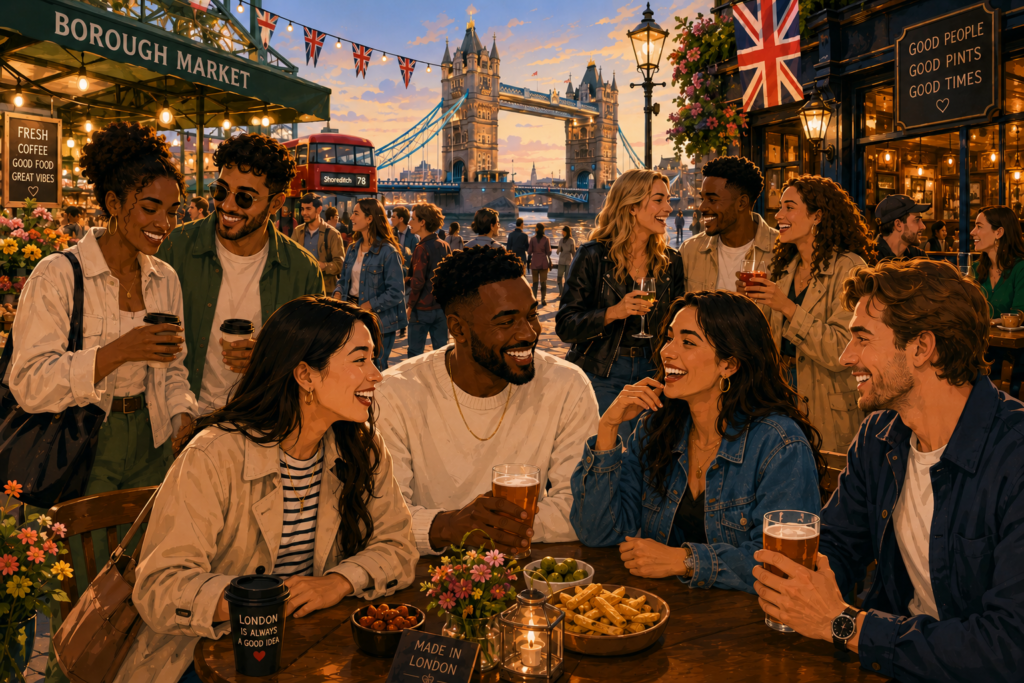
Knowing where to meet people in London is one of the most genuinely useful things anyone new to the city can learn — because London’s social landscape is enormous, fragmented, and full of places that work brilliantly and places that don’t work at all.
London has over nine million people. It has thousands of bars, hundreds of neighbourhoods, dozens of major social platforms, and a dating culture that is simultaneously one of the most international in the world and one of the most difficult to break into if you don’t know how it works.
This guide covers where to meet people in London in 2026 — not just the apps, but the specific neighbourhoods, venues, communities, events, and hidden gems that consistently produce genuine connections for both locals and newcomers.
Find Active Singles in Your Part of London Right Now
💡 London’s dating app user bases vary significantly by neighbourhood and platform — knowing which one is most active in your area matters.
This tool matches you with the top-rated dating platform available in your specific London location — updated for 2026.
Find Your Best Match in London →
Why Meeting People in London Is Both Easy and Hard
The Paradox of Nine Million People
London is simultaneously one of the easiest and one of the most difficult cities in the world to meet people in. The paradox is real and worth understanding before you try to navigate it.
Easy: The sheer volume of people, the extraordinary diversity of social environments, the city’s genuine openness to newcomers and internationals, and the density of organised social activity mean that opportunities to meet people are everywhere — if you know where to look.
Hard: London’s social culture involves a specific kind of self-containment that many newcomers find frustrating. People on the tube don’t make eye contact. People in bars are with their own group. Cold approaches feel more unusual here than in many other major cities. And the city’s sheer size means that social connection requires deliberate effort in ways that smaller, more community-oriented cities don’t.
According to research cited by Psychology Today, London consistently ranks among the most socially isolated major cities in the world — despite its extraordinary social infrastructure — precisely because its scale and pace work against the repeated casual contact that naturally builds connection in smaller environments.
Understanding this paradox shapes the strategy: in London, you don’t accidentally meet people. You meet people through deliberate choices about where to spend your time and what communities to join.
The International Factor
London is one of the most internationally diverse cities on the planet — approximately 37% of its population was born outside the UK. This extraordinary diversity means that social environments in London are genuinely unlike those in any other British city: more open, more accustomed to strangers engaging with each other, and more comfortable with direct communication than the rest of the UK.
The London that feels cold and impenetrable to newcomers is often the professional commuter London of the morning rush. The London of neighbourhoods, communities, and social venues is significantly more accessible.
Dating Apps: Where to Meet People in London Digitally
1. Hinge — Best Overall for Serious Connections
Hinge has the deepest relationship-focused user base of any app in London — and in the inner London boroughs where educated professionals concentrate, it has become the default platform for people specifically looking for something real.
Why it works in London: London’s educated professional demographic — the tech workers, finance professionals, creatives, and NGO employees that populate Shoreditch, Brixton, Peckham, and Hackney — is Hinge’s core demographic globally. The match is almost perfect.
The London-specific approach: London Hinge profiles that reference specific neighbourhoods, specific local venues, and genuine knowledge of the city consistently outperform generic profiles. “I’ve been trying to find the best flat white south of the river” is more effective than “love London life.”
Best London neighbourhoods for Hinge: Shoreditch, Hackney, Peckham, Brixton, Dalston, Stoke Newington, Clapham, Battersea, Fulham.
For everything about how Hinge works and how to get the most from it, our Hinge review 2026 covers the full picture.
2. Tinder — Largest Volume Across All of London
Tinder has the largest active user base in London by a significant margin — across every borough, every demographic, and every intention from casual to serious.
Why it works in London: Volume is genuinely valuable in a city this large. The sheer number of active London Tinder users means that the pool is deep enough to find genuinely compatible people even with highly specific preferences.
The London-specific reality: London’s Tinder user base is notably more international than most cities — the volume of people from other countries using Tinder in London means that fellow expats, international professionals, and visitors are well-represented alongside locally-born users.
Best for: Anyone who wants maximum reach across all of London’s demographics and all intentions.
3. Bumble — Best for Women and Professional Demographics
Bumble has a strong and active London user base — particularly in the inner boroughs and among the professional demographic that dominates the city’s creative and tech industries.
Why it works in London: The educated professional demographic that drives Bumble’s success elsewhere is extremely well-represented in London. The women-first mechanic is culturally well-received in a city that trends progressive and internationally-minded.
The London-specific approach: London Bumble users respond particularly well to openers that show genuine local knowledge. A question about a specific neighbourhood, a reference to a local venue, or genuine curiosity about what the person does in the city creates immediate common ground.
For a full comparison of how Bumble and Hinge differ across every relevant dimension, our Bumble vs Hinge guide covers everything.
4. Thursday — London’s Own Event-Based Dating App
Thursday is a dating app that was invented in London specifically to address the endless-swiping problem — and it has a genuinely loyal and active London user base.
How it works: Thursday is only active on Thursdays. Once a week, users can match and message — and the app organises real-life events around the city on Thursday evenings where matches can actually meet.
Why it works in London: The limited-time mechanic and the event-based format address two of the specific problems with London dating — the endless text exchanges that go nowhere, and the difficulty of actually meeting. Thursday forces both.
Best for: London-based users who are specifically tired of apps that never produce actual meetings and want a platform designed around in-person events.
5. Feeld — For Open-Minded Connection
Feeld has one of its strongest user bases in London — particularly in the creative and progressive communities of east London. Its explicitly honest culture — users state what they want and what they’re open to — suits a city that values directness.
Best for: Users looking for a judgment-free environment with clear communication about intentions.
6. OkCupid — Best for Values-Based Matching
OkCupid has a loyal and active user base in London’s more progressive inner boroughs — Hackney, Islington, Peckham, and Brixton in particular. The compatibility question system is particularly useful in a politically diverse city where values alignment matters significantly.
Best for: Users for whom political and lifestyle compatibility is a primary filter — particularly in London’s progressive inner-city communities.
Where to Meet People in London: The Neighbourhood Guide
This is what most guides miss — the specific neighbourhoods where social connection happens most naturally, and why.
Shoreditch and East London
Shoreditch and the broader east London area — Hackney, Dalston, Bethnal Green, Whitechapel — is London’s most socially accessible zone for meeting people outside apps.
The creative industry concentration, the mix of tech workers, artists, and internationals, the density of independent venues, and the genuinely open social culture of east London combine to create environments where strangers talking to each other is less unusual than anywhere else in the city.
Specific venues worth knowing:
The Old Blue Last (Shoreditch) — a legendary small venue that has hosted everyone. The intimate scale makes conversation natural.
Netil Market (Hackney) — weekend market with food, music, and a genuinely relaxed atmosphere where solo attendance is entirely normal.
Broadway Market (Hackney) — Saturday market that functions as a social gathering point for east London’s creative community.
Ridley Road Market (Dalston) — a more local, less tourist-facing market with genuine community atmosphere.
Brilliant Corners (Dalston) — a jazz and natural wine bar where the music creates conversation without requiring it.
Peckham and South-East London
Peckham has undergone a remarkable transformation over the past decade and is now one of London’s most vibrant and socially accessible areas — with a creative, diverse, genuinely community-oriented atmosphere that is distinct from east London’s more self-consciously cool culture.
Specific venues worth knowing:
Peckham Levels — a multi-storey car park converted into bars, studios, and event spaces. The rooftop is one of the best social environments in south London.
Bussey Building — a multi-venue space that hosts markets, events, and club nights with a genuinely diverse and socially open crowd.
Frank’s Café — seasonal rooftop bar with extraordinary views and a crowd that comes specifically to enjoy the space and atmosphere.
Rye Lane — the high street that anchors Peckham’s community life, with independent shops, food stalls, and market culture.
Brixton
Brixton has a strong community identity and a social culture that is more immediately warm than much of London. The music culture, the market, and the mix of longtime residents and newer arrivals create an environment that is genuinely social in ways that more gentrified areas often aren’t.
Specific venues worth knowing:
Brixton Village and Market Row — covered market arcades with restaurants and bars where the proximity and atmosphere create natural social environments.
Electric Brixton — venue that hosts everything from club nights to live music to comedy.
Pop Brixton — container village with food, bars, and regular events.
Soho and Central London
Soho is the most concentrated entertainment district in London — and despite its tourist overlay, it functions as a genuine social hub for Londoners across demographics.
Specific venues worth knowing:
Bar Italia — legendary Soho institution. The standing-room-only format and the mix of locals and visitors creates natural conversation.
Ronnie Scott’s — world-famous jazz club. The intimate format and the shared focus on the music creates connection between strangers.
The French House — Soho institution with a no-phones policy that creates an unusually present, social atmosphere.
Soho’s side streets — Dean Street, Frith Street, Greek Street — the smaller, quieter venues on these streets are significantly more social than the main tourist-facing bars.
Notting Hill and West London
Notting Hill has a specific social culture — wealthier, more international, more polished than east London but with genuine community depth in its markets and local venues.
Specific venues worth knowing:
Portobello Road Market — particularly on Saturdays when the antique market operates alongside the regular stalls. The browsing culture creates natural conversation.
Electric Cinema — one of London’s oldest cinemas with a genuinely communal bar and social area.
Books for Cooks — a cookbook shop that runs cooking demonstrations. The format creates immediate shared context.
Clapham and South-West London
Clapham has a reputation as London’s social hub for young professionals — and the reputation is accurate. The concentration of people in their late 20s and early 30s, the density of bars on Clapham High Street, and the common ground of the professional London experience create relatively accessible social conditions.
The Clapham Common context: On summer evenings, Clapham Common functions as one of London’s most genuinely spontaneous social environments — groups gather, people move between them, and the park setting removes the venue formality that makes London bars feel less accessible.
Specific venues worth knowing:
Clapham Grand — large venue hosting events, club nights, and live music.
The Windmill — Brixton/Clapham area live music pub with a loyal local following.
Where to Meet People in London: Beyond Bars
Pub Quizzes — The Single Best Low-Stakes Social Environment
The pub quiz is London’s most underrated social institution for meeting people. Every London borough has multiple pub quiz nights — usually on weekday evenings — and the format specifically rewards joining as a solo attendee by making team formation natural.
Walking into a pub quiz alone and asking to join a team is not unusual. It’s expected. And the structured interaction, shared competition, and genuine fun of a good quiz creates the kind of natural conversation that London’s ordinary bar culture rarely produces.
How to find them: Time Out London publishes weekly pub quiz listings. The app QuizFinder locates the nearest ones. Reddit’s r/london regularly recommends the best ones by area.
Best pub quizzes by area:
- East London: The Sebright Arms (Bethnal Green), The Crosse Keys (City)
- South London: The Gladstone (Peckham), Effra Social (Brixton)
- West London: The Tabard (Chiswick), The Gate (Notting Hill)
- North London: The Swimmer at the Grafton Arms (Kentish Town)
Running Clubs — London’s Best Kept Social Secret
London has an extraordinary running club culture — and its social dimension is significantly underappreciated by people who think of running as a solitary activity.
Peckham Runs (free, social, Peckham-based) — one of London’s most genuinely social running communities with post-run pub culture that produces genuine friendships and connections.
GoodGym (community-oriented, all areas of London) — combines running with community volunteering. The combination of shared purpose and physical activity creates unusually strong social bonds.
Nike Run Club London — large free weekly runs from various London locations, followed by social gatherings.
Track Mafia (east London-based) — track sessions with a strong community and social culture.
The recurring nature of running clubs — seeing the same people weekly over months — creates the kind of repeated-contact social environment that London’s transient bar culture can’t replicate.
Language Exchanges
London’s international population makes it one of the best cities in the world for language exchange — and language exchange events specifically attract people who are internationally-minded, curious about other cultures, and open to meeting strangers.
Speakeasy — London’s largest regular language exchange event, held in various central London venues.
Meetup.com language exchange groups — dozens of London-based language exchange communities organized by specific language pair.
Tandem and HelloTalk apps — language exchange apps with strong London user bases that sometimes produce in-person meetings.
Climbing Walls
Indoor climbing has become one of London’s most socially rich activities over the past five years — and the specific social dynamics of climbing (you physically help and spot each other, conversation happens naturally between routes, the skill-learning curve creates natural mentorship dynamics) make it one of the more genuinely effective places to meet people in London.
Stronghold (Hackney Wick) — one of London’s best-loved climbing walls with a strong community culture.
Bouldering Project (various London locations) — international climbing brand with strong London community.
Bloc (Bermondsey and other locations) — popular with London’s young professional demographic.
Markets and Food Events
London’s market culture is one of the city’s great social assets — and the browsing, eating, and exploring format creates natural social conditions that structured venue environments don’t.
Borough Market (London Bridge) — one of the world’s great food markets. The shared focus on food creates immediate conversation material.
Columbia Road Flower Market (Bethnal Green, Sunday mornings) — the combination of beauty, chaos, and genuine local character makes this one of London’s most socially alive environments.
Maltby Street Market (Bermondsey, weekends) — smaller and more local than Borough, with a social atmosphere that’s genuinely warm.
Brick Lane Market (Shoreditch, Sundays) — the surrounding area’s vintage and food culture creates an environment where solo exploration and social connection coexist naturally.
Classes and Workshops
London has an extraordinary range of classes and workshops across every interest — and the shared-learning format creates social conditions that ordinary social venues don’t.
Cookery classes: Leiths, Billingsgate Seafood School, Books for Cooks — all produce immediate shared context and natural conversation.
Pottery and ceramics: There has been a remarkable pottery boom in London — studios in Hackney, Peckham, and Brixton offer group classes with strong social dimensions.
Dance classes: Ceroc, Salsa classes across London, Swing Patrol — partner dancing is specifically social and creates interaction between strangers as a built-in feature.
Comedy and improv: The Nursery Theatre, City Academy, and various London improv communities produce strong social bonds through shared performance.
Events and Festivals
London’s event calendar is extraordinary — and knowing which events specifically create social conditions (rather than just being good events) is worth understanding.
Wilderness Festival (Oxfordshire, near London) — the festival with London’s most socially connected attendee base. The combination of music, ideas, and a genuinely communal atmosphere produces lasting connections.
Field Day (east London) — music festival with a social culture that is distinctive and London-specific.
Frieze Art Fair (Regent’s Park) — annual art fair that functions as London’s most important social event for the creative professional community.
Open House London (September) — a weekend when London’s extraordinary private buildings open to the public. The shared interest in architecture and the unusual contexts create natural conversation.
Specific Strategies for Different Situations
For Newly Arrived Expats
The most important single piece of advice for newly arrived expats trying to meet people in London: join something recurring before you join anything one-off.
One-off events produce one-off connections. Running clubs, sports teams, climbing walls, choir groups, language exchanges — anything where you’ll see the same people weekly — produce the repeated contact that genuine connection requires.
Internations has an active London community with regular professional and social events — and is specifically useful for meeting internationally-minded people, both expats and locally-born.
For more on navigating dating and social life as an expat in the UK, our guide on dating in the UK as a foreigner covers exactly the cultural dynamics you need to understand.
For People Who Hate Apps
London has more genuine alternatives to dating apps than almost any other city — and the alternatives work better here than in most places because London’s social infrastructure is rich enough to support serious social connection without digital mediation.
The pub quiz, the running club, the climbing wall, the pottery class, the language exchange, the neighbourhood market — these are not consolation prizes for people who can’t make apps work. They’re often more effective than apps, and significantly more enjoyable.
For more on building a social life beyond apps, our guide on dating apps for people who hate swiping covers exactly the alternatives that produce genuine connection.
For People Who Are Serious About Finding a Relationship
London has excellent serious-relationship-focused platforms alongside the mainstream apps.
eHarmony has a meaningful London user base — particularly among the 35+ demographic. For a detailed comparison, our eHarmony vs Match.com guide covers both platforms.
EliteSingles has one of its strongest user bases in London — the city’s concentration of educated professionals aligns exactly with the platform’s demographic. Our EliteSingles review 2026 covers whether it’s worth the investment.
London Dating Culture: What You Need to Know
The Tube Rule
No one talks on the tube. This is not rudeness — it is one of the most deeply embedded social norms in London culture. Do not attempt to start conversations on the tube. It is not a venue for meeting people.
The Queue Culture
Queues are one of London’s few genuinely social public environments. The shared experience of waiting, the mild comedy of British queue culture, and the implicit social permission that queuing creates — all make queues surprisingly effective for brief genuine contact.
The Post-Work Drink
The Friday post-work drink is one of London’s most reliable social institutions — and one of the most useful venues for meeting colleagues’ networks, extended social circles, and people who exist at the edges of your own social world. This is where London’s social graph expands.
The Weather Conversation Is Real
The British weather conversation is not just a cliché — it functions as a genuine social lubricant in London. Commenting on the weather is a culturally legitimate way to start a conversation with a stranger that doesn’t feel intrusive.
The Honest Truth About Meeting People in London
London rewards patience and deliberate effort more than almost any other major city. The connections that happen here are rarely accidental — they happen through communities joined, activities repeated, and the gradual accumulation of shared experience with people you encounter regularly.
The city’s scale works against spontaneous connection — but it works strongly in favour of intentional connection. The sheer number of communities, interests, venues, and social environments means that whatever you genuinely care about has a community in London — and that community is the most reliable path to genuine connection.
Find your community. Show up consistently. Be patient.
Looking for International Connection Beyond London?
🌍 If you’re open to connections that go beyond the city and across borders — international dating opens entirely new possibilities.
FindBride connects people across countries who are serious about meaningful relationships.
Explore International Dating at FindBride →
Final Thoughts
Where to meet people in London in 2026 — the honest answer is: everywhere and nowhere, depending on how you approach it.
The apps that work: Hinge for serious connections in inner London, Tinder for volume across all demographics, Bumble for women who want inbox control, Thursday for people who want events built in, OkCupid for values-based filtering.
The places that work: pub quizzes, running clubs, climbing walls, markets, classes, and the neighbourhoods — east London, Peckham, Brixton, Soho — where social culture is most accessible.
The principle that works everywhere: recurring contact through shared communities beats one-off encounters every time in a city this large. Join something. Show up. Let connection develop at the pace that London — and genuine connection anywhere — actually requires.