
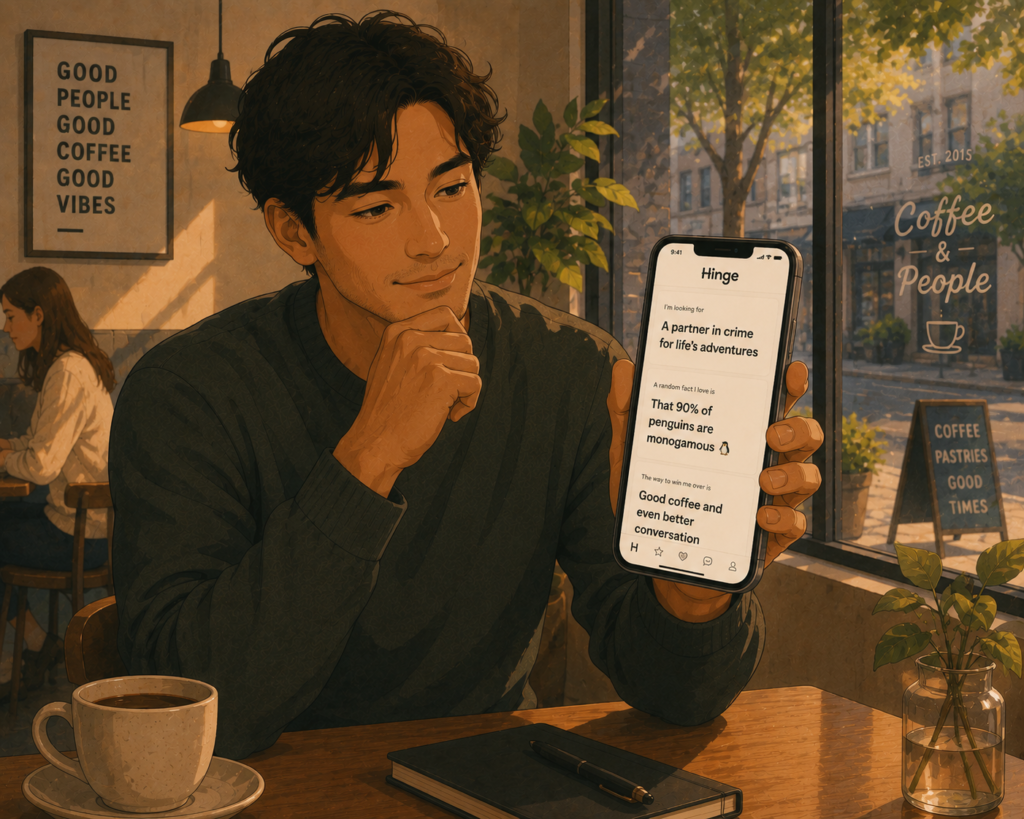
Hinge has one of the most effective marketing positions in the dating app industry: it’s the app designed to be deleted.
The implication is clear — Hinge is not trying to keep you swiping indefinitely. It’s trying to help you find someone worth stopping for. Whether that positioning reflects reality is exactly what this review examines.
Hinge has grown faster than any other major dating app over the past three years. It’s now the third most downloaded dating app globally — behind Tinder and Bumble — and in major cities across the US, UK, Canada, and Australia, it has become the default platform for people who are specifically tired of casual swipe culture and want something that actually produces relationships.
But does it actually work? This is an honest, detailed review of Hinge in 2026 — what it does well, where it falls short, who it’s best for, and whether it’s worth your time and money.
What Is Hinge and How Does It Work?
Hinge launched in 2012 as a Facebook-connected dating app — one of the first to use social graph data to suggest matches. It pivoted significantly in 2016, relaunching with its current prompt-based profile system and explicit relationship-focused positioning.
Match Group — the parent company of Tinder, Match.com, OkCupid, and several other platforms — acquired Hinge in 2019. Despite being part of the same corporate family as Tinder, Hinge has maintained a distinctively different product philosophy and user culture.
The core mechanic that distinguishes Hinge from most competitors is simple: instead of swiping on profiles, you like or comment on specific elements of someone’s profile — a photo, a prompt answer, or a specific detail. This means that every interaction starts with a reference to something real, which structurally produces better opening conversations than the blank-slate match that swiping creates.
Hinge Profile Setup: How It Works
The Profile Structure
A Hinge profile consists of:
Six photos — similar to most dating apps, but Hinge encourages variety rather than just headshots. The platform actively prompts you to add action shots, social photos, and images that show personality rather than just appearance.
Three prompts — chosen from a list of questions covering everything from personality and values to humor and lifestyle. Each prompt answer is a mini-conversation starter — the element of your profile that other users are most likely to engage with directly.
Basic information — age, height, location, job, education, religion, family plans, drinking and smoking habits, and more. Hinge collects significantly more lifestyle data than most apps, which feeds into the matching algorithm.
Why the Prompt System Matters
The prompt system is the most important differentiator in Hinge’s profile structure — and the element that most directly affects match quality.
On Tinder or Bumble, a match opens a blank conversation. On Hinge, a match opens with a specific comment on a photo or prompt — which means the first message is almost always more substantive than “hey” or “how’s your week.”
The quality of your prompt answers has a direct and significant impact on the quality of conversations you attract. Generic prompt answers — “I’m looking for someone to explore the city with,” “My love language is quality time” — produce generic engagement. Specific, personality-driven answers produce specific, personality-driven matches.
For detailed guidance on what makes prompt answers actually work — with real examples of strong versus weak responses — our guide on how to write a dating profile that gets matches covers exactly this.
The Hinge Algorithm: How It Decides Who You See
Hinge uses a matching algorithm called Most Compatible — built around the Gale-Shapley algorithm, which won the Nobel Prize in Economics for its work on stable matching theory.
In practice, this means Hinge learns from your behavior over time — who you like, who likes you back, who you actually have conversations with, and who you go on dates with — and progressively refines its suggestions based on that data.
The practical implication: Hinge gets better the longer you use it and the more actively you engage. Passive use — occasionally checking the app without meaningfully interacting — produces worse algorithmic suggestions than active, consistent engagement.
The Daily Feed vs Standouts
Hinge shows you two types of profiles:
Your daily feed — profiles suggested by the algorithm based on your preferences and behavior. This is your primary source of potential matches.
Standouts — profiles of people who have recently posted a popular prompt answer. These tend to be highly active users with strong profiles. You can send a Rose to a Standout — Hinge’s version of a super like — to signal elevated interest.
Hinge Free vs Hinge+ vs HingeX: What Do You Actually Get?
This is where honest review matters most — because Hinge’s monetization model has become increasingly aggressive, and understanding what you actually need to pay for affects whether the app is worth the investment.
Hinge Free
- Browse profiles and see your daily feed
- Like and comment on profiles (limited to a certain number of likes per day)
- Match and message with people who like you back
- Send one free Rose per week
The free tier is functional — you can genuinely use Hinge without paying. But the daily like limit can be frustrating for active users, and several features that significantly improve efficiency are locked behind paid tiers.
Hinge+ (~$20-30/month)
- Unlimited likes
- See everyone who has already liked you
- Advanced filters (height, religion, family plans, etc.)
- Five Roses per week instead of one
The most valuable feature here: seeing who has already liked you. This single feature dramatically improves efficiency — instead of liking profiles and waiting, you can see a pool of people who are already interested and choose from among them. For most users, this is the feature worth paying for.
HingeX (~$35-50/month)
- All Hinge+ features
- Priority likes — your likes are shown to matches sooner
- Enhanced visibility in the discovery feed
- More Roses per week
Honest assessment: HingeX is the most expensive tier and the hardest to justify. Priority likes and enhanced visibility provide incremental improvements that most users won’t notice significantly. Hinge+ is the tier where the value-to-cost ratio makes most sense.
Match Quality: Does Hinge Actually Produce Better Matches?
This is the central question — and the honest answer is yes, with important caveats.
Why Match Quality Tends to Be Higher on Hinge
The prompt system filters for self-awareness. Writing three genuine, specific prompt answers requires a degree of self-reflection that photo-only profiles don’t. Users who invest in their Hinge profiles tend to be more intentional about the process overall.
The comment-based interaction filters for engagement. Commenting on a specific prompt answer requires more effort than swiping right. This small friction filters for users who are actually paying attention rather than bulk-swiping.
The relationship-focused positioning self-selects. Hinge’s “designed to be deleted” positioning attracts users who are specifically tired of casual swipe culture. The user base is disproportionately populated by people who are genuinely looking for relationships — which means a higher proportion of your matches share that intent.
The algorithm improves over time. Unlike purely swipe-based platforms where the algorithm has limited behavioral data to work with, Hinge’s matching system becomes genuinely more accurate as it learns from your interactions.
The Caveats
User base is limited outside major cities. This is Hinge’s most significant limitation. In New York, London, Sydney, Toronto, Chicago, Los Angeles — the user base is deep and genuinely relationship-focused. In smaller cities and rural areas, the pool is often insufficient to compete with Tinder’s volume advantage.
Match quality varies by how well you use the platform. A weak profile — generic prompts, poor photo selection, minimal information — produces weak matches regardless of platform. Hinge’s quality advantage is most pronounced for users who invest in their profiles.
The algorithm takes time to calibrate. New users often have a frustrating first few weeks before the algorithm has enough behavioral data to produce genuinely well-suited suggestions. Patience in the early phase pays off.
Conversation Quality: Where Hinge Genuinely Stands Out
If there is one area where Hinge produces consistently better results than competitors, it’s the quality of opening conversations.
The data on this is consistent across user surveys and platform research: Hinge conversations start with more substance, go deeper faster, and convert to dates at a higher rate than conversations initiated on swipe-based platforms.
The reason is structural. When your opening message references something specific — “Your answer about [prompt] made me laugh — what’s the story there?” — you immediately have a shared reference point, a specific thread to pull, and evidence that you actually read their profile. This is a fundamentally better starting position than a blank message to a match you swiped right on three days ago.
For users who have always found opening messages difficult — the blank-page anxiety of figuring out what to say after matching — Hinge’s structure largely solves this problem. The prompt answers do the work of creating opening material.
For additional strategies on opening messages that work across different platforms, our guide on how to start a conversation on Tinder covers the principles that apply universally — with Hinge’s prompt system making the specific application even more straightforward.
Date Conversion: Does Hinge Actually Get You on Dates?
Match quality and conversation quality are useful metrics. The most useful metric is whether Hinge produces actual dates — and actual relationships.
The honest answer, based on available data and user research: Hinge produces dates at a higher rate per match than Tinder or Bumble for users who are actively relationship-seeking. Multiple surveys — including research cited by platforms like The Knot — show that Hinge users are more likely to go on dates within the first week of matching and more likely to describe those dates as leading somewhere meaningful.
This advantage is partially platform-driven — the quality of matches and conversations — and partially user-driven — the self-selected relationship-focused user base.
The limiting factor is volume. Hinge produces fewer matches than Tinder. For some users, the higher quality-per-match more than compensates for the lower volume. For others — particularly in areas where Hinge’s user base is thin — the volume reduction is a genuine problem.
Who Is Hinge Best For?
Hinge Works Best For:
People in major cities. New York, London, Sydney, Toronto, Chicago, LA, Dublin, Amsterdam — Hinge has deep user bases with genuine relationship-focused populations in all of these markets.
People looking for serious relationships. The platform’s positioning, user base, and algorithmic design are all oriented toward this outcome. If you want something casual, Hinge is not your best tool.
People willing to invest in their profile. The quality advantage Hinge provides scales directly with the quality of your profile investment. Generic profiles get generic results on any platform — but the gap between a strong and weak profile is particularly pronounced on Hinge.
People aged 25–40. This is Hinge’s demographic sweet spot. The user base skews slightly older than Tinder and younger than Match or eHarmony — with the 27–38 range being the most densely populated.
Women who want quality over quantity. Hinge’s like-based system means female users receive more thoughtful, specific outreach than on platforms where volume swiping is the norm. For women who find managing a high-volume inbox exhausting, Hinge’s more curated interaction model is genuinely better.
For women specifically navigating dating apps in their 30s, our detailed guide on best dating apps for women over 30 puts Hinge in context alongside its closest competitors.
Hinge Works Less Well For:
People outside major cities. If you’re in a smaller city, suburban area, or rural location, Hinge’s user base may be too thin to produce sufficient match volume. Tinder’s broader reach is more valuable in these contexts.
People over 45. The 45+ demographic is underrepresented on Hinge compared to Match or eHarmony. For this age group, those platforms tend to produce better results. Our guide on best dating apps for over 40 covers the full picture.
People who want casual connections. Hinge’s design, user base, and culture are all oriented toward relationships. It’s not impossible to find casual connections on Hinge — but it’s not what the platform is optimized for.
People who want maximum volume. If your strategy is based on high match volume, Tinder’s larger user base produces more matches. Hinge’s quality advantage comes at a volume cost.
Hinge vs Competitors: How It Compares
Hinge vs Tinder
Tinder wins on volume — more users, more matches, broader geographic coverage. Hinge wins on quality — better conversations, higher relationship intent, more accurate algorithmic matching over time.
The most effective strategy for serious relationship seekers in major cities: use both. Hinge as your primary platform, Tinder as your volume supplement.
Hinge vs Bumble
Both platforms attract relationship-focused users in a similar demographic. The key difference is the interaction mechanic — Bumble requires women to message first within 24 hours, while Hinge uses comment-based interaction with no gender-based rules.
Hinge produces better opening conversations. Bumble gives women more inbox control. For a detailed head-to-head comparison of both platforms across every dimension, read our guide on Bumble vs Hinge.
Hinge vs eHarmony
eHarmony wins on compatibility depth — its questionnaire-based matching produces more specifically compatible suggestions. Hinge wins on user experience, interface quality, and demographic range.
For users who are specifically ready for a committed long-term relationship and want maximum compatibility filtering, eHarmony is worth considering alongside or instead of Hinge. Our guide on eHarmony vs Match.com covers the serious-relationship platform landscape in detail.
Hinge vs OkCupid
OkCupid’s compatibility question system allows more granular filtering on specific values and lifestyle factors. Hinge’s prompt system produces better conversations. OkCupid works better for users who want to filter on political or social values specifically. Hinge works better for users who prioritize conversation quality and relationship intent.
Hinge’s Biggest Strengths
The prompt system genuinely works. It’s the most effective profile-based conversation starter mechanism of any major dating app.
The algorithm improves meaningfully over time. Most dating app algorithms are relatively static. Hinge’s Most Compatible system shows genuine improvement with use.
The user base is relationship-focused. The self-selection effect of Hinge’s positioning means a higher proportion of your matches share your intent than on broader platforms.
The interface is clean and well-designed. Hinge is genuinely pleasant to use — which matters more than it sounds for an app you’re spending real time in.
The “We Met” feature creates accountability. After dates, Hinge asks whether you met the person and how it went. This data feeds back into the algorithm and creates a feedback loop that improves suggestions over time.
Hinge’s Biggest Weaknesses
Limited outside major cities. This is the most significant limitation and the one most likely to affect whether Hinge is worth using for any given person.
Increasingly aggressive monetization. Features that were once free or included in lower tiers have progressively moved to higher subscription levels. The free tier is still functional but increasingly limited.
The like limit on the free tier is frustrating. Running out of likes mid-session is an experience designed to push you toward a paid subscription — and it works, but it’s not a user-friendly design choice.
The algorithm takes time to calibrate. New users often have a suboptimal experience in the first few weeks. Sticking with it long enough for the algorithm to learn is necessary but not immediately obvious.
Rose economy is unbalanced. Standouts — Hinge’s featured profiles — can only be contacted via Rose. With only one free Rose per week, this creates a significant paywall around some of the platform’s most active users.
Hinge Safety Features
Hinge has invested in safety features that are genuinely meaningful:
Phone number verification — required to create an account, which reduces fake profiles significantly compared to email-only verification.
Photo verification — available to confirm that profile photos match the real person. Verified profiles display a badge that signals authenticity.
Block and report — straightforward and functional. Blocking someone removes them from your feed and prevents further contact.
Incognito mode (paid feature) — allows you to browse without appearing in other users’ feeds, choosing to reveal yourself only when you like someone.
For broader perspective on personal safety in dating — including what to watch for on first dates regardless of which app you used to meet — our guide on red flags on a first date covers the signals worth paying attention to before and during any first meeting.
Practical Tips for Getting the Most Out of Hinge
Invest Seriously in Your Prompts
This is the single highest-leverage action you can take. Your three prompt answers are the primary driver of conversation quality — more so than your photos on most other apps.
Choose prompts that show something specific and genuine about your personality. Avoid generic answers. Include at least one answer with a clear hook — something that makes commenting obvious and easy.
Update Your Profile Regularly
Small profile updates — a new photo, a refreshed prompt answer — signal activity to the algorithm and tend to produce a short-term increase in visibility. Every four to six weeks is a reasonable update cycle.
Use the “We Met” Feature Honestly
When Hinge asks whether you met a match and how it went, answer honestly. This data directly improves the algorithm’s future suggestions. Users who engage with this feature consistently report better match quality over time.
Be Patient With the Algorithm
The first two to three weeks on Hinge often produce less well-suited suggestions than subsequent months. The algorithm needs behavioral data to work well. Give it time before drawing conclusions about the platform’s effectiveness.
Move Toward Dates Efficiently
Extended Hinge conversations that never result in a date are a common and avoidable mistake. After a few exchanges that feel genuinely promising, suggest meeting. The conversation that matters happens in person.
For advice on making that transition naturally, our guide on how to ask someone out online covers the exact timing and wording that works.
Is Hinge Worth Paying For?
Free tier: Worth using — genuinely functional for basic use. The like limit is the primary frustration.
Hinge+: Worth it if you’re actively dating and want to see who has already liked you. This single feature justifies the subscription cost for most active users.
HingeX: Hard to justify for most users. The incremental improvements over Hinge+ are real but modest.
Recommendation: Start with the free tier for two to three weeks to calibrate the algorithm. If you’re getting matches but want to optimize your time, upgrade to Hinge+ for the ability to see who already liked you.
The Verdict: Does Hinge Actually Work?
Yes — with the right expectations and in the right context.
Hinge produces better conversations, more relationship-focused matches, and higher date conversion rates than Tinder or Bumble for users who are specifically looking for serious relationships in major cities.
It does not produce the match volume of Tinder. It does not have the geographic reach of Tinder. It is not the best choice for users outside major cities or for users who are specifically looking for casual connections.
For its target user — a relationship-seeking professional aged 25–40 in a major city who is willing to invest in a quality profile and give the algorithm time to calibrate — Hinge is the best dating app available in 2026.
The “designed to be deleted” positioning is not just marketing. It reflects a genuine product philosophy that produces genuinely different results than platforms designed to maximize engagement. Whether it produces a relationship for you specifically depends on factors — your location, your profile quality, your willingness to move conversations toward dates — that the platform can support but not control.
Find the Best Dating App for Your Location
💡 Hinge works best in major cities — not sure if it’s active enough where you are? This tool matches you with the top-rated platform available in your location — updated for 2026. Find Your Best Dating App →
Final Thoughts
Hinge in 2026 is the best serious-relationship dating app for the right user in the right location. Its prompt-based profile system, improving algorithm, and relationship-focused user base combine to produce a dating experience that is meaningfully better than swipe-based alternatives for people who are genuinely ready for something real.
The limitations are real — geographic coverage, aggressive monetization, algorithm calibration time — but for users who fit the profile, these limitations are manageable.
If you’re in a major city, looking for a serious relationship, and willing to invest in a genuine profile — Hinge is worth making your primary platform.