
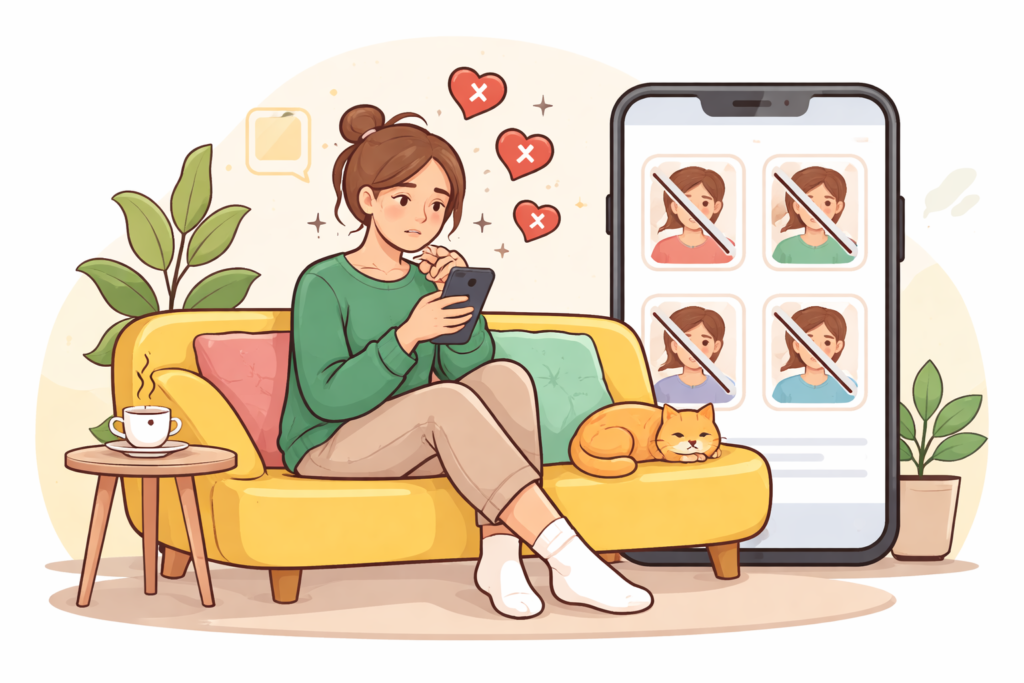
Dating Apps for People Who Hate Swiping (2026): A Smarter Way to Date Online
If you’ve ever closed a dating app feeling worse than when you opened it — more anxious, more cynical, more exhausted — you’ve experienced swipe fatigue.
And you’re not alone. A growing number of people are actively searching for alternatives to the endless left-right swipe cycle that defines most mainstream dating apps. Not because they’ve given up on dating, but because they’ve recognized that the swipe model wasn’t designed to help them find genuine connection. It was designed to keep them on the app.
This guide covers the best dating apps for people who hate swiping in 2026 — platforms built around intention, compatibility, and quality over volume — plus a practical strategy for using any dating app without burning out.
Why Swiping Feels So Empty
Before getting to the alternatives, it helps to understand why the swipe model produces the experience it does — because the problem is structural, not personal.
Swiping Is Designed to Be Addictive, Not Effective
The swipe mechanic was not invented to help people find relationships. It was invented to maximize engagement — time spent on the app, sessions opened, notifications responded to.
The variable reward system that swiping creates — sometimes a match, sometimes nothing — is structurally identical to the mechanism that makes slot machines compelling. Your brain releases a small dopamine signal with each match, which creates a loop of checking, swiping, and checking again that serves the platform’s engagement metrics rather than your relationship goals.
It Encourages the Wrong Mental Framework
When you’re swiping through hundreds of profiles, your brain enters a comparison mode rather than a connection mode. Instead of asking “do I find this person interesting?” you’re implicitly asking “is this person better than what else might be available?”
This framework — which the infinite scroll deliberately creates — is the opposite of what produces meaningful attraction. Genuine interest develops through attention. Swiping is designed to fragment attention across as many profiles as possible.
Matches Stop Feeling Real
The volume of matches that swiping produces is part of the problem. When matches accumulate faster than you can engage with them meaningfully, they stop feeling like people and start feeling like inventory. Conversations become harder to start because the investment feels lower — there’s always another match.
Emotional Burnout Is a Predictable Outcome
The combination of variable reward cycles, comparison-mode thinking, and disconnected matches produces a specific emotional trajectory that most long-term dating app users recognize: initial excitement, gradual numbness, and eventual cynicism.
The people who say they “hate dating apps” usually don’t hate the idea of meeting someone interesting online. They hate the specific experience of being trapped in a system that wasn’t designed for their actual goal.
Dating Apps That Don’t Rely on Swiping
1. Hinge — Best Overall Alternative to Tinder-Style Swiping
Hinge is the most significant departure from pure swipe culture among mainstream apps — and the one that has produced the most consistent serious-relationship outcomes for users who are specifically tired of Tinder’s approach.
Rather than swiping on full profiles, Hinge users like or comment on specific elements — a prompt answer, a photo detail, a specific thing someone wrote. This means every interaction begins with a reference to something real, which produces dramatically better opening conversations than the blank-slate match that swiping creates.
Why it works for swipe-haters: The comment-based system requires slightly more thought than a swipe — which filters for users who are actually paying attention. The prompt-based profiles reward personality over appearance. And the relationship-focused positioning attracts a user base that is specifically looking for something more intentional than swipe culture typically produces.
The honest limitation: Hinge still has a daily like limit on the free tier that can feel restrictive. And outside major cities, the user base is thinner than Tinder’s. For a full breakdown of everything Hinge offers, read our detailed Hinge review 2026.
Best for: Anyone in a major city who wants better conversations and a more relationship-focused user base.
2. eHarmony — Best for Maximum Compatibility Filtering
eHarmony eliminates swiping entirely. Instead of browsing profiles, you complete a detailed personality questionnaire and receive a curated selection of daily matches the algorithm believes are genuinely compatible with you.
This is a fundamentally different relationship with dating apps — one where you’re not making split-second visual judgments but receiving considered suggestions based on personality data. For people who find the aesthetic-first swipe model fundamentally misaligned with how they actually form connections, this approach is genuinely different.
Why it works for swipe-haters: No browsing. No comparison shopping. No infinite scroll. You receive a limited number of curated matches and decide whether to engage with each one. The daily structure prevents the boredom-swiping that produces low-quality interactions on other platforms.
The honest limitation: eHarmony is expensive and the interface is dated. The algorithm gives you less control over who you see than you might want. For a full comparison with Match.com — the other major serious-relationship platform — read our guide on eHarmony vs Match.com.
Best for: Adults 35+ who want maximum compatibility filtering and are specifically ready for a committed relationship.
3. OkCupid — Best for Compatibility-Based Matching
OkCupid uses a compatibility question system that allows users to answer hundreds of questions about values, lifestyle, politics, and relationship preferences. These answers generate match percentages — giving you immediately useful compatibility information before any conversation has started.
While OkCupid does have a swiping interface, the depth of profile information makes the decisions significantly more considered than on purely visual platforms. You’re not just assessing an appearance — you’re looking at stated values, lifestyle compatibility, and a match percentage that reflects genuine data.
Why it works for swipe-haters: The compatibility scores make selection feel more grounded and less arbitrary than pure visual swiping. The profile depth means you often know significantly more about a potential match before engaging than on image-forward platforms.
Best for: Users for whom values alignment — political, religious, lifestyle — is a primary compatibility factor. Strong in progressive urban markets.
4. Coffee Meets Bagel — Best for Busy Professionals Who Want Less Volume
Coffee Meets Bagel sends you a limited number of curated matches per day — called “bagels” — rather than giving you an infinite scroll of profiles to browse. This format forces intentional choice rather than impulsive volume swiping.
Why it works for swipe-haters: The limited daily selection removes the comparison-shopping dynamic that swiping creates. When you know you’re only seeing a handful of matches today, you pay more attention to each one. The user base skews toward busy professionals who prefer quality over volume — which tends to produce more serious, less game-playing interactions.
The honest limitation: The user base is smaller than Tinder or Hinge — which can mean a limited pool in smaller cities. Works best in major metropolitan areas.
Best for: Busy professionals who want fewer, higher-quality matches and hate the overwhelming volume of mainstream apps.
5. EliteSingles — Best for Education-Filtered Serious Relationships
EliteSingles uses a Big Five personality assessment and curated daily matches rather than open browsing. Like eHarmony, the entire model is built around compatibility suggestion rather than self-directed swiping.
Why it works for swipe-haters: No browsing, no volume, no comparison shopping. You receive compatibility-matched suggestions with detailed personality breakdowns. The education-filtered user base is uniformly serious about long-term relationships — which makes every match worth considering rather than filtering through a sea of casual connections.
For a full assessment of whether EliteSingles is worth the investment, read our EliteSingles review 2026.
Best for: Educated professionals 35–55 in major cities who want a uniformly serious-relationship user base.
6. Match.com — Best for Intentional Browsing With Relationship Focus
Match doesn’t eliminate browsing — but its explicitly relationship-focused positioning and paid subscription model produce a user base that is meaningfully more serious than free swiping apps. The search-based system also means you’re setting deliberate criteria rather than passively processing an algorithmic feed.
Why it works for swipe-haters: The search tools let you define exactly what you’re looking for rather than receiving whatever the algorithm decides to show you. The relationship focus attracts users who are less likely to be casual time-wasters. And the broader geographic coverage means more options in smaller cities where Hinge and Coffee Meets Bagel are thin.
Best for: Adults 30–55 anywhere in the US who want broad reach and a relationship-focused user base. Our guide on best dating sites for serious relationships in the USA puts Match in context alongside all major competitors.
How to Use Any Dating App Without Burning Out
Even if you stay on a mainstream app, you can dramatically change your experience by changing how you use it rather than which app you’re on.
Set a Time Limit and Stick to It
Fifteen to twenty minutes of focused, intentional use produces better results than two hours of bored scrolling. Open the app when you’re genuinely present and available — not as a reflexive behavior when you’re bored or anxious.
Boredom swiping is the single biggest driver of both swipe fatigue and low-quality matches. The quality of your attention when you swipe right is directly related to the quality of matches you attract.
Shift Your Selection Criteria
Instead of asking “is this person attractive?” ask: does this person communicate clearly? Do their values seem compatible with mine? Does their profile suggest genuine personality rather than curated performance?
These questions slow the selection process down — which is the point. Slower, more considered selection produces better matches than reactive visual judgment.
Move to Real Interaction Faster
Extended text conversations that never progress to an actual meeting are one of the primary causes of dating app burnout — because they produce emotional investment without any of the real-world information that would tell you whether that investment is warranted.
After a few exchanges that feel genuinely promising, suggest meeting. A real conversation over coffee produces more useful compatibility information in an hour than two weeks of messages. Our guide on how to ask someone out online covers exactly how to make this transition naturally and confidently.
Limit Your Active Conversations
Managing ten simultaneous conversations on dating apps is exhausting and produces shallow engagement with each. Three to five active conversations — given genuine attention — produces better outcomes than ten given fractional attention.
Quality of engagement, not volume of conversations, is the variable that produces dates.
Why Your Profile Matters More When You Hate Swiping
If you’re specifically trying to attract people who value depth over swipe-speed decisions, your profile needs to make that depth visible.
Generic profiles — the kind that could belong to anyone — attract the kind of attention that swiping produces: impulsive, visual, shallow. A specific, personality-driven profile attracts the kind of attention that intentional daters give: thoughtful, considered, based on genuine interest in who you actually are.
This means prompt answers that reveal something real rather than something safe. Photos that show you doing things rather than just standing in front of things. A bio that has a point of view rather than a list of activities.
For detailed guidance on every element of profile construction — with real examples of what works versus what doesn’t — our guide on how to write a dating profile that gets matches covers everything.
The Pattern Problem: When It’s Not About the App
If you’ve tried multiple apps, tried different strategies, and still find dating consistently frustrating — the issue may not be the platform at all.
Many people who experience persistent dating app burnout are unconsciously repeating relationship patterns — being drawn to the same type of person, maintaining the same dynamic, producing the same outcome. The platform changes but the experience stays the same.
Recognizing these patterns is often more transformative than finding the right app. Our guide on psychological patterns in relationships covers why these patterns develop and how to interrupt them.
And if you find yourself repeatedly attracted to people who are emotionally unavailable — exciting but unreliable, intense but not present — our guide on emotional availability and how to recognize if someone is ready for love covers exactly what genuine availability looks like and how to identify it early.
Real-Life Dating: The Best Alternative to Swiping
One option worth naming directly: the best alternative to swiping apps is not a different app. It’s offline social life.
Most of the qualities that make someone genuinely interesting and compatible — how they carry themselves in a room, how they treat people they have no reason to impress, how they behave when things don’t go as planned — are invisible on any dating app, regardless of how good the matching algorithm is.
Activities, communities, events, and social contexts that put you around people who share your values and interests are simply better environments for genuine attraction to develop than any app can replicate.
Our guide on how to create instant chemistry without apps covers exactly how to build real-life attraction — including how to flirt naturally in person in a way that most people have forgotten because they’ve spent years behind a screen.
Find the Right Low-Swipe Platform for Your Location
💡 Not sure which non-swipe platform has the most active users where you are? This tool matches you with the top-rated dating app available in your location — updated for 2026. Find Your Best Dating App →
Final Thoughts
Hating swiping is not a sign that online dating isn’t for you. It’s a sign that the specific model of swiping — designed to maximize engagement rather than connection — isn’t working for you. That’s a reasonable response to a system that genuinely wasn’t built with your interests in mind.
The alternatives in 2026 are genuinely better than they were five years ago. Hinge’s prompt-based interaction, eHarmony’s compatibility matching, Coffee Meets Bagel’s limited daily selection, OkCupid’s values-based filtering — these are all meaningfully different experiences from Tinder-style swiping, and they produce meaningfully different results for users who are specifically looking for something real.
More important than which platform you choose is how you approach it. Intentional use of any platform — limited time, considered selection, faster movement toward real meetings — produces better outcomes than volume-based swiping on the theoretically perfect app.
Online dating can still work. The swipe model is just one way to do it — and not the best one for everyone.