
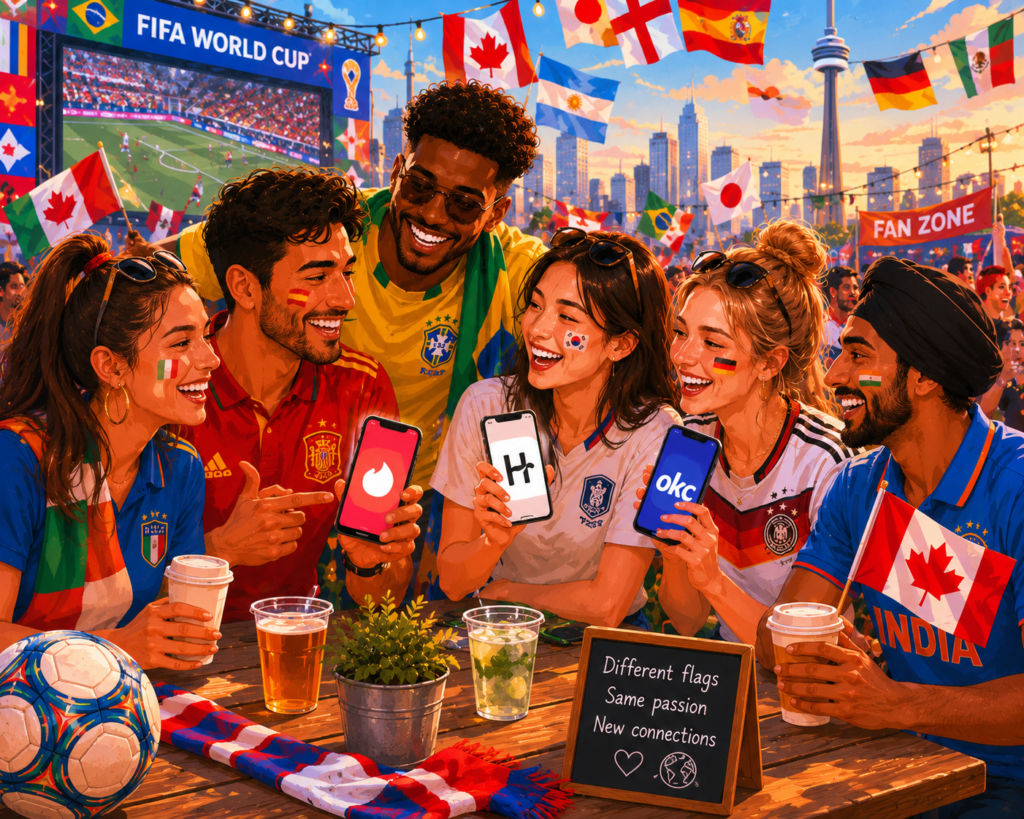
The FIFA World Cup 2026 is the largest sporting event in history — 104 games, 16 host cities, three countries, and an estimated five million visitors descending on the USA, Canada, and Mexico between June and July 2026.
For anyone traveling solo or simply open to connection, this is genuinely one of the most extraordinary social environments on the planet. Strangers become instant friends over a shared goal. Language barriers collapse around a shared language — football. And the specific combination of collective emotion, travel adrenaline, and unfamiliar cities creates conditions for connection that ordinary life rarely provides.
This guide is not a list of dating apps. It’s a practical, city-specific guide to meeting people — locals and fellow travelers — during the World Cup 2026. Where to go, how to approach, what to know about each country’s social culture, and what actually works when you’re a visitor trying to connect in an unfamiliar place.
Start Here: Find People Who Are Open to Meeting
💡 Dating apps work differently in each host country — and right now, the active user bases in all three are at peak levels.
This tool matches you with the top-rated dating platform available in your specific location — updated for 2026.
Find Your Best Match in Your Current City →
Why the World Cup Creates Exceptional Conditions for Meeting People
Everyone Is Already Open
The social barrier that makes approaching strangers difficult in ordinary city life — the sense that people are busy, closed off, in their own world — largely disappears during a major international tournament. People are traveling, celebrating, emotional, and already in conversation with strangers. The context does the social work that would normally require courage.
Football Is a Universal Icebreaker
You don’t need a sophisticated opener. “Who are you supporting?” works in every language, in every bar, in every fan zone on the planet. Football creates instant common ground between people who share nothing else — and in a tournament with 48 nations represented, the diversity of allegiances creates endless natural conversation.
The Cities Are Alive in Specific Ways
Host cities during the World Cup have a particular energy that transforms even their most ordinary spaces. A regular sports bar becomes a gathering point for supporters from five countries. A city plaza becomes a spontaneous fan zone. A subway train after a match becomes a party. Understanding where this energy concentrates — and being in those places — is the single most important practical step.
The Three Countries: Social and Dating Culture You Need to Know
The United States: Direct, Fast-Paced, App-Heavy
American social culture rewards directness. Making eye contact, smiling, starting a conversation — these are not considered unusual or aggressive. Americans are generally easy to talk to and quick to warm up in social settings.
The dating app reality: The US has the highest per-capita dating app usage in the world. Tinder, Hinge, and Bumble all have enormous active user bases across all 11 host cities. Match activity typically spikes significantly during major events in a city — the World Cup will produce some of the highest activity these platforms have ever recorded in these markets.
Key social insight: Americans are warm in initial contact but the path from conversation to genuine connection can require more effort than the initial warmth suggests. Following through — suggesting something specific, exchanging details and actually using them — matters more than the initial interaction.
Tipping culture as social signal: In American bars, being a generous and friendly tipper signals social confidence and creates positive rapport with bartenders — who are often the most useful social connectors in any bar environment.
Canada: Polite, Genuine, Takes Slightly Longer
Canadian social culture is genuinely warm — but slightly more reserved in the initial approach than American culture. The politeness that characterizes Canadian interaction is real rather than performed, which means that once genuine connection is established, it tends to be more substantial.
The dating app reality: Tinder and Hinge both have deep user bases in Toronto and Vancouver — the two Canadian host cities. Bumble is particularly strong among Canadian professional women. Activity will be extremely high during the tournament.
Key social insight: Canadians respond well to humor and genuine curiosity. Self-deprecation lands particularly well. The “Canadian directness” — which is slightly more understated than American directness — is appreciated. Being genuine rather than impressive is more effective here than in the US.
Toronto vs Vancouver: Toronto’s social culture is more urban and fast-paced — closer to New York in feel. Vancouver is more outdoors-oriented and slightly more reserved. Both cities have large, internationally-minded populations that are comfortable interacting with visitors.
Our in-depth guides to dating apps in Toronto and dating apps across Canada explore the best platforms and strategies tailored to each Canadian city.
Mexico: Warm, Social-First, Community-Oriented
Mexican social culture is the most immediately warm of the three host countries — but it operates through different social mechanics than American or Canadian culture. Connection in Mexico tends to develop through social contexts rather than direct cold approaches.
The dating app reality: Tinder dominates in Mexico City, Guadalajara, and Monterrey. Badoo has strong local penetration beyond the internationally-minded crowd. Dating app activity will spike significantly during the tournament — particularly among users looking to connect with international visitors.
Key social insight: In Mexico, the approach to connection is more social and less direct than in the US. Being part of a group, being introduced through a shared context, and demonstrating genuine warmth and respect for Mexican culture all create more natural connection than direct approaches.
Language matters more here: Spanish ability — even basic phrases — is genuinely appreciated and creates immediate warmth. “¿Quién crees que gane hoy?” (Who do you think wins today?) is a perfect opening in any Mexican fan environment.
The family and group dynamic: Mexican social life tends to be group-oriented. Being welcomed into someone’s group is a more significant signal of genuine interest than individual attention.
Where to Meet People: The Definitive Location Guide
1. Official FIFA Fan Zones
Every host city has official FIFA fan zones — large public viewing areas with screens, food, and tens of thousands of people from around the world. These are the most accessible and most socially charged environments of the entire tournament.
Why they work: Fan zones remove every social barrier simultaneously. The energy is collective and positive. Everyone is already talking to strangers. There is no “approach” in a fan zone — you’re all already together.
Best strategy: Position yourself near other solo travelers or small groups before the match. The pre-match period is the optimal connection window — people are excited, not yet absorbed in the game, and naturally social.
Key cities with the largest fan zones:
- New York/New Jersey — MetLife area and Manhattan fan zones
- Los Angeles — multiple large venues across the city
- Mexico City — Zócalo and official FIFA fan zone
- Toronto — Harbourfront and Nathan Phillips Square
2. Supporter Bars and Official National Team Pubs
Every national team that travels in significant numbers brings its own social infrastructure — the “official supporter bar” where fans of that nation gather before and after matches.
Why they work: These bars create concentrated communities of fellow travelers with an immediate shared identity. If you’re supporting a particular nation, finding their supporter bar gives you an instant social context. If you’re looking to meet people from a specific country, these bars are the most direct route.
How to find them: Search “[national team] supporter bar [host city]” in the weeks before each match. Official supporter organizations publish locations. Reddit football communities (r/soccer, national team subreddits) are excellent real-time resources.
The post-match moment is crucial: The hour immediately after a match — win, lose, or draw — is the most emotionally charged social window of the entire day. Emotions are high, inhibitions are lower, and the shared experience creates immediate bonding material.
3. Hotel Bars and Lobbies
Hotels hosting visiting fans — particularly those near stadiums — become extraordinary social environments during the tournament. The lobby bar of any hotel in a host city during match week will have people from a dozen countries in close proximity, most of them traveling solo or in small groups.
Why they work: Hotel bars self-select for travelers who are open to social interaction. The shared transience — everyone is away from home — creates a specific openness that permanent residents don’t always have.
Best strategy: Go during the hour before and the two hours after matches. The bar fills up with people processing the same game experience.
4. Public Transport — Particularly After Matches
Every major city’s public transport system becomes a social experience after major matches. Metro cars, buses, and trains fill with supporters still buzzing — and the contained space creates conversation that wouldn’t happen on an ordinary commute.
The specific dynamic: Post-match transport particularly from/to stadiums creates spontaneous social moments. Sharing the experience — whether euphoric or disappointed — is a natural conversation starter that requires no planning or approach strategy.
5. Street Food and Market Areas
Every host city has concentrated street food and market areas that become social hubs during major events. These spaces have a natural flow that makes meeting people organic rather than forced.
City-specific recommendations:
- New York — food courts near Times Square, Brooklyn Bridge area after matches
- Los Angeles — Grand Central Market, Venice Beach area
- Miami — Wynwood Art District, Calle Ocho
- Dallas — Deep Ellum, Bishop Arts District
- Houston — Montrose, East Downtown
- Mexico City — Roma Norte, Condesa, Mercado de Medellín
- Guadalajara — Tlaquepaque, Chapultepec area
- Monterrey — Barrio Antiguo
- Toronto — Kensington Market, Distillery District
- Vancouver — Granville Island, Commercial Drive
6. Rooftop Bars and Terraces
Cities with strong rooftop bar culture — Miami, Los Angeles, New York, Mexico City — see their terrace venues become premium social locations during major events. The view, the atmosphere, and the self-selecting crowd of people looking for a good time create ideal conditions.
Best cities for this approach: Miami (Wynwood Brewing, Sugar rooftop), NYC (230 Fifth, PHD Terrace), LA (Perch, Upstairs at the Ace), Mexico City (La Terraza Orizaba, Azul Histórico).
Dating Apps: What Works in Each Host Country Right Now
USA Host Cities
Primary: Tinder + Hinge
Tinder has enormous active user bases in all 11 US host cities — and during the tournament, users from visiting nations will be active alongside locals. Setting your location to the specific city you’re in (rather than your home location) is essential.
Hinge performs particularly well in New York, Los Angeles, Boston, Miami, and Seattle — cities where the educated professional demographic that drives Hinge’s results is strongly represented.
Bumble is strong across all US host cities for female users who want inbox control.
Profile tip for the US: Update your bio to reference the World Cup and your location. “Here for the World Cup — [your team] supporter looking to explore [city]” is both honest and an immediate conversation starter.
Canada Host Cities (Toronto and Vancouver)
Primary: Hinge + Tinder
Toronto in particular has one of the strongest Hinge user bases in North America. A World Cup-specific bio that references your team and your genuine curiosity about Toronto or Vancouver creates immediate local appeal.
Bumble is particularly strong for women in both Canadian cities.
Mexico Host Cities (Mexico City, Guadalajara, Monterrey)
Primary: Tinder
Tinder dominates in all three Mexican host cities. The international presence during the tournament means the English-speaking user base on Tinder will be larger than at any other point in these cities’ histories.
Badoo has stronger local penetration than internationally focused apps in Mexico — worth downloading if you specifically want to connect with Mexican locals rather than fellow international visitors.
Profile tip for Mexico: Including any Spanish — even one line — in your profile creates immediate warmth with local users. “Aquí para el Mundial — supporting [team] and loving Mexico City” goes significantly further than an English-only profile.
How to Start a Conversation: Scripts That Work
The Universal Football Opener
“Who are you supporting?” — works in every language, every venue, every social context associated with the World Cup. It’s a genuine question with a genuine answer that immediately establishes common ground or interesting difference.
Follow-ups that work:
- “Have you been to their matches yet?”
- “Which match was your favorite so far?”
- “Where are you watching the next one?”
- “Are you from [country] or just a fan?”
For Approaching Locals Specifically
In the US: “Have you been coming to these fan zones all tournament? What’s been the best atmosphere so far?” — locals who are engaged with the tournament are proud of it and happy to talk about it.
In Canada: “I’ve been trying to find the best spots for this — do you have any recommendations?” — Canadians love giving recommendations and it opens genuine conversation.
In Mexico: “¿Qué partido fue el mejor ambiente?” (Which match had the best atmosphere?) — asking for local knowledge in Spanish creates immediate warmth.
The Solo Traveler Opening
“I’m traveling solo and don’t really know this city — what’s your favorite thing that’s happened here during the tournament?” works across all three countries because it’s honest, slightly vulnerable, and invites the other person to share knowledge and perspective.
The Post-Match Window: Why the Hour After the Final Whistle Matters Most
The sixty minutes immediately after a match ends is the single most socially charged period of any match day.
Emotional intensity is high — either the euphoria of victory or the processing of defeat. The shared experience of watching the same match creates an immediate common narrative. And the natural question — “where are you going now?” — is the most natural continuation available.
The specific conversation that works post-match:
After a win: “That was extraordinary — where are you celebrating?” leads naturally to a shared destination.
After a loss: “That was brutal. I need a drink — are you heading somewhere?” — shared commiseration is one of the most reliable bonding mechanisms available, and a loss produces it more reliably than a win.
Safety for Visitors in All Three Countries
Meeting people in unfamiliar cities during a major event requires the same basic precautions that apply to any travel dating:
Meet in public. First connections made at fan zones or bars — whether planned or spontaneous — should stay in public spaces for the initial period. This is standard practice and anyone you’d want to spend time with will find it entirely reasonable.
Share your location. Tell someone you trust where you are, who you’re with, and roughly when you expect to be back. Basic safety practice regardless of context.
Trust your instincts. The heightened social atmosphere of a major event can lower normal vigilance. If something feels wrong in an interaction — even without a specific articulable reason — act on that feeling.
Be aware of tourist-targeting. Major international events attract scammers alongside genuine people. Be cautious of unusually quick financial interest, requests for loans, or situations that seem designed to separate you from your money or your group.
For Those Looking for Something More Serious
The World Cup creates conditions for meeting people — including people worth staying in contact with after the tournament ends. If you’re open to connection beyond the tournament itself — with someone you meet in one of the host cities, or with someone from another country entirely — international dating platforms are worth having alongside the mainstream apps.
🌍 Looking for genuine international connection that outlasts the tournament?
FindBride connects people across borders who are serious about meaningful relationship.
Explore International Dating at FindBride →
City Quick-Reference Guide
New York / New Jersey
Best areas: Times Square fan zone, Brooklyn bars, Lower East Side
Best apps: Hinge, Tinder, Bumble
Local tip: New Yorkers are direct and fast-moving — get to the point and suggest something specific rather than vague connection
Los Angeles
Best areas: Santa Monica fan zones, Silver Lake bars, DTLA venues
Best apps: Tinder, Hinge, Bumble
Local tip: Outdoor settings work particularly well — suggest a walk, a beach, an outdoor event
Miami
Best areas: Wynwood, Brickell rooftops, South Beach fan areas
Best apps: Tinder, Bumble strong among women
Local tip: Miami’s Latin-influenced culture means Spanish is genuinely useful even in the US context — and the party atmosphere makes it one of the more socially accessible cities of the tournament
Dallas / Houston / Kansas City / Atlanta / Philadelphia / Boston / Seattle / San Francisco
Each of these cities has strong Tinder and Hinge user bases. Fan zones, sports bars near stadiums, and city center areas are the primary social hubs.
Toronto
Best areas: Harbourfront, Distillery District, King West
Best apps: Hinge + Tinder
Local tip: Toronto rewards patience and genuine engagement — the social culture is slightly more reserved than American cities but warmer once connection is established. Full guide: best dating apps in Toronto
Vancouver
Best areas: Gastown, Yaletown, Granville Island
Best apps: Tinder, Hinge, Bumble
Local tip: Vancouver’s outdoor culture means activity-based connections work particularly well — suggest a waterfront walk, a market, something that involves moving rather than sitting
Mexico City
Best areas: Roma Norte, Condesa, Zócalo fan zone
Best apps: Tinder, Badoo for local connections
Local tip: Roma Norte is the most internationally-minded neighborhood and has the highest concentration of English-comfortable locals during major events
Guadalajara
Best areas: Chapultepec, Centro Histórico
Best apps: Tinder primarily
Local tip: Guadalajara has a more traditional social culture than Mexico City — group settings and social introductions work better than direct approaches
Monterrey
Best areas: Barrio Antiguo, San Pedro Garza García
Best apps: Tinder
Local tip: Monterrey’s business culture makes it slightly more formal than other Mexican host cities — professional context and genuine interest in the city create better first impressions than purely casual approaches
Final Thoughts
The World Cup 2026 is happening right now — and the social conditions it creates are genuinely unlike anything else available in ordinary life. Five million visitors, 16 cities, collective emotion shared across language barriers, and a universal conversation starter that works everywhere.
The practical formula is simple: be where the energy is, start with football, stay open to wherever the conversation goes, and follow through when something genuine appears.
The connections made in environments like this — brief, charged, between people who wouldn’t otherwise have met — are sometimes nothing more than a good conversation and a shared memory. And sometimes they’re the beginning of something that outlasts the tournament entirely.
Explore more on LoveFinder: most popular dating apps in North America, best dating apps in Canada, best dating apps in Toronto, and how to start a conversation on Tinder.