
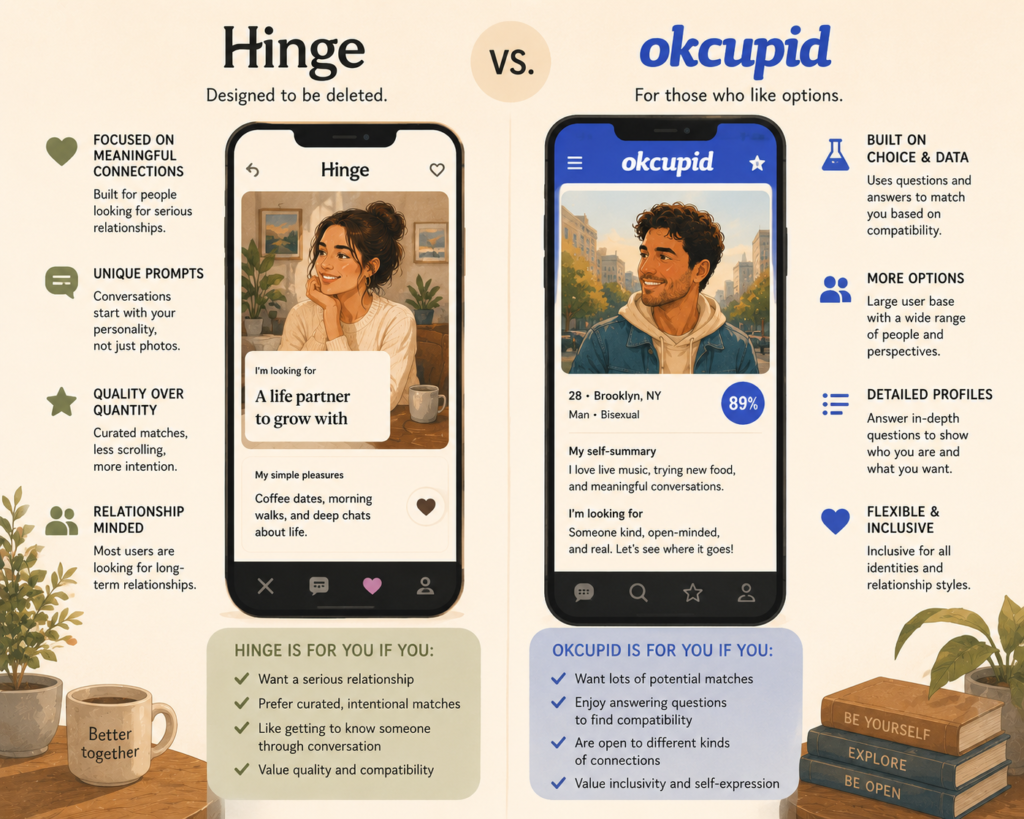
Hinge vs OkCupid is a comparison that comes up less often than Hinge vs Tinder or Bumble vs Hinge — but for people specifically looking for serious relationships, it’s one of the most relevant comparisons available.
Both Hinge and OkCupid position themselves as alternatives to casual swipe culture. Both attract users who want something more intentional than Tinder. Both have features specifically designed to help people find genuine compatibility rather than maximum volume.
But they work very differently — and understanding how determines which one is actually better for your specific situation.
Hinge vs OkCupid: The Core Difference
The fundamental difference between Hinge and OkCupid comes down to how each platform defines compatibility.
Hinge believes compatibility is built through conversation — specifically, through the prompt-based interaction system that starts every exchange with a reference to something real the other person shared. Its algorithm learns from your behavior over time and improves its suggestions accordingly. The positioning is explicit: designed to be deleted.
OkCupid believes compatibility can be measured through values, beliefs, and lifestyle alignment — specifically through the hundreds of compatibility questions that generate match percentages between users. The platform thinks you can identify the right person before you’ve ever spoken to them, through the data their answers provide.
Both philosophies have genuine merit. Which one works better for you depends on whether you’re more driven by conversational chemistry or values alignment.
Hinge vs OkCupid: User Base
Hinge
According to data cited by Business of Apps, Hinge has grown significantly over the past three years — with particularly strong user bases in major English-speaking cities. Its demographic skews 25–38, urban, and relationship-focused.
The self-selection effect of Hinge’s “designed to be deleted” positioning means the user base is disproportionately populated by people who are genuinely tired of casual swipe culture and specifically looking for something real. This makes the match pool meaningfully different from Tinder’s — not just in stated intentions but in actual behavior.
Geographic strength: US, UK, Canada, Australia, Ireland. Strong in major metropolitan areas. Thin outside major cities.
OkCupid
OkCupid has been part of the dating landscape longer than Hinge — launched in 2004, it predates the smartphone era entirely. Its user base is broad and diverse — both in age (18–55+) and in intentions.
OkCupid’s demographic tends toward the educated, politically engaged, and socially progressive — particularly in urban markets. The compatibility question system self-selects for users who are willing to invest time in detailed self-reflection, which tends to mean more thoughtful, relationship-serious users than platforms with lower onboarding friction.
Geographic strength: US, UK, and other English-speaking markets. Less international penetration than Hinge in non-English markets.
Hinge vs OkCupid on user base: Hinge wins on relationship-intent consistency in major cities. OkCupid wins on age range diversity and values-filtering depth.
Hinge vs OkCupid: Profile System
Hinge Profiles
Hinge profiles consist of six photos plus three prompt answers chosen from a list of personality, lifestyle, and humor questions. The prompts are the heart of the experience — they give matches specific material to comment on and respond to.
The profile system rewards personality expression. A specific, genuine prompt answer consistently outperforms a strong photo in generating quality conversations. This makes Hinge unusually friendly to people whose personality is their strongest asset.
For detailed guidance on making the most of Hinge’s prompt system, our Hinge review 2026 covers everything in depth.
OkCupid Profiles
OkCupid profiles include photos, a bio, and — most distinctively — answers to compatibility questions. Users can answer as many or as few questions as they choose, on topics ranging from politics and religion to lifestyle preferences and relationship values.
These answers serve two functions: they generate match percentages that appear on every profile, and they provide conversation material that is genuinely substantive. Knowing your match percentage on openness, on political alignment, or on family values before you’ve said a word is information that no other major platform provides at this stage of the interaction.
Hinge vs OkCupid on profiles: Hinge wins on conversation-starting material through prompts. OkCupid wins on compatibility data depth. Both significantly outperform photo-only platforms on personality expression.
Hinge vs OkCupid: Matching Mechanics
How Hinge Matches Work
Hinge users scroll a feed of profiles and like or comment on specific elements — a photo, a prompt answer, a specific detail. This comment-based interaction is the mechanic that produces Hinge’s conversation quality advantage. Every exchange starts with a reference to something real, which immediately differentiates it from the blank-slate match that swiping creates.
Hinge’s Most Compatible algorithm — built around Nobel Prize-winning stable matching theory — learns from your behavior over time and progressively refines its suggestions. The longer you use Hinge actively, the better its suggestions become.
How OkCupid Matches Work
OkCupid uses a combination of user-driven browsing and algorithmic suggestions. You can search the database using detailed filters — by age, location, match percentage, specific question answers — or browse algorithmic recommendations.
The match percentage system is OkCupid’s most distinctive feature. When you see a profile with an 89% match percentage, you already know something significant about how your values and lifestyle preferences align — before any conversation has happened.
Hinge vs OkCupid on matching: Hinge wins on conversation quality through the comment mechanic. OkCupid wins on pre-conversation compatibility information through match percentages.
Hinge vs OkCupid: Conversation Quality
This is where the practical difference between the two platforms is most significant.
Conversations on Hinge
Hinge conversations almost universally start with a comment on a specific prompt answer or photo detail. This immediate specific reference creates a conversation foundation that blank-slate matches can’t replicate.
The result: Hinge conversations tend to go somewhere faster than conversations on most other platforms. The opening message already contains substance — something real was said about something real in the profile — which makes continuing the conversation feel natural rather than forced.
According to research cited by Psychology Today, conversations that start with specific, contextual references produce higher levels of perceived genuine interest and continue significantly longer than conversations that start with generic openers.
Conversations on OkCupid
OkCupid conversations have a specific advantage that Hinge lacks: built-in conversation material from the compatibility question data. Knowing that you and a match answered a specific question differently — or identically — gives you immediate, substantive material to explore.
“I saw we answered the [specific question] differently — I’m genuinely curious about your reasoning” is a Hinge-impossible opener that OkCupid makes natural. And the discussions that emerge from genuine values differences or alignments can go significantly deeper than prompt-based small talk.
Hinge vs OkCupid on conversation quality: Hinge wins on first-message quality and momentum. OkCupid wins on depth potential through values-based conversation material.
Hinge vs OkCupid: For Specific Situations
For Values Alignment (Politics, Religion, Lifestyle)
OkCupid wins clearly. If political alignment, religious beliefs, family planning intentions, or lifestyle compatibility are primary factors in whether a relationship works for you — OkCupid’s filtering is unmatched. No other major platform lets you filter by these dimensions with this level of granularity before any conversation begins.
For users in politically diverse markets where values mismatches have been genuine friction points in past relationships, this filtering capability is genuinely valuable.
For Relationship-Focused User Base
Hinge wins. The consistent “designed to be deleted” positioning, the prompt system that rewards genuine personality expression, and the behavioral algorithm that learns over time combine to produce a user base that is more uniformly serious about relationships than OkCupid’s broader demographic.
For Users in Major Cities
Hinge wins — its user base in major metropolitan areas is deeper and more active than OkCupid’s in most English-speaking cities. For a full picture of how Hinge performs across different markets, our guide on most popular dating apps in North America covers the geographic landscape in detail.
For Users Outside Major Cities
OkCupid has an advantage — its longer history and broader demographic range mean a more distributed user base that may be more viable in smaller cities and suburban areas where Hinge is thin.
For the 35+ Demographic
OkCupid — its broader age range and longer market presence mean a stronger 35+ user base than Hinge’s in most markets. For a comprehensive look at the best platforms for this demographic, our guide on best dating apps for over 40 covers the full picture.
For Women Who Want More Control
Neither — both platforms allow either person to message first without the mechanic restrictions that Bumble uses. If inbox control is a priority, Bumble remains the better choice. Our Tinder vs Bumble comparison covers the inbox dynamics in detail.
Hinge vs OkCupid: Free vs Paid
Hinge Pricing
Free tier: Browse profiles, like and comment on a limited number per day, match and message with people who like you back.
Hinge+ (~$20–30/month): Unlimited likes, see everyone who has already liked you, advanced filters.
HingeX (~$35–50/month): All Hinge+ features plus priority likes and enhanced visibility.
The most valuable paid feature on Hinge — seeing who has already liked you — is on the paid tier. For active users, this single feature meaningfully improves efficiency.
OkCupid Pricing
Free tier: Significantly more functional than Hinge’s free tier. You can browse, like, message, and see your match percentages with everyone — without paying.
OkCupid Basic (~$10–15/month): See who liked you, unlimited likes, ad-free.
OkCupid Premium (~$25–35/month): All Basic features plus read receipts, advanced filters, boost visibility.
Hinge vs OkCupid on pricing: OkCupid wins clearly. The free tier is genuinely functional — you can have real conversations without paying. Hinge’s like limits on the free tier are more restrictive.
Hinge vs OkCupid: Which Is Better for Serious Relationships?
The honest answer depends on what “serious relationships” means in your specific context.
Choose Hinge if:
- You’re in a major metropolitan area where Hinge’s user base is deep
- You’re 25–40 and specifically looking for a committed relationship
- You value conversation quality and want the prompt system’s structural advantages
- You’re willing to invest in a quality profile and give the algorithm time to calibrate
Choose OkCupid if:
- Values alignment — political, religious, lifestyle — is a genuine priority for you
- You’re outside a major city where Hinge’s user base is thin
- You’re 35+ and want a broader age range in your match pool
- You want a functional free tier without like limits
Use both if:
- You have the time to manage two platforms actively
- You’re not getting sufficient results from either one alone
- You want to compare results directly rather than choosing theoretically
How Hinge and OkCupid Compare to Other Major Platforms
Hinge and OkCupid are not the only serious-relationship options in 2026. Understanding how they fit into the broader landscape helps you make the most informed platform choice.
For a full comparison of all major serious-relationship platforms — including eHarmony and Match.com — our guide on best dating sites for serious relationships in the USA covers every option in detail.
And if you’re specifically deciding between Hinge and Bumble — the more common comparison for urban users — our detailed Bumble vs Hinge guide covers that comparison across every dimension.
Find the Right Platform for Your Location
💡 Not sure whether Hinge or OkCupid has more active users in your area? This tool matches you with the top-rated dating platform available in your location — updated for 2026. Find Your Best Dating App →
Final Thoughts
Hinge vs OkCupid doesn’t have a universal winner — because the right platform depends on what you’re actually optimizing for.
Hinge wins on conversation quality, relationship-intent consistency, and algorithmic improvement over time in major cities. OkCupid wins on values-based compatibility filtering, pricing, and user base breadth outside major metropolitan areas.
For most users in major English-speaking cities who are specifically looking for serious relationships: Hinge is the better primary platform, with OkCupid as a useful supplement if values alignment is a particular priority.
For users outside major cities, older demographics, or anyone for whom political and lifestyle compatibility is a primary filter: OkCupid’s combination of values-based matching and functional free tier makes it genuinely competitive with Hinge.
Explore more on LoveFinder: Bumble vs Hinge, eHarmony vs Match.com, EliteSingles review 2026, and best dating app strategy for 2026.