
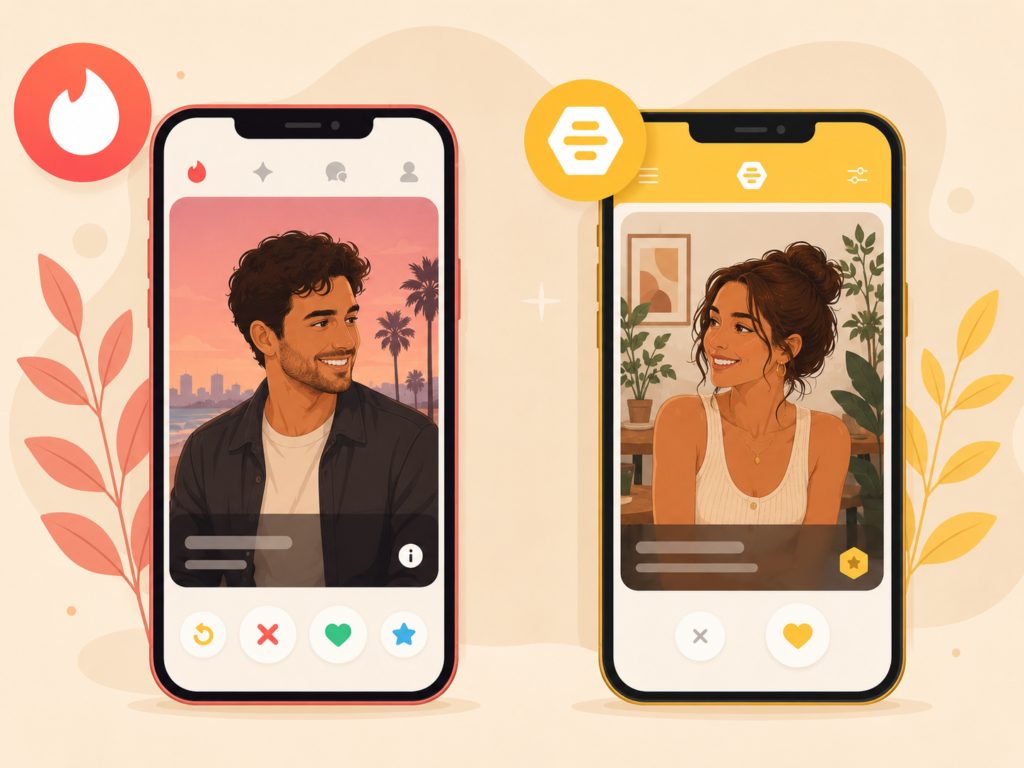
Tinder vs Bumble is the most common comparison in online dating — and for good reason. These two apps dominate the market, serve overlapping demographics, and are often the first two platforms people try when they enter the world of dating apps.
But despite their surface similarities — both are swipe-based, both are widely used, both are available globally — Tinder and Bumble are meaningfully different experiences. Different cultures, different mechanics, different user bases, and different outcomes depending on who you are and what you’re looking for.
This guide gives you an honest, detailed Tinder vs Bumble comparison across every dimension that actually matters — so you can stop guessing and start using the right app for your specific situation.
Tinder vs Bumble: The Core Difference
Before getting into specifics, the fundamental difference between Tinder and Bumble comes down to one mechanic:
On Tinder, either person can message first after a match. The interaction is symmetric — whoever wants to start the conversation can.
On Bumble, women must send the first message in heterosexual matches within 24 hours, or the match expires. In same-sex matches, either person can message first.
This single difference — who controls the opening move — cascades through everything else: the culture of each app, the quality of opening messages, the composition of the user base, and the overall experience for both men and women.
Everything else in the Tinder vs Bumble debate flows from here.
Tinder vs Bumble: User Base
Tinder
According to Business of Apps, Tinder has over 75 million active users globally as of 2026 — making it the most widely used dating app in the world by a significant margin. It’s available in 190 countries and has the broadest demographic reach of any platform.
In terms of age, Tinder’s user base skews 18–35, with particular strength in the 21–29 range. The user base is genuinely diverse in both intentions and demographics — you’ll find people looking for serious relationships, casual connections, and everything in between.
The key implication: Tinder’s scale means it’s viable virtually everywhere — in major cities, smaller cities, and many rural areas. This geographic reach is one of its primary advantages over more curated platforms.
Bumble
Bumble has approximately 50 million users globally as of 2026 — smaller than Tinder but still substantial. Its user base is more concentrated in urban areas and skews slightly older than Tinder’s, with particular strength in the 25–35 demographic.
Bumble’s user base also has a higher proportion of educated professionals than Tinder’s — partly a function of the platform’s positioning and partly a self-selection effect of the women-first mechanic, which tends to attract users who are specifically looking for a less chaotic inbox experience.
The key implication: Bumble’s smaller user base means thinner options in smaller cities and rural areas. In major metropolitan areas, however, the user base is deep enough to be highly competitive with Tinder.
Tinder vs Bumble on user base: Tinder wins on volume and geographic reach. Bumble wins on demographic quality in urban markets.
Tinder vs Bumble: The Experience for Women
The Tinder vs Bumble question looks different depending on your gender — and for women specifically, the difference is significant.
On Tinder
Women on Tinder typically experience a high volume of incoming messages — often more than they can meaningfully engage with. The quality of these messages varies enormously, from thoughtful and specific to generic and inappropriate.
Managing this inbox requires significant effort. Many women report feeling overwhelmed by the volume and disengaged as a result — which means that even strong matches sometimes go uncontacted simply because the inbox management required is too demanding.
On Bumble
The women-message-first mechanic fundamentally changes this experience. Female users receive matches but no incoming messages — instead, they choose which matches to engage with and initiate contact themselves.
This produces a filtered, manageable inbox where every conversation is one the woman has actively chosen to start. The result is a significantly less overwhelming experience and, for many women, a sense of genuine agency over their dating experience that Tinder’s open-inbox model doesn’t provide.
According to research cited by Psychology Today, women who use Bumble report higher satisfaction with the quality of their conversations and lower rates of receiving unwanted contact compared to users of open-inbox platforms.
Tinder vs Bumble for women: Bumble wins for most women — particularly those who find Tinder’s open inbox overwhelming.
Tinder vs Bumble: The Experience for Men
On Tinder
Men on Tinder can message immediately after a match — which gives them direct agency over starting conversations. The challenge is that this agency is shared with every other male user, which means the opening message has to work significantly harder to stand out in a crowded inbox.
Match rates for men on Tinder tend to be lower than women’s — a well-documented feature of the platform’s gender dynamics. Men typically need to generate a higher volume of right swipes to produce the same number of matches as female users.
On Bumble
The experience for men on Bumble is fundamentally more passive — you match, and then you wait. For men who are comfortable with this, Bumble’s user base quality and the higher quality of conversations (since women initiate more thoughtfully) can make the wait worthwhile.
For men who find the passive dynamic frustrating, Bumble can feel like a worse version of the same match-and-wait experience they’d have on Tinder.
Tinder vs Bumble for men: Tinder gives men more agency in starting conversations. Bumble’s passive dynamic suits some men and frustrates others.
Tinder vs Bumble: Profile Quality and Conversation Depth
Tinder Profiles
Tinder profiles are photo-forward. You have photos, a short bio (up to 500 characters), and the option to link your Spotify and Instagram. The emphasis is on visual presentation — a decision in the first swipe is almost entirely based on photos.
This photo-forward model rewards visual presentation but provides limited material for opening conversations beyond what’s visible in photos or briefly mentioned in the bio.
Bumble Profiles
Bumble profiles are similar in structure to Tinder — photos plus a bio — but Bumble has added prompt questions that give users more personality-based material to work with. These prompts function similarly to Hinge’s, giving women (who message first) more specific material to reference in their opening message.
Bumble also has a badge system where users can signal dealbreakers and preferences — whether they want kids, their relationship goals, communication style, and more. This upfront information reduces misalignment and filters for genuine compatibility before any conversation begins.
Tinder vs Bumble on profile depth: Bumble’s prompt system and badge features produce slightly more material for genuine conversation. Neither approaches Hinge’s depth.
Tinder vs Bumble: Opening Message Quality
This is one of the most practically significant differences between the two platforms.
Tinder Opening Messages
On Tinder, men initiate the majority of conversations — and the opening message quality across the platform is, on average, low. Generic greetings, appearance-based compliments, and low-effort openers dominate the incoming inbox for most female users.
This is a structural problem: when anyone can message anyone immediately, the friction of sending a thoughtful opener is low — and so is the average quality of what gets sent.
For guidance on how to write opening messages that actually stand out on Tinder, our guide on how to start a conversation on Tinder covers the specific approach that works across different profile types.
Bumble Opening Messages
Because women initiate on Bumble — and because women have already expressed specific interest in this particular person by choosing to message — the quality of opening messages on Bumble tends to be higher than on Tinder.
Women who have chosen to message are doing so with intention — which means their openers are more likely to be specific, thoughtful, and genuinely engaging than the volume-based outreach that characterizes Tinder’s male-initiated messages.
Tinder vs Bumble on conversation quality: Bumble produces higher quality opening exchanges on average. The women-first mechanic structurally raises the quality floor.
Tinder vs Bumble: Free vs Paid Features
Tinder Free vs Paid
Free: Unlimited swiping (with a daily limit), basic matching, messaging with mutual matches.
Tinder Gold (~$25–30/month): See who liked you, unlimited likes, five Super Likes per day, one Boost per month.
Tinder Platinum (~$35–40/month): All Gold features plus message before matching, prioritized likes.
Bumble Free vs Paid
Free: Unlimited swiping, matching, messaging with matches you’ve initiated (women) or received messages from (men).
Bumble Boost (~$17–25/month): See who liked you, rematch with expired connections, extend matches by 24 hours.
Bumble Premium (~$30–45/month): All Boost features plus advanced filters, Spotlight, SuperSwipes.
Tinder vs Bumble on pricing: Bumble is generally less expensive at equivalent tiers. Both platforms’ most valuable paid feature — seeing who already liked you — is worth the upgrade for active users.
Tinder vs Bumble: Which Is Better for Serious Relationships?
This is the question that matters most for a significant proportion of users — and the honest answer is that neither Tinder nor Bumble is primarily optimized for serious relationship outcomes.
Both platforms have users who are looking for committed relationships — and both have produced genuine long-term partnerships. But the design philosophy of both apps — swipe-based, photo-forward, high-volume — is more oriented toward generating engagement than toward producing compatible long-term matches.
For users who are specifically serious about finding a committed relationship, platforms designed explicitly around relationship intent — Hinge, eHarmony, Match — tend to produce more consistently relationship-focused user bases.
Our detailed Bumble vs Hinge comparison covers how Bumble specifically compares to Hinge — which is often the more relevant comparison for users who are looking for something serious. And our guide on best dating sites for serious relationships in the USA puts both platforms in the context of the full serious-relationship landscape.
Tinder vs Bumble for serious relationships: Bumble edges Tinder on relationship intent — its user base skews slightly more relationship-focused. But neither is the optimal platform for users primarily seeking commitment.
Tinder vs Bumble: Geographic Performance
Where Tinder Performs Best
Tinder’s scale advantage is most pronounced in smaller cities, suburban areas, and countries where Bumble has limited penetration. In these markets, Tinder’s larger user base means significantly more options — which outweighs any quality advantage Bumble might offer.
In major metropolitan areas globally — New York, London, Sydney, Toronto, Paris, Berlin — Tinder’s user base is deep enough to produce excellent results regardless of its competitive landscape.
Where Bumble Performs Best
Bumble performs best in English-speaking major cities — particularly in the US, UK, Canada, and Australia. In these markets, Bumble’s user base is substantial, its demographic quality is high, and the women-first mechanic’s benefits are most pronounced.
Outside these markets and outside major cities, Bumble’s user base can be too thin to produce the volume needed for effective dating.
For country-specific breakdowns of how both platforms perform internationally, our guides on best dating apps in Toronto, dating apps for expats in Australia, and most popular dating apps in North America cover the local dynamics in detail.
Tinder vs Bumble: The Verdict
| Dimension | Winner |
|---|---|
| User base size | 🏆 Tinder |
| Geographic reach | 🏆 Tinder |
| Experience for women | 🏆 Bumble |
| Opening message quality | 🏆 Bumble |
| Profile depth | 🏆 Bumble (slight edge) |
| Pricing | 🏆 Bumble (slight edge) |
| Serious relationship intent | 🏆 Bumble (slight edge) |
| Casual connections | 🏆 Tinder |
| Performance outside major cities | 🏆 Tinder |
Overall: Neither is universally better. The right choice depends on who you are, where you live, and what you’re looking for.
Who Should Choose Tinder
- You’re outside a major city or in a country where Bumble has limited presence
- You want maximum match volume
- You prefer to control when and how you initiate conversations (men)
- You’re comfortable managing a high-volume inbox (women)
- You’re open to a broad range of intentions rather than specifically relationship-focused
Who Should Choose Bumble
- You’re a woman who wants more control over your inbox
- You’re in a major English-speaking city
- You want a slightly more relationship-focused user base than Tinder
- You prefer a cleaner, less overwhelming experience
- You’re comfortable with (or interested in) the women-first dynamic
Should You Use Both?
Yes — if you have the time and attention to manage both actively.
Tinder and Bumble attract overlapping but distinct user bases. Your ideal match may be on one platform but not the other. Running both simultaneously for four to six weeks — and tracking which produces better conversations and actual dates — is a more informed way to make the decision than committing to one based on reputation alone.
For a complete strategy for using multiple platforms effectively without burning out, our guide on best dating app strategy for 2026 covers exactly how to approach multi-platform dating intentionally.
Find the Right Platform for Your Location
💡 Not sure whether Tinder or Bumble has more active users in your area? This tool matches you with the top-rated dating platform available in your location — updated for 2026. Find Your Best Dating App →
Final Thoughts
The Tinder vs Bumble debate doesn’t have a universal answer — because the right platform depends on factors that are specific to you.
Tinder wins on scale, geographic reach, and giving men direct agency in starting conversations. Bumble wins on inbox quality for women, conversation depth, and a slightly more relationship-focused user base in major cities.
If you’re a woman in a major city who’s overwhelmed by Tinder’s inbox — use Bumble. If you’re in a smaller city or a country where Bumble is thin — use Tinder. If you’re not sure — use both, give them a fair trial, and let your actual results tell you which works better for your specific situation.