
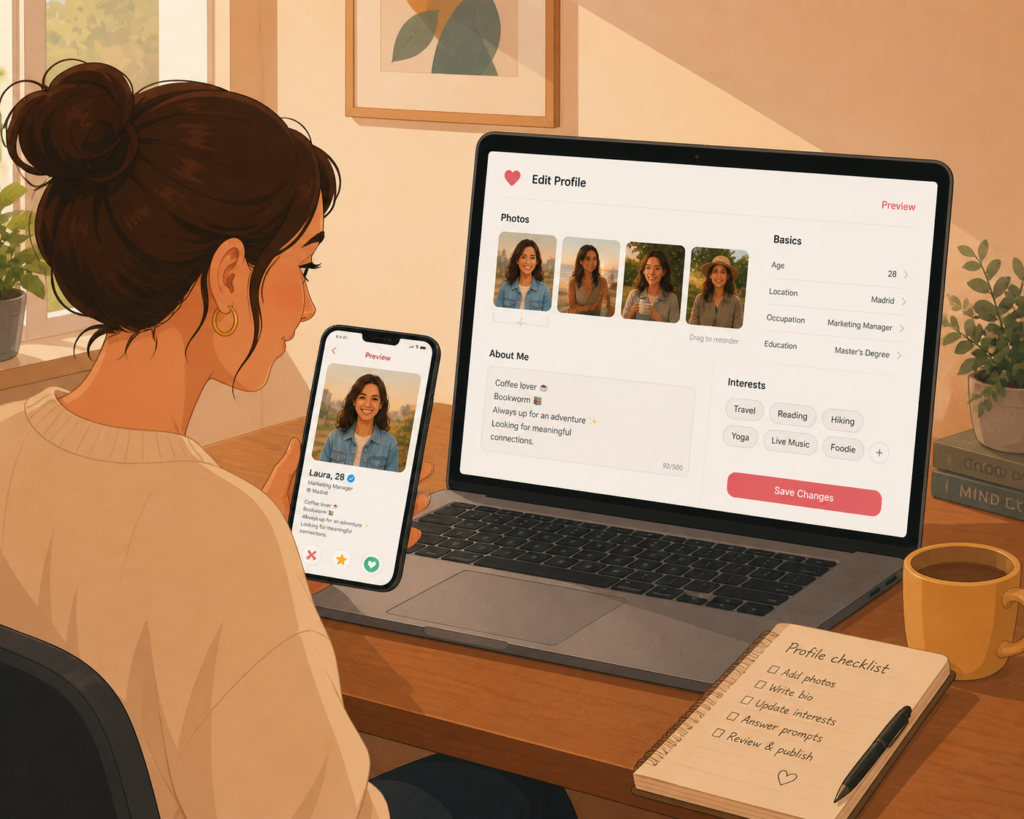
Most people spend more time choosing their profile photo than writing anything about themselves. Then they wonder why their matches are inconsistent, their conversations go nowhere, or the people they attract don’t seem right for them.
Your dating profile is not a formality. It’s the first real impression you make — and on apps where split-second decisions determine everything, a weak profile costs you matches you’ll never know you missed.
This guide covers exactly how to write a dating profile that gets matches — what to write, what to avoid, how to choose photos, and real examples of what works versus what doesn’t.
Why Most Dating Profiles Fail
Before getting into what works, it helps to understand the most common reasons profiles underperform.
They’re Generic
“I love to laugh.” “I work hard and play harder.” “Looking for my partner in crime.” These phrases appear on thousands of profiles. They communicate nothing specific about who you are — and they give the other person nothing to respond to.
Generic profiles produce generic results. If your profile could belong to anyone, it will attract no one in particular.
They’re Too Vague or Too Long
Both extremes hurt. A profile that says almost nothing — just a name, age, and one-line bio — gives people no reason to invest. A profile that reads like a personal essay asks too much of someone who’s making a five-second decision.
The sweet spot is specific, concise, and warm. Enough to make someone curious. Not so much that it feels like homework.
They Focus on What You Want Instead of Who You Are
“Looking for someone honest and loyal.” “Want someone who loves adventure.” “Must love dogs.”
These phrases tell the other person what you’re demanding — not who you are. A profile that’s entirely wish-list focused feels transactional and gives matches nothing to connect with.
The best profiles lead with personality. The right people self-select naturally.
They Have No Personality
Safe, neutral profiles that try not to offend anyone end up connecting with no one. A profile with a genuine point of view — even a mildly controversial food opinion or an unusual hobby — is infinitely more memorable than a perfectly inoffensive one.
The Anatomy of a Great Dating Profile
A strong dating profile has four components working together: photos, bio, prompts, and preferences. Each one plays a different role.
Photos: The Foundation of Everything
On most dating apps, your photos determine whether anyone reads your bio at all. A strong photo set opens the door. Everything else keeps people inside.
Your First Photo
This is the most important decision you make on any dating app. Your first photo should be:
- A clear, well-lit photo of your face — alone, not in a group
- Recent — within the last one to two years
- Smiling or with a natural, relaxed expression
- Shot in natural light when possible
What to avoid: sunglasses, group photos where it’s unclear who you are, heavily filtered images, photos taken at awkward angles, and anything where your face isn’t clearly visible.
Your Full Photo Set
Beyond the first photo, your remaining images should do different things:
A full-body photo — gives people an honest, complete picture. Profiles without one often generate suspicion rather than intrigue.
A social photo — you with friends, at an event, in a group setting. Signals that you have a life and people who enjoy your company.
An activity photo — doing something you genuinely love. Travel, sport, cooking, music, hiking. This is one of the most powerful conversation starters in your entire profile.
A natural candid — not posed, not performed. Laughing at something, caught mid-conversation, genuinely in the moment. These photos communicate warmth better than any posed shot.
What Your Photos Communicate
Every photo sends a signal beyond just your appearance. A photo at a concert says you value live music, photo mid-hike says you’re active. A photo in a kitchen you clearly know your way around says something specific about your lifestyle.
Choose photos that show the version of your life you’d actually want to share with someone.
The Bio: Where Personality Lives
Your bio is where you go from a face to a person. It doesn’t need to be long — but it needs to be specific, genuine, and leave the reader wanting to know more.
The Ideal Bio Length
Somewhere between three and eight sentences is the sweet spot on most platforms. Long enough to show personality, short enough to leave room for curiosity.
What to Include
Something specific about what you do or care about — not just your job title, but what actually interests you. “I’m a teacher” is a fact. “I’m a teacher who somehow got obsessed with competitive bread baking on weekends” is a person.
A glimpse of your sense of humor — even one line that makes someone smile is more valuable than three sentences of earnest self-description.
Something that invites a response — a question, a mild debate-starter, a preference they can agree or disagree with. Give people a thread to pull.
Who you actually are — not who you think sounds good on paper. The goal is to attract the right people, not to maximize likes from everyone.
What to Leave Out
- Your height, unless the app has a specific field for it
- Negative filters (“no time wasters,” “swipe left if you just want hookups”)
- Lists of requirements for matches
- Clichés that could apply to literally anyone
- Anything that sounds like a job application
Bio Examples: What Works vs What Doesn’t
❌ Weak Bio Example 1
“I love to travel, eat good food, and spend time with my friends and family. Looking for someone genuine who knows what they want. I work hard but always make time for the things that matter.”
Why it fails: Every sentence could apply to virtually anyone. There’s nothing specific, nothing surprising, nothing to respond to.
✅ Strong Bio Example 1
“Software engineer by day, aggressively mediocre surfer by weekend. Recently moved to Barcelona and still haven’t figured out dinner before 9pm. Ask me about the best meal I’ve had this year — I have strong opinions.”
Why it works: Specific details, genuine humor, a clear personality, and an explicit invitation to start a conversation.
❌ Weak Bio Example 2
“Looking for my travel partner and best friend. Must love dogs and spontaneous adventures. No drama please.”
Why it fails: Entirely wish-list focused. “No drama” is a red flag to many readers. Nothing here tells us who this person actually is.
✅ Strong Bio Example 2
“I’ll always know the best coffee shop in whatever city we’re in. Terrible at mornings, excellent at Sundays. My dog has better social skills than I do and he’ll be at the interview.”
Why it works: Warm, specific, funny, and the dog line is a natural conversation starter. The reader already has a sense of this person’s personality.
❌ Weak Bio Example 3
“Just moved here and trying to meet new people. Love hiking, cooking, and Netflix. Looking for something real.”
Why it fails: Generic hobbies listed without context. “Something real” is vague. Nothing here is memorable.
✅ Strong Bio Example 3
“Moved here six months ago and have embarrassingly strong opinions about which neighborhood has the best food market. Currently learning Spanish — my vocabulary is excellent for restaurants and terrible for everything else. Looking for someone to explore the city with who won’t judge my pronunciation.”
Why it works: Specific, self-aware, relatable, and it immediately creates common ground with locals and fellow expats alike.
Prompts: The Secret Weapon Most People Waste
On apps like Hinge, prompts are the most powerful part of your profile — and the most frequently misused.
A prompt is not an opportunity to list more facts about yourself. It’s an opportunity to show your personality in a way that invites a direct response.
Prompt Examples: Weak vs Strong
Prompt: “A fact about me that surprises people”
❌ Weak: “I’ve been to 20 countries.”
✅ Strong: “I can name every country in the world alphabetically but I can’t parallel park.”
Prompt: “I’m looking for”
❌ Weak: “Someone genuine who knows what they want.”
✅ Strong: “Someone who will debate with me about whether a hot dog is a sandwich. (It is. Fight me.)”
Prompt: “My most irrational fear”
❌ Weak: “Spiders.”
✅ Strong: “That I’ll be in the middle of telling a story and forget where it’s going. This happens more than I’d like to admit.”
Prompt: “Typical Sunday”
❌ Weak: “Coffee, gym, brunch, Netflix.”
✅ Strong: “Farmers market for things I’ll definitely cook this week. Lying about going to the gym. A walk somewhere I haven’t been before. Cooking the things I actually bought.”
The difference in every case is specificity and personality. The strong answers tell you something real about who this person is. The weak answers could belong to anyone.
Tailoring Your Profile to Different Apps
Different platforms reward different approaches.
Tinder
Photo quality matters most. Your bio has roughly three seconds of attention. Keep it punchy — two to four lines maximum, with a clear personality hook in the first sentence.
Hinge
Prompts are the heart of the experience. Spend more time on your three prompt answers than on your bio. The goal is to give matches something specific to comment on — the more specific, the better.
If you’re wondering how to use Hinge’s system to its full advantage compared to other apps, read our detailed Bumble vs Hinge comparison — it breaks down exactly how the two platforms differ in practice.
Bumble
Since women message first, your profile needs to give them something specific and easy to respond to. Clear prompts, a bio with a question or debate-starter, and an activity photo that invites a natural comment all help significantly.
Apps Focused on Serious Relationships
On platforms like Meetic or eHarmony, depth matters more. Users expect more detailed profiles and are more likely to read everything carefully. A longer, more thoughtful bio performs better here than the punchy two-liner that works on Tinder.
The Profile Audit: Questions to Ask Before You Publish
Before setting your profile live — or updating an existing one — run through these questions.
Could this profile belong to anyone else? If yes, make it more specific.
Is there at least one thing here that someone could directly comment on? If no, add a debate-starter, a question, or an unusual detail.
Are my photos honest and recent? If you’ve changed significantly since your photos were taken, update them.
Does my bio sound like me — or like who I think sounds good? If it sounds performative, rewrite it in a more natural voice.
Is there anything negative, demanding, or defensive in my profile? If yes, remove it.
Would I swipe right on this profile if I came across it? If you’re not sure, that’s your answer.
Common Mistakes That Kill Your Match Rate
Even strong profiles can be undermined by a few specific mistakes.
Only having one or two photos. Most apps allow six. Using fewer signals either low effort or something to hide — neither is attractive.
Using only posed group photos. If every photo requires the reader to guess which person you are, you’re losing matches before they’ve even decided.
Writing your bio in the third person. “John is a passionate traveler who loves…” reads as deeply strange. Write as yourself.
Listing dealbreakers. “No smokers,” “must be taller than 6ft,” “vegetarians only” — these negative filters make your profile feel like a job posting with strict requirements rather than a person worth knowing.
Copying someone else’s profile style. Templates are a starting point, not a destination. Your profile should sound like you — not like a curated version of what you think a good profile sounds like.
Updating Your Profile: How Often and Why
Your dating profile is not a set-and-forget exercise. Regular updates — every four to six weeks — signal activity and give the algorithm reasons to show your profile to new people.
What to update: swap out your least-performing photo, refresh a prompt answer that hasn’t generated many conversations, or update your bio to reflect something new in your life.
Small updates matter more than you’d think. On most apps, recently active profiles get prioritized in the discovery feed — which means a minor refresh can meaningfully increase your visibility.
Beyond the Profile: What Comes Next
A great profile gets you matches. What happens after that depends on how you open conversations and how quickly you move toward actually meeting.
For copy-paste openers that work across different profile types, read our guide on how to start a conversation on Tinder — the same principles apply on Hinge, Bumble, and every other major platform.
Once you’ve matched and the conversation is going well, the next step is asking someone out. Our guide on how to ask someone out online covers exactly how to make that transition smoothly — including the right timing and the specific wording that works.
And if you’re dating after a period away from it — whether after a long relationship, a breakup, or simply not prioritizing it for a while — our guide on how to overcome fear before the first date offers practical advice on showing up confidently when the nerves are real.
Final Thoughts
Writing a dating profile that gets matches is not about presenting the most impressive version of yourself. It’s about presenting the most specific version of yourself — clearly enough that the right people recognize something worth pursuing, and honestly enough that what follows the match actually has a foundation.
Generic profiles attract generic interest. Specific profiles attract the right people.
Take the time to do it well. Update it regularly. And remember that the goal of the profile is not to maximize matches — it’s to start the right conversations with the right people.
That distinction changes everything about how you write it.
Explore more on LoveFinder: situationship vs relationship, why men pull away after getting close, flirting vs being nice, and how to find love online and offline.