
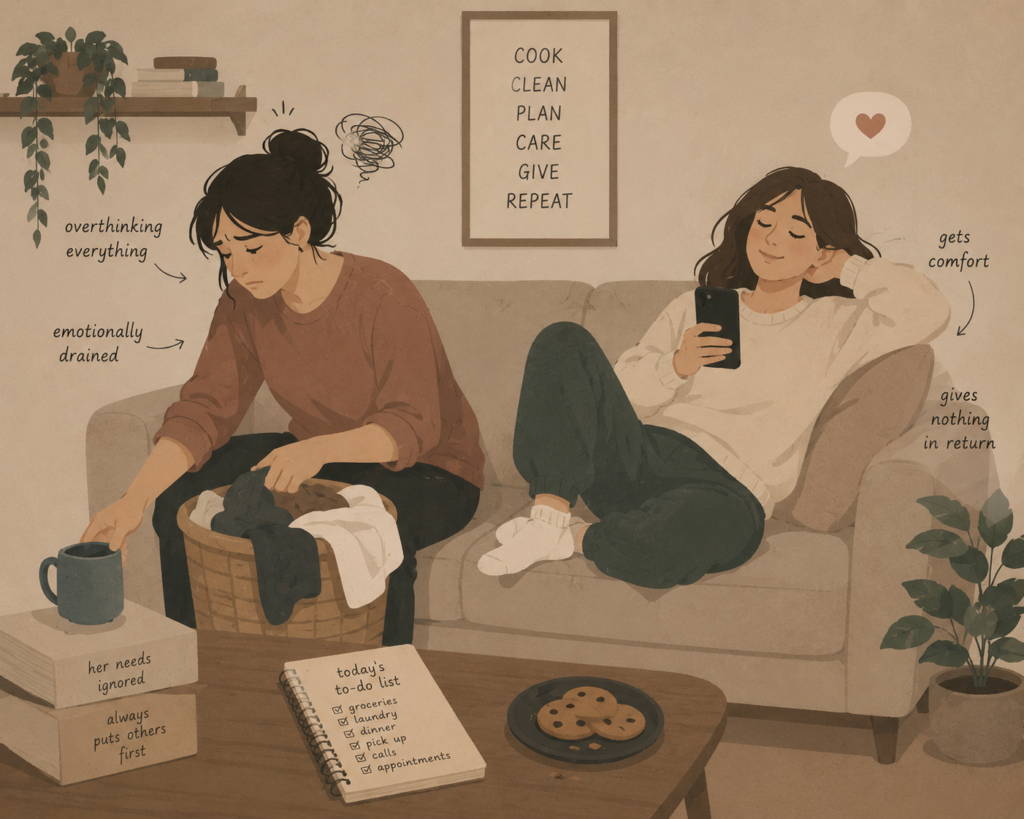
Some of the most draining relationships don’t involve obvious cruelty or clear mistreatment. They involve someone who takes — consistently, selectively, and often without acknowledgment — while giving back just enough to keep you invested.
Emotional manipulation isn’t always dramatic. It rarely announces itself. It develops gradually, through patterns that feel normal until you step back and look at the full picture.
If you’ve been feeling consistently drained after interactions with someone, if you always seem to be the one giving while they receive, if the relationship feels unbalanced in ways you can’t quite articulate — this guide is for you.
Here’s how to tell if someone is using you emotionally, what the signs look like in practice, why it happens, and what to do about it.
What Emotional Manipulation Actually Looks Like
Before getting into specific signs, it helps to understand what emotional manipulation and emotional exploitation actually mean — because both terms get used loosely in ways that can dilute their meaning.
Emotional manipulation is the use of psychological tactics — guilt, flattery, withdrawal, gaslighting — to influence someone’s behavior in ways that serve the manipulator’s interests at the expense of the other person.
Emotional exploitation is a broader pattern where one person consistently extracts emotional resources — support, validation, time, energy — from another without meaningful reciprocity.
These often overlap. But not everyone who uses you emotionally is consciously manipulating you. Some people have learned patterns of taking from others that feel entirely natural to them — not because they’re calculating, but because they’ve never been required to examine those patterns.
Understanding this distinction matters because it affects how you respond. Conscious manipulation requires firm boundaries and often distance. Unconscious exploitation may be addressable through honest conversation — though it often isn’t.
15 Signs Someone Is Using You Emotionally
1. The Relationship Runs on Your Schedule — But Only When It Suits Them
They reach out when they need something — support after a bad day, help with a problem, someone to talk to when they’re feeling low. When you need the same, they’re less available. Busy. Distracted. Full of reasons why now isn’t a good time.
This pattern — available when they need you, absent when you do — is one of the clearest signs of emotional one-sidedness in a relationship. Genuine connection runs on mutual need. Exploitation runs on selective availability.
2. You Feel Drained After Spending Time With Them
Healthy relationships leave you feeling energized — or at least neutral. You might be tired after a long evening with someone, but there’s a warmth to it. A sense of having genuinely connected.
When someone is using you emotionally, interactions consistently leave you feeling depleted. There’s an after-effect of heaviness that you don’t feel after time with other people. If you notice this pattern — if you repeatedly feel worse after spending time with a specific person — your body is telling you something worth listening to.
3. Your Problems Are Always Less Important Than Theirs
Every relationship has an ebb and flow of who needs more support at any given time. That’s normal.
What isn’t normal is a consistent dynamic where your problems are minimized, redirected, or met with impatience — while theirs receive full attention and extensive processing.
Watch how they respond when you try to share something difficult. Do they listen? Do they ask follow-up questions? Or does the conversation find its way back to them within minutes?
Consistently making space for someone else’s emotional experience while receiving little in return is one of the clearest forms of emotional exploitation in relationships.
4. They Use Guilt as a Tool
Guilt is one of the most common instruments of emotional manipulation — and one of the hardest to recognize when you’re inside it.
Guilt-based manipulation doesn’t always sound like “you should feel bad.” It often sounds like: “I just thought you cared more than that.” “Fine — I’ll figure it out myself.” “I guess I expected too much from you.” “After everything I’ve done for you.”
These phrases are designed to produce compliance through shame rather than through honest communication of need. If you consistently feel guilty around someone — without being able to identify anything you’ve actually done wrong — the guilt is probably manufactured rather than earned.
5. They’re Warm When They Need You and Distant When They Don’t
One of the most disorienting signs of being emotionally used is the experience of a person who is genuinely warm, engaged, and connected when they need something from you — and noticeably cooler, more distracted, or less available when they don’t.
This inconsistency is often what makes emotional exploitation so confusing. The warm version of them feels real — because it is real, in the sense that it’s not entirely performed. But it’s conditional. It appears when you’re useful and fades when you’re not.
This dynamic is closely related to the patterns discussed in our guide on signs he likes you but is scared — the difference being that conditional warmth driven by fear looks different from conditional warmth driven by self-interest, though both are worth recognizing.
6. Your Boundaries Are Consistently Tested or Ignored
Healthy relationships involve respect for boundaries — stated or unstated. When you say no, it’s accepted. When you signal discomfort, it’s acknowledged.
In emotionally exploitative relationships, boundaries tend to be treated as obstacles rather than information. Your no gets negotiated. Your discomfort gets minimized. The pressure to override your own limits comes in various forms — guilt, persuasion, sulking, withdrawal — but it’s consistently there.
If you find yourself regularly doing things you didn’t want to do because saying no felt too costly — too much conflict, too much guilt, too much withdrawal of warmth — your boundaries are not being respected.
7. They Share Everything — But Know Little About You
A relationship where one person is the constant subject and the other is the constant audience is not a mutual relationship. It’s a performance with a captive viewer.
Notice how much they know about your life. Your current stresses, your goals, your family situation, what’s been weighing on you lately. Now notice how much you know about theirs — and whether that knowledge was offered freely or required extraction.
Emotional intimacy requires reciprocal vulnerability. When one person consistently occupies the emotional center of every interaction, the other person is functioning as support staff rather than an equal participant.
8. They Disappear When Things Get Hard for You
One of the clearest tests of any relationship is what happens when you genuinely need support.
Not just casual conversation or low-stakes companionship — but real support during a difficult period. A health scare, a family crisis, a professional failure, a loss.
People who use you emotionally tend to be significantly less present during these periods. They may offer initial sympathy, but sustained support — showing up consistently when things are genuinely hard — is where exploitative relationships reliably fail.
Pay attention to where people are when you’re the one who needs something.
9. You’re Always the One Reaching Out
Count the initiations over the past month. Texts, calls, plans, check-ins. Who starts them?
If the balance is heavily skewed — if you’re consistently the one making contact and they’re consistently the one responding (or not) — that’s meaningful information about the level of investment on each side.
Occasional imbalance is normal. Consistent, persistent imbalance is a pattern.
10. They Use Your Vulnerabilities Against You
This is one of the more serious signs — and one of the clearest indicators of conscious manipulation rather than unconscious exploitation.
When you’ve shared something personal — a fear, an insecurity, a past experience — and it later gets used to make you feel bad, pressure you into something, or undermine your confidence, the trust that made that sharing possible has been violated.
This might look like referencing your insecurities during an argument. Bringing up something you told them in confidence to gain leverage. Using your known fears to produce guilt or compliance.
People who do this have learned that your vulnerabilities are access points — and they use them.
11. The Relationship Only Works on Their Terms
Plans happen when they’re available, not when you are. Conversations happen about topics they want to discuss. The format, timing, and content of the relationship is consistently shaped around their preferences — and deviations from this produce friction or withdrawal.
Relationships that work only on one person’s terms are not mutual relationships. They’re arrangements that serve one person’s needs while requiring accommodation from the other.
12. You Feel Like You’re Walking on Eggshells
A persistent low-level anxiety about saying the wrong thing, expressing an inconvenient need, or failing to meet an expectation — even an unstated one — is a significant warning sign.
Healthy relationships don’t require constant self-monitoring. You should be able to be imperfect, to have bad days, to express needs, to disagree — without it costing you something significant.
When you find yourself carefully managing your behavior to avoid triggering a negative response, you’re not in a relationship — you’re in a performance.
13. Their Problems Are Always Urgent, Yours Can Wait
There’s a specific version of emotional exploitation where the other person’s needs consistently carry a sense of urgency — they need support now, they’re struggling right now, this can’t wait — while your needs are perpetually deferrable.
This creates a dynamic where you’re always in response mode to their emotional state, with little space for your own. Over time, you stop bringing your needs forward because the pattern has taught you that there’s no room for them.
14. You Find Yourself Justifying the Relationship to Others
When friends or family express concern about a relationship — when the people who know you well notice something you’ve normalized — it’s worth taking seriously.
If you find yourself regularly explaining why the relationship is actually fine, defending behaviors that gave others pause, or making excuses for patterns that others find troubling — step back and ask yourself honestly whether you’re explaining or rationalizing.
The need to consistently justify a relationship to people who care about you is often a signal that something isn’t right.
15. You Feel Less Like Yourself Around Them
This is perhaps the most important sign — and the hardest to articulate.
Healthy relationships expand you. They make you more confident, more yourself, more capable of expressing who you are.
Emotionally exploitative relationships do the opposite. Over time, they shrink you. You become more cautious, more self-monitoring, less likely to express needs or opinions that might create friction.
If you’ve noticed that you’re different around this person — smaller, more careful, less authentically yourself — that difference is information.
Why People Use Others Emotionally
Understanding why emotional exploitation happens doesn’t excuse it — but it does make it less mysterious and less personal.
They Learned It
Many people who exploit others emotionally grew up in environments where emotional resources were scarce and taking was the only reliable way to get needs met. The pattern became automatic — not calculated, just habitual.
They Have Underdeveloped Empathy
Some people genuinely struggle to register other people’s emotional states with the same acuity that they register their own. This isn’t necessarily narcissism in a clinical sense — it’s simply a limited capacity for mutual emotional awareness.
They’re Unconsciously Replicating Patterns
Emotional exploitation often replicates the dynamics of earlier relationships — with parents, siblings, or previous partners. People don’t always know they’re doing it because it feels like the normal texture of close relationships.
For a deeper understanding of how early relationship dynamics create patterns that show up in adult connections, read our guide on psychological patterns in relationships.
They Have Avoidant Attachment
People with avoidant attachment styles often take more emotional support than they give — not because they don’t care, but because genuine reciprocity feels threatening to their sense of independence. For more on how attachment styles shape relationship dynamics, our guide on attachment styles in relationships provides a practical framework.
What to Do When Someone Is Using You Emotionally
Step 1: Get Clear on the Pattern
Before taking any action, get clear on what you’re actually seeing. Patterns matter more than incidents. One difficult conversation, one period of neediness, one moment of boundary-pushing doesn’t define a relationship.
But if you’ve read through this guide and recognized multiple consistent signs — that consistency is what matters.
Step 2: Name It to Yourself Honestly
Emotional exploitation relies partly on the exploited person’s unwillingness to name what’s happening. The relationship continues because it’s easier to rationalize than to confront.
Naming it honestly — to yourself, without minimizing — is the first step toward changing it.
Step 3: Set a Clear Boundary and Watch the Response
The most revealing thing you can do in a potentially exploitative relationship is set a clear, reasonable boundary and watch what happens.
Not an ultimatum — just a boundary. “I can’t talk tonight — I need to rest.” “I’m not in a position to help with that right now.” “I need some space this week.”
How someone responds to a clear, reasonable boundary tells you almost everything about the nature of the relationship. Respect, even if they’re disappointed, is healthy. Guilt, anger, sulking, or withdrawal in response to a simple boundary is a significant signal.
Step 4: Have an Honest Conversation — If It’s Safe to Do So
If the relationship matters to you and you believe the exploitation may be unconscious rather than deliberate, an honest conversation is worth attempting.
Not an accusation — a description of your experience. “I’ve noticed that I often feel drained after we spend time together.” “I feel like our conversations are mostly focused on your situation, and I’d like more space for mine too.” “When I’ve needed support recently, I’ve felt like it wasn’t available in the way I try to make myself available for you.”
Their response to this conversation — defensive, dismissive, or genuinely reflective — tells you a lot about whether change is possible.
Step 5: Reduce Your Investment and See What Happens
In relationships where emotional exploitation has become normalized, one of the most clarifying things you can do is quietly reduce your investment — reach out less, offer less, be less immediately available — and observe what happens.
If the relationship continues much as before, with the other person picking up some of the slack, the imbalance was partly a dynamic that both people had settled into rather than pure exploitation.
If the relationship essentially disappears when you stop carrying it — if they only appear when they need something and are absent when you stop providing — you have a clear answer about what the relationship actually was.
Step 6: Make a Decision About the Relationship
Based on what you observe, you face a decision: work on the relationship, set firm ongoing boundaries within it, or step away from it.
None of these is automatically the right choice. Context matters — the nature of the relationship, your history with the person, the degree of exploitation, whether change seems genuinely possible.
What isn’t a good choice is continuing the relationship exactly as it has been while hoping something will change on its own. Patterns in relationships almost never change without something disrupting them.
The Cost of Staying in an Emotionally Exploitative Relationship
It’s worth being honest about what prolonged emotional exploitation costs — because the costs accumulate gradually in ways that can be hard to see from inside the relationship.
Emotional exhaustion — the chronic depletion of giving more than you receive, sustained over months or years.
Eroded self-worth — consistently having your needs treated as less important sends an implicit message about your value that is hard not to internalize over time.
Reduced capacity for healthy connection — people who have been emotionally exploited often carry patterns of over-giving, excessive accommodation, and difficulty setting boundaries into subsequent relationships.
Lost time — time and emotional energy invested in an exploitative relationship is time and energy unavailable for connections that are genuinely mutual.
If you’ve recognized the signs of emotional manipulation or one-sided relationships in your current situation and are considering stepping back, our guide on what to do after cheating offers a broader framework for processing relationship endings — even ones that don’t involve infidelity but involve a similar need to grieve what was lost.
Protecting Yourself Going Forward
Recognizing and leaving an emotionally exploitative relationship is an important step. Equally important is understanding why you stayed as long as you did — and what made you vulnerable to the dynamic in the first place.
This isn’t self-blame. It’s self-knowledge.
Common factors that make people more vulnerable to emotional exploitation include anxious attachment, a strong need to be needed, difficulty setting boundaries, a history of similar dynamics in earlier relationships, and a tendency to prioritize others’ comfort over your own.
None of these are character flaws. All of them are patterns that can be understood and worked with.
When you’re ready to re-enter the dating world with clearer awareness of these dynamics, our guides on red flags on a first date and how to get over someone you never dated offer practical frameworks for approaching new connections with clarity and appropriate self-protection.
Final Thoughts
Emotional exploitation is rarely obvious from the inside. It develops through patterns — small imbalances that normalize over time until the full picture becomes visible only when you step back and look honestly at what the relationship actually is.
The signs are there. The consistent unavailability when you need support. The guilt when you say no. The warmth that appears when they need something and fades when they don’t. The exhaustion that follows time together. The sense of being smaller than you are when you’re around them.
You deserve relationships that expand you rather than deplete you. Connections where your needs matter as much as theirs. People who show up when things are hard — not just when things are convenient.
Recognizing the signs is the first step. What you do with that recognition is what changes things.
Explore more on LoveFinder: situationship vs relationship, why men pull away after getting close, signs he likes you but is scared, and psychological patterns in relationships.