
The Subtle Difference That Changes Everything in Dating
Flirting is one of the most misunderstood forms of human communication. People talk about it constantly, yet few truly understand what it is or how it works. Some believe flirting requires confidence, boldness, or clever lines. Others avoid it altogether, afraid of being misunderstood or rejected. As a result, countless dating interactions fall into a grey zone where interest exists — but connection never fully forms.
In modern dating, this confusion has only intensified. Online communication removes tone, body language, and context. Offline interactions are shaped by social norms, fear of crossing boundaries, and heightened sensitivity to personal space. Many people end up being “nice” when they actually want to flirt — and then wonder why attraction fades or conversations go nowhere.
If you’ve ever felt stuck in polite but emotionally flat conversations, this article is for you. Here, we’ll explore the true difference between flirting and being nice, how it shows up in real life and online dating, why “niceness” often kills attraction without you realizing it, and how to flirt naturally without feeling awkward, fake, or inappropriate.
Why This Confusion Happens So Often in Modern Dating
The line between flirting and friendliness has never been thinner. In the past, social roles and dating norms were more rigid. Today, communication is more nuanced — which is healthy, but also confusing.
One major reason this confusion exists is fear. Many people are afraid of rejection, misinterpretation, or being perceived negatively. As a result, they default to safety. And safety, in dating, often looks like politeness rather than attraction.
Another reason is the influence of online dating. Text-based communication strips away facial expressions, tone of voice, and timing. A message that might sound playful in person can appear neutral or even cold on a screen. To avoid misunderstandings, people often tone themselves down — unintentionally removing the very signals that create chemistry.
Cultural changes also play a role. Respect, consent, and emotional intelligence are rightfully emphasized today. However, without guidance on how to express attraction respectfully, many people suppress it entirely. They become excellent conversationalists — but poor romantic communicators.
The Core Difference: Intention vs. Emotional Energy
At its core, the difference between flirting and being nice isn’t about words. It’s about intention and emotional energy.
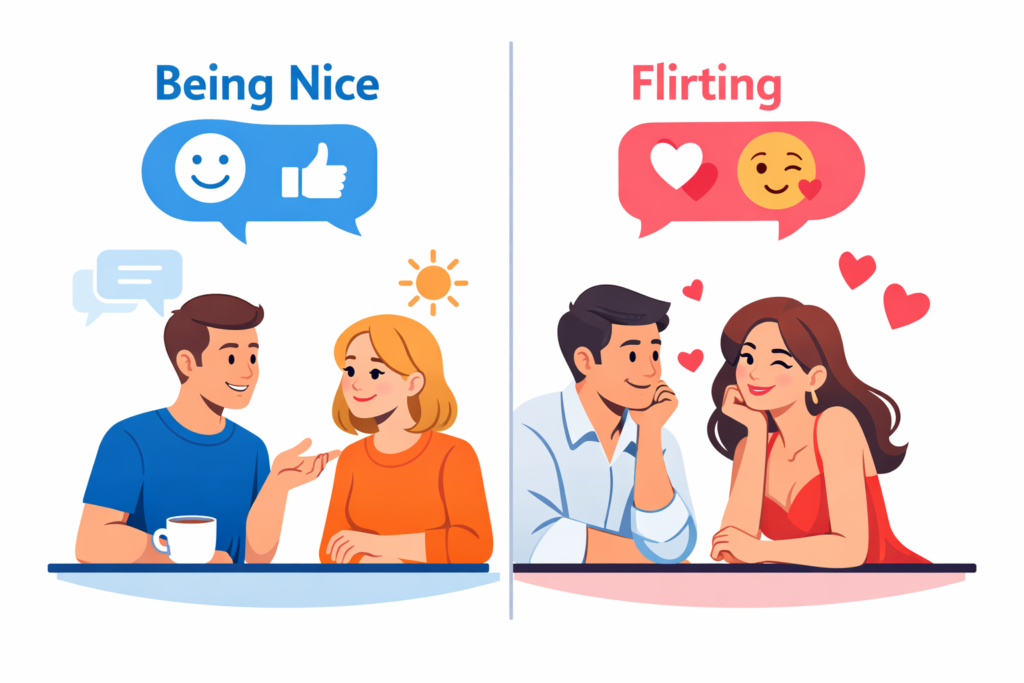
Being nice is about creating comfort. It’s polite, safe, and socially acceptable. Flirting, on the other hand, introduces emotional presence. It signals interest, curiosity, and desire for connection — without necessarily being sexual or explicit.
When you are being nice, your intention is neutral. You want the interaction to go smoothly. When you are flirting, your intention is personal. You want this interaction to matter.
Flirting subtly communicates:
“I see you.”
“This moment matters.”
“I’m open to connection.”
That emotional signal is what separates a pleasant conversation from a memorable one.
How This Difference Appears in Real Life (Offline Dating)
Being Nice in Offline Interactions
In real life, being nice often looks like good manners and friendly engagement. There’s nothing wrong with it — but it rarely creates attraction on its own.
Examples of “nice” behavior:
- Polite smiles and nodding
- Neutral topics like work, weather, or routines
- Safe compliments (“You seem kind”)
- Minimal personal curiosity
These interactions feel comfortable and respectful — but emotionally flat. They could happen between colleagues, acquaintances, or strangers without any romantic context.
Flirting in Offline Interactions
Flirting, even subtle flirting, changes the emotional tone of the interaction.
It might show up as:
- Slightly longer eye contact
- A playful tone or gentle teasing
- Curiosity about thoughts, not just facts
- Relaxed body language and presence
Flirting doesn’t need dramatic gestures. Often, it’s simply a shift from talking at someone to engaging with them emotionally.
Online Dating: Where the Confusion Multiplies
Online dating magnifies the difference between flirting and being nice — and also makes it harder to recognize.
Being Nice Online
Online niceness often sounds like:
- “How was your day?”
- “You seem like a good person.”
- “Nice profile.”
These messages are polite and respectful — but generic. They don’t create emotional engagement or signal clear interest.
As a result, conversations often fade because neither person feels truly chosen.
Flirting Online
Flirting online requires intention and specificity. Since tone and body language are missing, emotional cues must be communicated through attention.
Examples of online flirting:
- Noticing something specific in a profile
- Responding emotionally rather than factually
- Using light humor or curiosity
Flirting online isn’t about saying more — it’s about saying something that only makes sense for that person.
Why Being “Too Nice” Often Kills Attraction
This is one of the hardest truths in dating: niceness alone does not create attraction.
When conversations stay safe and neutral:
- Emotional momentum stalls
- Curiosity disappears
- Interactions feel interchangeable
This is why many dating app chats feel like interviews. Everyone is polite. Everyone is pleasant. And no one feels special.
Attraction requires emotional contrast. Flirting introduces that contrast by gently breaking neutrality.
Many people believe compliments automatically create attraction. In reality, the type of compliment matters far more than the compliment itself. Generic praise often feels polite rather than romantic, while thoughtful compliments can deepen emotional connection.
If you want to understand which compliments actually work in dating conversations — and which ones unintentionally reduce attraction — this article breaks it down clearly:
The best compliments for Online Chat in Dating Apps
Flirting Is Not About Lines — It’s About Presence
One of the biggest misconceptions about flirting is that it requires clever lines or confidence tricks. In reality, flirting is rooted in presence.
Flirting means:
- Listening fully instead of waiting to respond
- Reacting emotionally instead of logically
- Allowing pauses without rushing to fill them
- Showing genuine curiosity
A simple sentence can feel flirty or flat depending on presence.
Compare:
- “That’s interesting.”
- “That’s interesting — what made you feel that way?”
The difference is emotional engagement.
Why Some People Appear Naturally Flirty
Some people seem effortlessly flirty, even without trying. This is rarely about looks or charisma.
Naturally flirty people tend to:
- Be comfortable with emotional expression
- Stay present in conversations
- Respond intuitively rather than strategically
- Allow vulnerability without oversharing
They are not trying to impress. They are simply engaged.
This emotional availability is often what others perceive as confidence or charm.
What often looks like “natural flirting” is actually emotional availability. People who feel comfortable expressing interest, curiosity, and presence tend to appear more attractive — not because of technique, but because of openness.
This article explains how to recognize emotional availability early in dating and why it plays such a critical role in building attraction:
Emotional Availability: How to Recognize If Someone Is Ready for Love
The Role of Emotional Intelligence in Flirting
Emotional intelligence plays a huge role in successful flirting. It allows you to read cues, adjust your energy, and respond appropriately.
Emotionally intelligent flirting:
- Respects boundaries
- Adapts to feedback
- Feels natural, not forced
This is why the best flirting often feels effortless — it’s responsive, not scripted.
When Flirting Crosses the Line
Flirting should never feel overwhelming, uncomfortable, or invasive.
Signs flirting has crossed into discomfort:
- Ignoring lack of response
- Sexualizing too early
- Forcing intimacy
- Disregarding emotional cues
Healthy flirting always leaves space for the other person to engage willingly.
How to Flirt Without Feeling Awkward
Awkwardness usually comes from overthinking or trying to perform.
Instead of “trying to flirt,” focus on:
- Being curious
- Sharing one honest thought
- Responding naturally
Flirting becomes easier when you stop treating it as a technique and start treating it as communication.
Why Clear Flirting Saves Time and Emotional Energy
Clear flirting creates clarity. It removes ambiguity and reduces wasted emotional effort.
When you flirt respectfully:
- The other person understands your intention
- Mixed signals decrease
- Compatibility becomes clearer faster
Flirting isn’t about pushing someone — it’s about expressing interest honestly.
Flirting as a Skill, Not a Personality Trait
It`s not something you either “have” or don’t. It’s a communication skill that can be learned, practiced, and refined.
The goal isn’t to become someone else — it’s to express interest in a way that feels authentic to you.
Recommended Dating Apps by Country
Dating culture varies significantly from country to country. Communication styles, flirting norms, and relationship expectations all influence how dating apps are used.
Below are curated guides to dating apps and sites that work best in different regions, especially for people who value communication, emotional connection, and real-life compatibility:
- United States — dating platforms focused on real relationships, emotional clarity, and intentional matching
- United Kingdom — apps and sites popular among locals looking for meaningful, long-term connections
- Europe (Multiple Countries) — an overview of dating platforms across different European cultures and expectations
- India — dating apps adapted to local traditions, values, and modern relationship dynamics
- Canada — platforms that work well for locals and newcomers looking for serious dating and compatibility
- Germany — dating apps popular among locals and expats who value structure, honesty, and long-term potential
- Australia — dating platforms suited for relaxed communication styles and real-life meetups
- Denmark — apps that fit Scandinavian dating culture, where clarity and balance matter more than swiping volume
- Singapore — dating apps designed for busy professionals who prefer efficient, intentional dating
Choosing a dating platform that fits both your communication style and local dating norms often makes flirting feel more natural — and far less exhausting.
Final Thoughts
The difference between flirting and being nice is subtle — but powerful. Being nice creates comfort. Flirting creates connection.
If your dating life feels stuck in polite conversations and fading interest, the issue may not be confidence, attractiveness, or effort. It may simply be a lack of emotional intention.
Flirting is not about manipulation, boldness, or performance. It’s about presence, curiosity, and allowing yourself to be seen.
Once you understand this difference, dating conversations stop feeling confusing — and start feeling meaningful.