
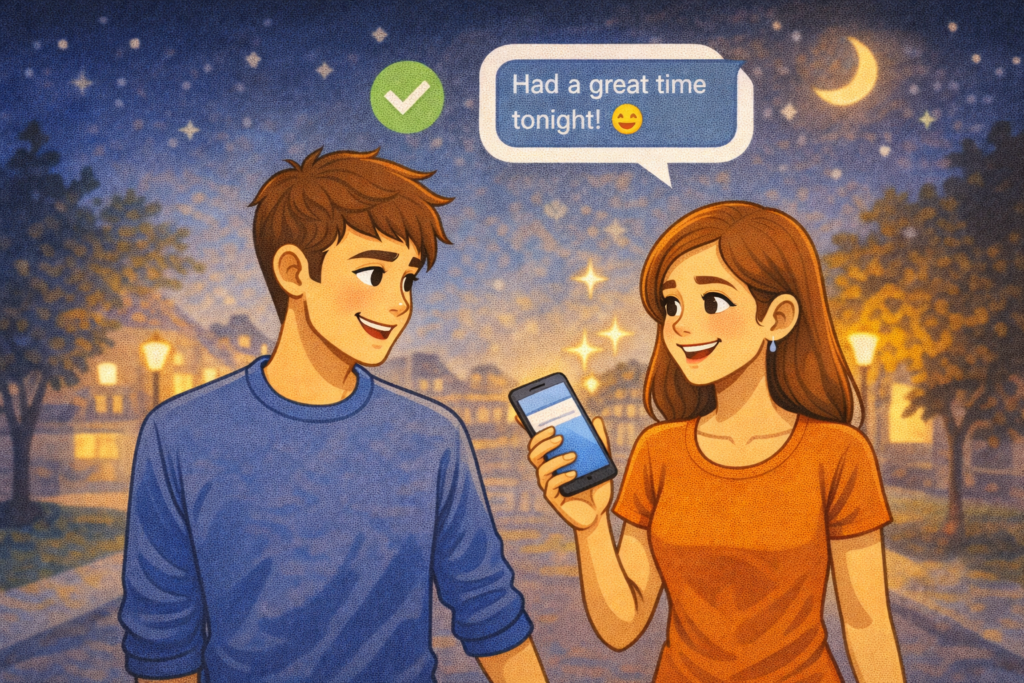
The date went well. Or at least you think it did. Now you’re staring at your phone wondering whether to text, what to say, how soon is too soon, and whether sending anything at all makes you look too keen.
This is one of the most universally overthought moments in modern dating — and the overthinking is almost always more damaging than whatever you eventually send.
This guide cuts through the noise. Should you text after a first date? Yes. When? How? What exactly do you say? And what do you do when they don’t respond?
All of it, answered directly.
Why Texting After a First Date Actually Matters
Before getting into timing and wording, it’s worth understanding why the post-date text matters as much as it does — because once you understand the function it serves, the content becomes much easier to figure out.
It Converts Potential Into Movement
A first date that ends without follow-up often dies not because of lack of interest but because of lack of momentum. Both people had a good time, neither is sure whether the other felt the same, and the connection dissipates in the absence of any signal to move it forward.
A follow-up text converts the ambiguity of a good evening into something concrete. It closes the loop on “did they like me?” and opens the door to “when are we seeing each other again?”
It Signals Emotional Maturity
In a dating culture where ghosting is common and follow-through is not guaranteed, a thoughtful follow-up message signals something about your character. Not desperation — directness. Not neediness — confidence. The ability to express genuine interest without game-playing is one of the most attractive qualities in early dating, and a well-timed post-date text demonstrates it clearly.
It Reduces Anxiety on Both Sides
The silence after a first date — for both the person waiting and the person deciding whether to reach out — produces a specific kind of low-grade anxiety that’s entirely unnecessary. A brief, genuine message eliminates it immediately and allows both people to move forward with clarity rather than uncertainty.
When to Send It: The Timing Question
Timing is the most debated aspect of post-date texting — and the debate is largely driven by outdated game-playing logic that doesn’t reflect how modern dating actually works.
The Simple Rule
Send it the same evening or the following morning. That’s it.
The same evening works if the date ended early enough that a message doesn’t feel like you went straight home and immediately picked up your phone. A message sent an hour after the date ends is entirely normal and increasingly common.
The following morning works as a universal default — warm enough to signal genuine interest, relaxed enough to avoid any sense of desperation.
What Doesn’t Work
Waiting three days to seem less interested — this doesn’t signal confidence. It signals game-playing, and most people in their late 20s and beyond recognize it and respond accordingly.
Waiting longer than 48 hours without reaching out — by this point, the momentum has dissipated and the message has to work harder to recreate what was already naturally there the night of the date.
Sending a message immediately as you’re leaving — this can work if it’s very light and feels genuinely spontaneous. It doesn’t work if it’s elaborate, heavy, or clearly composed in advance.
What to Actually Say: Templates That Work
The best post-date text is specific, warm, and forward-looking. Here’s how that translates across different situations.
If the Date Was Genuinely Good
This is the most common situation and the easiest to handle. You had a good time, you want to see them again, and you want to communicate both things without making it a bigger deal than it is.
Template:
“Really enjoyed tonight — especially [specific thing from the date]. Would love to do it again.”
The specific reference is the most important element. It proves you were actually present during the date, not just performing interest. “Especially the conversation about [topic]” or “especially that place you mentioned” is significantly better than a generic “had a great time.”
Variations:
“That was a really good evening. The [specific thing] conversation alone was worth it. Let’s do this again.”
“Just got home — that was genuinely fun. What are you doing this weekend?”
If You Want to Keep It Light
Sometimes the date was good but the vibe was casual rather than intense, and matching that tone is the right call.
“Had a good time tonight. Hope you got home okay.”
“That was fun — thanks for the recommendation on [thing they suggested]. Would check it out again sometime.”
These are warm without being heavy. They signal genuine enjoyment without creating pressure.
If There Was Humor or a Specific Moment
One of the most effective follow-up texts is one that references a specific funny or memorable moment from the date — because it shows you were genuinely present and it immediately recreates the positive emotional experience of the date in the reader’s mind.
“Still thinking about [funny thing that happened]. Genuinely did not see that coming.”
“I looked it up — I was wrong about [thing you debated]. I’ll accept my defeat gracefully.”
“[Inside reference from the date]. Okay, I had to say it.”
If You Want to Directly Suggest a Second Date
This is the most confident approach and the one most likely to produce a clear, fast outcome. It works best when the date clearly went well and the mutual interest was visible.
“I had a really good time tonight. Are you free [specific day]?”
“That was great — let’s do it again. What does your week look like?”
The specificity of “what does your week look like?” is important. It’s not a vague “we should do this again sometime” — it’s a genuine inquiry that invites a concrete answer.
If the Date Was Average and You’re Uncertain
Not every first date is obviously good or obviously poor. Sometimes you’re genuinely unsure how you feel. The right move in this case is still to send something — but something lighter that doesn’t commit you to more than you feel.
“Thanks for tonight — it was good to meet you properly.”
“That was a nice evening. I had a good time.”
These are honest without being either misleading or dismissive. They close the loop politely and give the other person information without overpromising.
If You Don’t Want a Second Date
This is the message most people avoid sending — which is why ghosting has become so common. But it’s also the message that most clearly demonstrates the character you bring to relationships.
A brief, kind message that acknowledges the date while being honest about your interest is always better than silence.
“It was really good to meet you — I just don’t feel the romantic connection I’m looking for. I hope you find what you’re looking for.”
“Thanks for tonight — you’re a genuinely interesting person, but I didn’t feel the chemistry on my end. Wishing you well.”
These messages are uncomfortable to send. They’re significantly kinder than disappearing. And if you’ve been on the other side of ghosting — most people have — you know exactly how much a brief honest message would have been appreciated.
For more on why ghosting has become so normalized and what it actually costs both people, our guide on what is ghosting and why do people do it covers the psychology in detail.
The Common Mistakes That Undermine Good Follow-Up Texts
Waiting Too Long and Then Over-Explaining
If you waited three days and now feel like you need to explain why, don’t. Just send a normal message as if the timing is fine. Drawing attention to the delay makes it more significant than it needs to be.
Writing an Essay
The follow-up text is a bridge, not a destination. It should be short enough to read in thirty seconds and specific enough to feel genuine. Three to four sentences maximum. If you’ve written eight sentences, cut it down.
Being Vague About Intentions
“Had fun” as a complete message — with nothing that indicates whether you’d like to see them again — puts all the interpretive work on the other person. If you want a second date, say so. If you’re unsure, send something that honestly reflects that uncertainty.
Over-Analyzing Their Response
How quickly they respond, the length of their reply, the specific words they used — this analysis produces more anxiety than information. What matters is whether they respond positively and whether they engage with your follow-up. Everything else is noise.
When They Don’t Respond
This happens — and it’s worth having a clear plan for it rather than leaving it to anxious improvisation.
If 24 hours have passed with no response: One brief follow-up is appropriate. Not a demand for an explanation — just a light second message that gives them an easy opportunity to respond if they want to.
“Just checking in — hope you’re well. No pressure either way.”
If they don’t respond to the follow-up: You have your answer. Leave it there. Sending a third message when two have already been ignored is not persistence — it’s a failure to read a clear signal.
If they respond but seem cooler than they were on the date: Don’t interpret individual message tone too literally. People have different energy at different times. Give it one or two more genuine exchanges before drawing conclusions about their interest level.
The Relationship Between Post-Date Texting and How the Date Itself Went
The follow-up text works best when it’s building on a date that was already genuinely good — which means that the quality of the date itself matters more than any specific post-date text formula.
If you’re consistently having first dates that feel positive in the moment but don’t produce second dates, the issue is probably not with your follow-up texts. It’s more likely with something that happened during the date itself.
Our guide on first date mistakes to avoid covers the specific behaviors that quietly undermine first date connection — many of which aren’t obvious in the moment but consistently affect whether things progress.
And for clarity on how to read the signals of how the date actually went — so you’re not sending a “can’t wait to see you again” text after an evening that felt more lukewarm than you registered — our guide on signs your first date went well gives you a reliable framework.
Texting After a First Date When You’re Nervous About Rejection
The most common reason people don’t send a post-date text — or send one so hedged and vague that it communicates almost nothing — is fear of rejection.
The follow-up text feels high-stakes because it makes your interest explicit in a way that the date itself doesn’t always require. On the date, you can express interest through presence and engagement. In the text, you’re making it clear.
A few things that help:
Separate the action from the outcome. Sending the text and getting a positive response are two different things. You control the first. You don’t control the second. Focus your energy on what you can actually influence.
Remember that genuine interest is attractive. The fear of seeming “too keen” produces the hedged, low-energy messages that are actually less attractive than direct, warm ones. Confidence is attractive. And confidence looks like: “I had a good time and I’d like to see you again.” That’s not desperate — it’s clear.
Accept that some non-responses are about them, not you. If someone doesn’t respond to a warm, genuine, appropriately timed follow-up message, the most likely explanation is something about their situation or interest level — not something catastrophically wrong with your message.
For broader guidance on building genuine confidence in dating contexts rather than the performed version that collapses under pressure, our guide on how to be more confident on dates covers the specific mental shifts that make the real difference.
What Happens Before the Date Matters Too
Post-date texting doesn’t happen in isolation — it’s part of a communication arc that starts from the first message and shapes how each subsequent interaction lands.
The amount you texted before the date affects the emotional stakes of the post-date message. Someone you’ve been texting intensively for two weeks will feel the silence of a delayed follow-up more acutely than someone you’ve only exchanged a few messages with.
For guidance on calibrating pre-date communication in a way that maintains interest and anticipation rather than burning it out before you’ve met, our guides on texting too much before a first date and how long you should text before a first date cover the specific calibration that works.
Final Thoughts
Should you text after a first date? Yes — same evening or the following morning, specific and warm, with enough clarity about your interest that the other person knows where they stand.
The game-playing around follow-up timing is outdated and counterproductive. The hedging around expressing genuine interest produces worse outcomes than the directness it’s trying to avoid. And the silence that comes from fear of rejection is almost always more damaging to your chances than whatever imperfect message you might have sent.
Send it. Be specific. Be genuin and clear about what you want. And then let the response — or the non-response — give you the information you need to decide what comes next.