
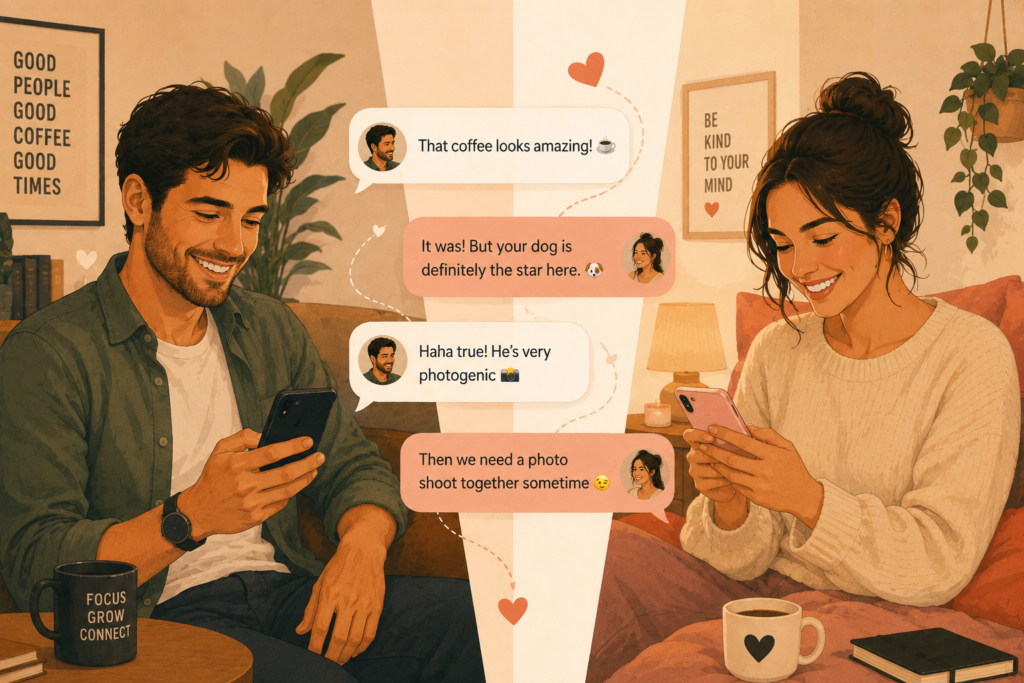
Flirting online is a skill — and like most skills, it’s learnable.
The problem is that most people approach online flirting the same way they approach online dating generally: with the wrong mental model. They treat it as a numbers game, send the same openers to everyone, and wonder why the conversations feel hollow or go nowhere.
The apps matter. But how you use them matters more. A great flirting approach on the wrong platform produces poor results. A poor approach on the right platform produces the same. This guide covers both — the best apps for online flirting in 2026 and the specific techniques that actually work on each one.
What Online Flirting Actually Is (And What It Isn’t)
Before getting into apps and techniques, it helps to be clear about what flirting actually does — because most people’s mental model of it is slightly off.
Flirting is not about being charming. It’s not about witty lines or elaborate openers. It’s not about performing confidence you don’t feel or deploying techniques designed to produce attraction mechanically.
Flirting is about creating a specific kind of emotional atmosphere — one of playful, mutual interest where both people feel genuinely seen and genuinely curious about each other. It’s the communication equivalent of leaning in.
The best online flirting does three things simultaneously:
It signals genuine interest — not in a heavy, declaring way, but in the lighter, more playful way that invites a response rather than demanding one.
It shows personality — specifically enough that the other person gets a sense of who you actually are, rather than a generic interaction that could be happening with anyone and creates an opening for reciprocation — by leaving space, asking something real, or making a gentle provocation that invites the other person to engage back.
Everything else — the specific words, the timing, the tone — is secondary to these three fundamentals.
Why Platform Choice Matters for Online Flirting
Not all dating apps create the same environment for flirting — and the platform you’re on significantly shapes what kind of flirting works.
Hinge wins for relationship-leaning flirting with prompt-driven openers, while Tinder still has the largest active user base and conversations skew shorter and faster. Bumble changes the dynamic entirely by requiring women to message first. OkCupid’s compatibility scores give you built-in conversation material before you’ve said a word.
Understanding these differences means you can calibrate your approach to the specific environment rather than using the same technique everywhere and getting inconsistent results.
The Best Apps for Online Flirting in 2026
1. Hinge — Best for Meaningful Flirting That Leads Somewhere
Hinge is the strongest platform for online flirting that has genuine depth — and it’s structured in a way that makes good flirting significantly easier than on swipe-based alternatives.
The prompt system is the key. Instead of opening a blank conversation, Hinge users like or comment on specific elements of a profile — a photo, a prompt answer, a specific detail. This means every flirtatious opening has a built-in anchor — something specific that the other person actually said or showed — which immediately makes it feel personal rather than generic.
Why it works for flirting: The prompt system removes the blank-page problem that kills most opening messages. You always have material to work with. And the relationship-focused user base means that flirting on Hinge tends to go somewhere rather than stalling at surface level.
Flirting approach on Hinge: Comment on something specific from their prompt with a genuine reaction plus a question or mild provocation. “Your answer about [prompt] made me laugh — is that actually true or are you just trying to sound interesting?” is better than any generic opener. It’s warm, slightly teasing, and invites a real response.
Best for: People who want flirting that develops into genuine connection. The prompt system rewards specificity and personality over volume.
For a full breakdown of everything Hinge offers, read our detailed Hinge review 2026.
2. Tinder — Best for High-Volume, Fast-Paced Flirting
Tinder still has the largest active user base of any flirting platform in 2026. Conversations skew shorter and faster, but the volume means options.
Tinder’s culture rewards a specific kind of flirting — quick, light, high-energy, and fast-moving toward something concrete. Extended slow-burn flirting that works well on Hinge tends to stall on Tinder, where the platform culture moves faster and attention spans are shorter.
Why it works for flirting: The volume of potential matches means you can find your rhythm quickly and learn fast what lands and what doesn’t. The lower-stakes culture also makes it easier to be playful without overthinking.
Flirting approach on Tinder: Your bio does more work here than on any other platform — because the conversation often starts from virtually nothing. A bio with a built-in flirtatious hook — a mild claim, a debate-starter, a slightly absurd statement — gives matches something to respond to before you’ve even said hello.
For opening messages, reference something specific from their profile if anything is available. If not, a playful question that shows personality works better than a generic greeting. “Your first photo is either hiking or you’re very convincingly pretending — which is it?” is better than “hey, how’s your week?”
For copy-paste openers organized by profile type, our guide on how to start a conversation on Tinder covers the full framework.
3. Bumble — Best for Women Who Want to Lead the Flirting
Bumble’s women-message-first mechanic changes the flirting dynamic in a specific and significant way: female users have both the responsibility and the opportunity to set the tone of the opening exchange.
This is actually an advantage for women who are comfortable with it — because the opening message is where tone is established, and having control over that tone means you can immediately signal the kind of interaction you’re looking for.
Why it works for flirting: The filtered inbox means you’re only flirting with people you’ve chosen to engage, rather than managing incoming volume. And the 24-hour window creates a natural urgency that keeps things moving rather than letting matches go cold.
Flirting approach on Bumble: Don’t waste the opening message on “hey” or “how’s your week.” You have the floor — use it. Reference something specific from their profile, make a playful observation, or ask a question that invites a real answer. “I noticed you listed [thing] in your bio — I have strong opinions about this. What’s your take?” is better than anything generic.
For detailed guidance on what actually makes Bumble different from Hinge as a flirting environment, our Bumble vs Hinge comparison covers everything.
4. OkCupid — Best for Flirting With Built-In Conversation Material
OkCupid’s question-based matching produces compatibility scores rooted in shared values, not just looks. The free tier limits visibility, but conversations tend to start deeper.
OkCupid gives you something no other major platform provides: detailed compatibility information before you’ve said a word. Knowing your match percentage and the specific dimensions where you align — or don’t — gives you immediate, specific material for the opening exchange.
Why it works for flirting: The compatibility scores create an instant, legitimate reason to engage beyond surface-level attraction. “I noticed we’re both high on openness but opposite on [dimension] — does that actually show up in how you approach things?” is a flirtatious opener that’s grounded in real information about both of you.
Flirting approach on OkCupid: Lead with the compatibility data when it’s interesting. Use the questions themselves as conversation material — “I saw your answer to [question] and I’d love to understand your reasoning” is both curious and subtly flirtatious.
Best for: People who prefer flirting that has substance from the first message, and who find purely surface-level openers uncomfortable.
5. Plenty of Fish — Best for Casual, Pressure-Free Flirting
Plenty of Fish makes it a breeze to chat and flirt with someone new without feeling pressured to rush things, providing icebreakers and search filters to help like-minded individuals connect easily.
POF has a larger and more diverse user base than most people realize — and its culture is generally more relaxed and low-pressure than Tinder or Hinge. For people who find the intensity of other platforms anxiety-inducing, POF’s more casual environment can actually be more conducive to natural, comfortable flirting.
Why it works for flirting: The lower-pressure culture means interactions feel less high-stakes, which tends to produce more natural and genuine exchanges. The free messaging system also means you’re not limited by like counts or subscription tiers in the same way.
Best for: People who want a more relaxed flirting environment without the competitive intensity of Tinder or the relationship pressure of Hinge.
6. Feeld — Best for Open-Minded Flirting
Feeld is the most honest flirting platform on the list — users state what they want, what they’re open to, and what’s off the table. It’s polyamorous, kink-friendly, queer-friendly, and judgment-light.
Feeld occupies a specific niche — it’s designed for people who want to be explicit about what they’re looking for and who want to engage with others who are equally clear. The culture of radical honesty about intentions and desires makes it a uniquely direct flirting environment.
Best for: People who value explicit clarity about intentions and who are looking for a judgment-free environment for more adventurous flirting.
Platform Comparison: Which App for Which Flirting Style
| Flirting Style | Best Platform |
|---|---|
| Playful, personality-driven, relationship-leaning | Hinge |
| Fast, high-volume, casual | Tinder |
| Women leading the conversation | Bumble |
| Values-based, substantive from the start | OkCupid |
| Relaxed, low-pressure | Plenty of Fish |
| Explicit and open-minded | Feeld |
The Techniques That Actually Work for Online Flirting
Platform aside, the techniques that produce genuine flirtatious connection are consistent across apps. Here’s what actually works.
Technique 1: Be Specific, Not Generic
The single biggest differentiator between flirting that lands and flirting that doesn’t is specificity.
Generic openers — “hey,” “you’re cute,” “how’s your week?” — give the other person nothing to work with and signal that you’re not really paying attention to who they are. Specific openers — ones that reference something real from their profile, ask about something they mentioned, or respond to a specific photo or prompt — signal genuine attention and give the conversation an immediate anchor.
Specificity applies to everything: the opener, the compliments, the questions you ask, the observations you make. The more specific you are, the more the other person feels actually seen rather than generically appreciated.
Technique 2: Use Playful Tension
The best online flirting creates a specific kind of energy — light tension between interest and uncertainty. This is what makes flirting fun rather than just pleasant.
Playful tension comes from: mild teasing (“I noticed you listed hiking as an interest — is that the aspirational version of yourself or do you actually go?”), gentle challenges (“that’s a bold opinion, I’m not sure I agree”), and questions that have a slightly provocative edge (“what’s the most wrong thing you’ve ever been completely right about?”).
The key word is “playful.” Tension that feels genuine and weighted — or that comes across as critical rather than teasing — kills the mood rather than creating it. The lightness is essential.
For more on what separates flirting from just being friendly — and how to read whether someone is flirting back — our guide on flirting vs being nice covers the distinction in detail.
Technique 3: Match Their Energy
One of the most important calibration skills in online flirting is reading the energy of the other person and matching it — rather than maintaining a fixed approach regardless of how they’re responding.
Someone who replies with short, playful messages is usually looking for light and fast-moving flirtation. A person who sends longer, more thoughtful responses is often inviting a deeper kind of conversation. When someone communicates through humor, they’re usually signaling that playful energy is welcome. And if a person speaks in a more sincere or earnest way, overly aggressive teasing may feel uncomfortable rather than attractive.
Mirroring energy — not mechanically, but genuinely — creates a sense of resonance that makes the other person feel understood and comfortable. Forcing a specific tone regardless of how they’re responding makes the interaction feel off-balance.
Technique 4: Ask Questions That Invite Real Answers
The questions you ask in online flirting reveal as much about you as they do about the other person — because questions signal what you find interesting and what kind of conversation you’re capable of having.
Questions that invite real, specific answers — “what’s something you’ve changed your mind about recently?” “what’s the best decision you’ve ever made on impulse?” “what’s a skill you have that would surprise people?” — create conditions for genuine exchange. They show intellectual curiosity, signal that you’re interested in who the person actually is, and give them an interesting question to engage with.
Questions that produce one-word answers — “do you like hiking?” “have you been to [place]?” — don’t.
Technique 5: Know When to Suggest Meeting
The natural endpoint of successful online flirting is moving from digital to in-person — and knowing when and how to make that suggestion is part of the skill.
The common mistake is waiting too long. Extended text-based flirting that never progresses to an actual meeting produces a specific kind of frustration — the connection feels real in the digital context but never gets tested in reality. Most connections that could have gone somewhere don’t — not because of incompatibility, but because nobody suggested meeting.
When the conversation is flowing well and genuine mutual interest is clear — usually after a few genuinely good exchanges — suggest something specific and light. “There’s a good coffee place near [area] — would you want to check it out this weekend?” is better than “we should meet up sometime.”
For the exact wording and timing that makes this transition natural rather than heavy, our guide on how to ask someone out online covers the full approach.
Online Flirting Mistakes That Kill the Vibe
Even with the right platform and the right approach, certain specific mistakes consistently undermine flirting that was going well.
Opening With a Compliment on Appearance
This is the most common opening mistake — and one of the least effective. Not because physical compliments are wrong, but because they’re the most generic possible thing you could say.
“You’re beautiful,” “gorgeous profile,” “love your smile” — these phrases appear in thousands of opening messages and signal nothing about you except that you found the person physically attractive. Which they already knew.
A compliment that references something specific — “your answer about [prompt] is the most accurate thing I’ve read on this app” — works significantly better because it’s both a compliment and evidence that you were paying attention.
Over-Explaining Yourself
Anxiety in online flirting often produces over-explanation — messages that justify themselves, that add too much context, that explain the joke. “I’m asking because I’m also into this” or “sorry if that came across wrong, I meant it as a compliment.”
Over-explanation removes the lightness that makes flirting fun. Let the message stand. If it was good, it didn’t need a footnote.
Moving Too Fast Emotionally
There’s a version of online flirting that escalates too quickly — intense compliments, deep emotional questions, expressions of strong feeling — before any real foundation has been established.
This feels like too much weight for the early stage of a connection and tends to produce withdrawal rather than reciprocation. Let the intensity develop naturally rather than trying to accelerate it.
Ignoring What They Say
The most common conversation killer in online flirting is asking a question, receiving an answer, and then moving to a completely different topic rather than following up on what they said.
Genuine follow-up — “that’s interesting, what made you decide that?” “wait, tell me more about that” — signals that you’re actually listening and actually interested. It’s one of the most attractive things you can demonstrate in a text-based interaction.
Flirting Confidence: How to Build It
One reason online flirting feels difficult for many people is that confidence in this context isn’t about knowing the right lines — it’s about being comfortable enough with potential rejection that you can be genuinely playful without over-monitoring every message for how it might land.
That comfort comes from experience — from sending messages, seeing what happens, adjusting, and gradually building evidence that you’re capable of creating interesting interactions.
It also comes from remembering what flirting actually is: an invitation, not a demand. When you send a playful message, you’re offering the other person an opportunity to engage in an interesting exchange. If they don’t take it, that’s information about compatibility or timing — not a verdict on your worth.
For a deeper look at what builds genuine confidence in dating contexts — rather than performed confidence that collapses under pressure — our guide on how to be more confident on dates covers the specific habits and mental shifts that make the real difference.
From Online Flirting to Real-Life Chemistry
The best online flirting creates enough genuine connection that the transition to in-person feels natural and anticipated rather than uncertain and high-stakes.
But it’s worth remembering that online flirting and in-person chemistry are related but different skills. Some people who are fluid and engaging in text become stilted in person. Others who are average texters come alive face-to-face.
The goal of online flirting is not to be maximally impressive in the digital medium — it’s to establish enough genuine mutual interest that meeting in person makes sense. The real flirting happens there.
For the specific techniques that create natural chemistry in real-life contexts, our guide on how to create instant chemistry without apps covers exactly how real-life attraction works and how to build it deliberately.
Find the Right Flirting Platform for Your Location
💡 Not sure which flirting app has the most active users where you are? This tool matches you with the top-rated dating platform available in your location — updated for 2026. Find Your Best Flirting App →
Final Thoughts
The best app for online flirting depends on what kind of flirting you’re looking for — Hinge for personality-driven connection that goes somewhere, Tinder for volume and pace, Bumble for female-led interaction, OkCupid for substantive exchanges from the start.
But the platform is less important than the approach. Specific over generic. Playful tension over heavy intensity. Genuine curiosity over performance. Questions that invite real answers over ones that produce one-word responses. And the willingness to suggest meeting before the digital connection runs its natural course.
Online flirting is a skill that gets better with practice — not because you memorize better lines, but because you develop a clearer sense of your own voice, a better read of other people’s energy, and a more comfortable relationship with the uncertainty that makes flirting playful rather than stressful.
The right platform, the right approach, and the willingness to actually try — that’s the complete formula.