
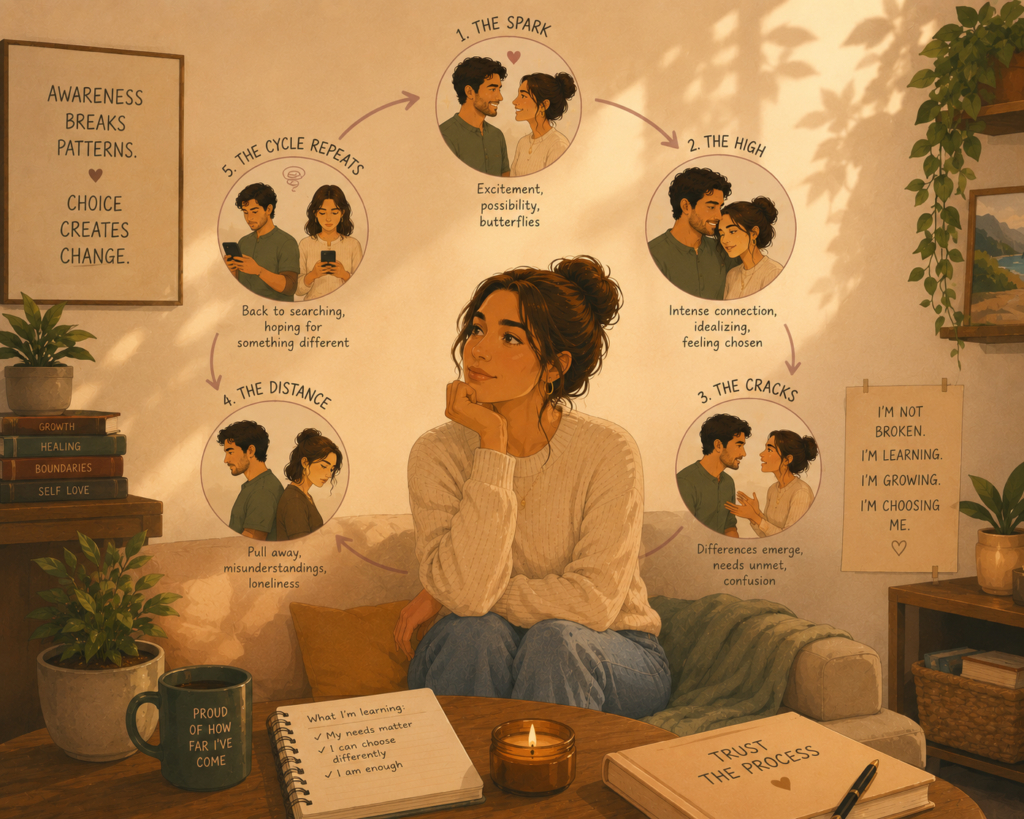
“Why do I keep attracting the wrong person?” is one of the most searched questions in relationship psychology — and one of the most honestly answered questions in this guide.
If you’ve found yourself repeatedly drawn to partners who are emotionally unavailable, unreliable, or fundamentally incompatible with what you say you want — and you can’t quite understand why it keeps happening — the answer is almost never about bad luck or a shallow dating pool.
It’s about patterns. Specifically, the unconscious patterns that drive attraction, selection, and behavior in ways that consistently produce the same outcome regardless of who the specific person is.
This guide covers the real reasons you keep attracting the wrong person — the psychology behind the pattern, what maintains it, and what actually changes it.
Why “Why Do I Keep Attracting the Wrong Person?” Is the Wrong Question
The question itself contains a subtle but significant misdirection — and noticing it is the first step toward changing the pattern.
“Attracting” implies passivity. It suggests that wrong people are drawn to you magnetically, through some external force beyond your control, and that your role in the pattern is to be a victim of it.
The more accurate question is: “Why do I keep choosing the wrong person?” — or even more precisely: “Why do I keep finding the wrong person attractive while the right person fails to hold my interest?”
This reframe is not about blame. It’s about agency. Patterns that are created through unconscious choices can be changed through more conscious ones. Patterns that are simply happening to you cannot.
According to research published by Psychology Today, the experience of repeated attraction to incompatible partners is almost always driven by a combination of attachment patterns, unconscious familiarity seeking, and selective attention — all of which operate below conscious awareness but are entirely modifiable through understanding and deliberate practice.
The Real Reasons You Keep Attracting the Wrong Person
1. You’re Drawn to Familiar, Not Compatible
The most fundamental reason people keep attracting the wrong person is that attraction is shaped by familiarity — specifically, by the emotional dynamics of early relationships with caregivers.
The brain builds its template for “connection” based on early experience. If your early experiences of love involved inconsistency, emotional unavailability, or the need to work hard for approval — your nervous system learned to associate those qualities with connection. They feel like home, even when they’re damaging.
This means that emotionally unavailable people don’t just feel familiar — they feel right. They feel like love. The person who is consistently available, straightforwardly interested, and emotionally present may feel boring or lacking in chemistry — not because they actually lack these qualities, but because their consistency doesn’t match the familiar template.
Research from the Journal of Personality and Social Psychology shows that people reliably rate partners with characteristics similar to their primary caregivers as more attractive — even when those characteristics were sources of pain in childhood.
2. You Confuse Anxiety for Chemistry
This is one of the most important distinctions in understanding why you keep attracting the wrong person — and one of the least discussed.
The physiological experience of anxiety and the physiological experience of attraction are similar enough that the brain can misidentify one as the other. Elevated heart rate, heightened attention, preoccupation with another person, the feeling of being slightly off-balance — these are symptoms of both anxiety and romantic attraction.
People who grew up in unpredictable emotional environments often learned to equate that activated, uncertain, slightly anxious feeling with connection. As adults, a relationship that doesn’t produce that feeling — one that is calm, predictable, and secure — can feel flat or unexciting, even when it’s everything they say they want.
The person who produces anxiety — who is intermittently available, slightly unpredictable, difficult to fully read — produces the feeling that has been coded as attraction. The person who produces ease and security produces a feeling that has been coded as boring.
Understanding this distinction is essential. What feels like chemistry is sometimes chemistry. And sometimes it’s anxiety you’ve learned to misread.
3. You Have an Anxious Attachment Style
Anxious attachment — developed through inconsistent caregiving — produces a specific relationship pattern that consistently attracts the wrong person.
Anxiously attached people are most strongly drawn to avoidantly attached people — not in spite of the mismatch, but because of it. The avoidant’s intermittent warmth and frequent withdrawal activate exactly the attachment system that anxious attachment has sensitized: the preoccupation with connection, the heightened attentiveness to signals of interest or withdrawal, the need to secure and maintain closeness.
This dynamic feels intensely alive — because for the anxiously attached person, it is. Every warm moment is hard-won and therefore feels meaningful. Every withdrawal is threatening and therefore demands resolution.
The problem is that this dynamic is also profoundly destabilizing — and it consistently produces the wrong person, because the right person (a securely attached partner who is consistently available and warm) doesn’t activate the same intensity.
For a complete framework on how attachment styles drive relationship patterns, our guide on attachment styles in relationships covers all three patterns and what each one means for who you’re drawn to.
4. You’re Ignoring Early Signs Because the Chemistry Is Strong
Early chemistry is a notoriously unreliable guide to compatibility. The intensity of early attraction — the feeling that this person is different, that this connection is special, that something real is happening — can suppress the normal information-processing that would flag concerning patterns.
When the chemistry is strong, you explain away the red flags. “They’re emotionally unavailable because they’ve been hurt before.” “They’re inconsistent because they’re busy.” “They pull away because they’re scared — they’ll open up with time.”
These explanations may occasionally be true. More often, they’re the stories you tell yourself because the alternative — recognizing that someone who produces this level of feeling isn’t actually available for the relationship you want — is too disappointing to face early.
Our guide on red flags on a first date covers the specific warning signs that appear early and are most commonly rationalized away by strong chemistry — a useful calibration tool for anyone who recognizes this pattern.
5. You Mistake Intensity for Depth
Another common reason people keep attracting the wrong person is confusing the intensity of a connection with the quality of it.
Intensity — the consuming, preoccupying, slightly destabilizing feeling of being drawn to someone — is not the same as depth, compatibility, or genuine mutual investment. It’s often the opposite. The connections that produce the most intense early feeling are frequently the ones that are least stable, least equitable, and least compatible with long-term satisfaction.
Depth — genuine mutual knowledge, shared values, consistent care, the kind of connection that deepens through ordinary time together — tends to develop more quietly and feel less immediately dramatic. But it’s significantly more predictive of genuine long-term connection.
The pattern of confusing intensity for depth is one of the most common reasons people keep attracting the wrong person — because the “right” person often doesn’t feel intense enough at first.
6. You Believe, at Some Level, That You Don’t Deserve Better
This is one of the most uncomfortable reasons — and one of the most important.
Many people who keep attracting the wrong person carry an underlying belief — often not fully conscious — that they are not worthy of consistent, equitable, genuinely caring love. This belief, formed through early experience, shapes both who they’re attracted to and how they behave in relationships.
If you believe you’re not enough, you’ll find the confident, consistently available partner threatening — because their investment seems to exceed what you deserve, which creates dissonance. The person who keeps you slightly uncertain, who doesn’t fully show up, who requires constant effort to maintain — they confirm the belief rather than challenging it.
This is not self-awareness — it’s self-confirmation bias. And it operates largely outside of consciousness, which makes it one of the harder patterns to address without deliberate, honest self-examination or professional support.
7. You’re Attracted to Potential Rather Than Reality
Falling in love with someone’s potential — with who they could be, who they’ve shown glimpses of being, who you believe they’re capable of becoming — rather than who they actually are consistently is one of the most reliable paths to repeatedly attracting the wrong person.
Potential is compelling because it combines genuine observed qualities with the imagination’s ability to fill in everything else optimistically. The person who is occasionally brilliant, occasionally warm, occasionally fully present — but inconsistently so — provides enough material for the imagination to construct an idealized partner.
The actual partner — the consistent, daily, unedited version — is the wrong person. The imagined potential — which may never materialize — is the person you’re actually attracted to.
For more on this specific dynamic, our guide on how to tell the difference between infatuation and real feelings covers exactly how to distinguish between projected potential and genuine compatibility.
8. You Haven’t Processed Previous Relationship Pain
Unprocessed pain from previous relationships has a way of shaping current ones — not through deliberate choice, but through the unconscious ways that unresolved emotional material influences behavior and perception.
Someone who was hurt by a dishonest partner may become hypervigilant in ways that produce self-fulfilling dynamics. Someone who was abandoned may unconsciously choose partners who are likely to leave, replaying the original wound in an attempt at resolution. Someone who was controlled may choose partners who seem safe through their emotional distance — even when that distance is damaging in a different way.
The pattern of attracting the wrong person is often, at its root, a pattern of unconsciously trying to resolve past pain through present relationships — which consistently produces the same outcome because the mechanism is based on old material rather than present reality.
For a framework on identifying and interrupting the psychological patterns that drive recurring relationship dynamics, our guide on psychological patterns in relationships covers exactly why these patterns repeat and what actually changes them.
What Actually Changes the Pattern
Understanding why you keep attracting the wrong person is necessary but not sufficient. What actually changes the pattern is different — and more demanding — than understanding alone.
1. Develop Genuine Curiosity About the Pattern Rather Than Shame
The first practical shift is approaching the pattern with curiosity rather than self-judgment. “Why do I keep doing this?” asked with genuine interest rather than self-recrimination opens the pattern to examination. Asked with shame, it closes it.
Shame is not a change mechanism. It’s a protection from the vulnerability of honest self-examination. What produces change is the willingness to look honestly at what’s happening and why — without making the pattern itself evidence of your fundamental inadequacy.
2. Expand Your Definition of Attraction
If the pattern is consistently producing the wrong outcomes, the definition of attraction that’s driving it needs to be examined and deliberately expanded.
This means paying genuine attention to people who produce feelings of ease, warmth, and security — rather than only to people who produce intensity and uncertainty. Not because ease is automatically right, but because the people you’ve been systematically overlooking may include exactly the kind of connection you say you want.
This doesn’t mean forcing attraction to people you genuinely don’t find appealing. It means noticing whether your filter for “interesting” systematically excludes the people who would be genuinely good for you.
3. Slow Down the Selection Process
One of the most practical interventions in changing who you attract is slowing down the early selection process — deliberately investing more time before high emotional investment rather than less.
The patterns that drive attraction to the wrong person operate fastest when attraction is immediate and intense — because that’s when unconscious familiarity-seeking and anxiety-chemistry confusion are most active.
Investing in getting to know someone gradually — before the intensity peaks — provides more information and more time for the cognitive processes that are more aligned with your actual values and needs.
For specific guidance on how to use dating apps more intentionally rather than reactively, our guide on best dating app strategy for 2026 covers the practical approach that produces better outcomes through more considered engagement.
4. Work With a Therapist
For patterns that are deeply rooted — particularly those connected to early attachment experiences or significant relationship trauma — working with a therapist who specializes in relationship patterns is the most reliable path to genuine change.
This is not a concession that something is fundamentally wrong with you. It’s a recognition that some patterns are complex enough to require more structured support than self-awareness alone provides. According to the American Psychological Association, attachment-based therapy and schema therapy both show strong evidence for modifying the deep relational patterns that drive repeated attraction to incompatible partners.
5. Be Honest About What “Right” Actually Means for You
One final question worth sitting with honestly: are you sure you actually want what you say you want?
Some people say they want a stable, committed, loving relationship — but their behavior consistently suggests that what they actually want (or are prepared for) is something less defined, less demanding, or less vulnerable.
This is not a criticism. It’s a genuinely useful distinction. If what you actually want at this point in your life is something more casual and less committed, acknowledging that honestly — rather than pursuing serious relationships while unconsciously sabotaging them — produces significantly less pain for everyone involved.
For more on recognizing genuine emotional readiness for a relationship versus performing readiness that isn’t quite there, our guide on emotional availability and how to recognize if someone is ready for love covers exactly this distinction.
Final Thoughts
Why do you keep attracting the wrong person? Almost certainly because of patterns — in what feels familiar, in how you read attraction, in the selection processes that operate largely outside conscious awareness — rather than because of bad luck or an inadequate dating pool.
The eight reasons in this guide — familiarity seeking, confusing anxiety for chemistry, attachment patterns, ignoring early signs, confusing intensity for depth, underlying beliefs about worth, attraction to potential, and unprocessed pain — are not a verdict on your character. They’re patterns. Patterns that developed for understandable reasons, that have been maintained by consistent experience, and that can be genuinely changed through understanding, deliberate practice, and sometimes professional support.
The person who is actually right for you exists. Finding them requires not just looking in the right places — but showing up to the search with enough self-knowledge that you can recognize them when they appear.