
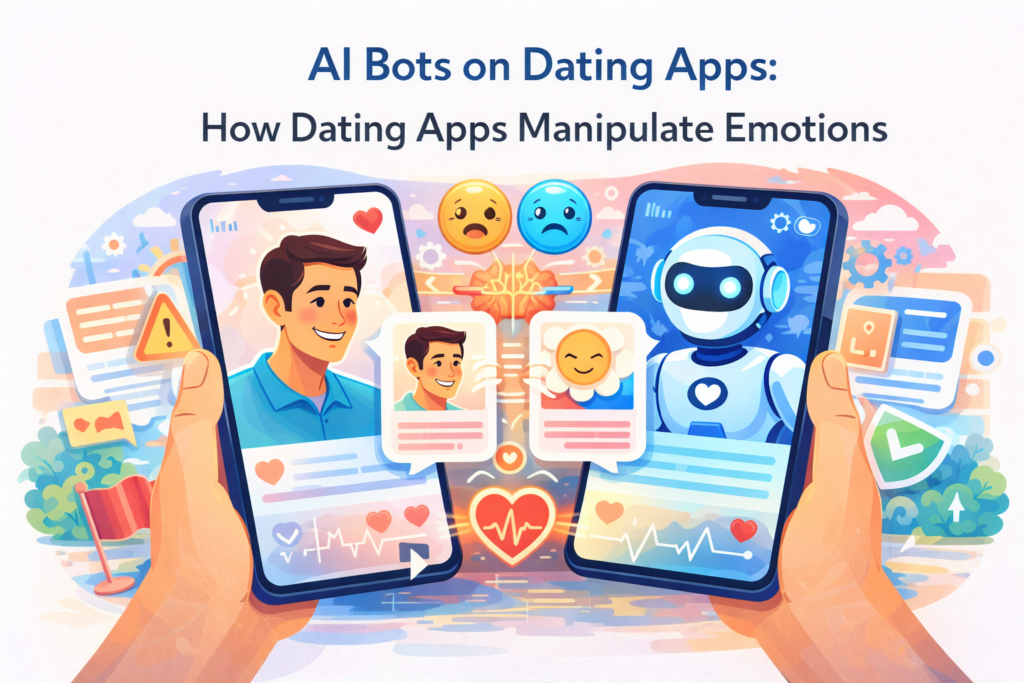
AI bots on dating apps are becoming increasingly common in 2026, changing how people experience online dating. As dating platforms rely more on artificial intelligence, many users are no longer sure whether they are chatting with a real person or an AI-driven profile. Understanding how AI bots on dating apps work is essential for protecting your emotions and building real connections online.
This raises an uncomfortable but increasingly common question:
Are dating apps using AI to manipulate your emotions?
The short answer is not entirely simple. Artificial intelligence plays a major role in modern dating platforms, but the way it is used can influence how people feel, behave, and form emotional attachments. Sometimes this influence is subtle. Other times, it directly affects emotional well-being, confidence, and decision-making.
This article takes a deep look at how AI works inside dating apps, how emotional manipulation can occur (intentionally or not), and how users can protect themselves while still finding genuine connections online.
How AI Became the Invisible Engine of Modern Dating
Artificial intelligence is no longer a futuristic concept in dating apps. It is deeply embedded in almost every part of the experience.
AI is commonly used to:
- rank profiles
- predict compatibility
- personalize matches
- optimize engagement
- analyze user behavior
- control what and who you see
On the surface, this sounds helpful. After all, better matches should lead to better relationships. However, AI systems are usually optimized for engagement, not emotional health.
This distinction is critical.
Dating apps are businesses. Their success is measured by:
- time spent in the app
- number of interactions
- frequency of returns
- subscription upgrades
As a result, AI systems are trained to keep users emotionally invested — sometimes at the cost of emotional clarity.
Emotional Engagement vs Emotional Manipulation
Not all emotional influence is manipulation. Human interaction itself is emotional by nature. However, manipulation occurs when systems are designed to:
- trigger emotional highs and lows
- create uncertainty intentionally
- exploit vulnerability
- reward addictive behavior patterns
Many users report similar emotional cycles:
- excitement after a good match
- anxiety during silence
- relief when a message arrives
- disappointment when interest fades
- renewed hope with the next match
AI doesn’t create these emotions, but it can amplify and control their timing.
How Dating App Algorithms Shape Your Emotional State
The Illusion of Scarcity and Abundance
One of the most powerful psychological tools AI uses is controlling perception.
The presence of AI bots on dating apps is closely connected to how modern algorithms optimize user engagement.
At times, apps show many attractive profiles in a short period. This creates excitement and optimism. Later, visibility drops, and matches become scarce. The emotional contrast encourages users to swipe more, message more, and stay engaged longer.
This pattern mirrors classic reward-conditioning systems.
Delayed Rewards and Emotional Hooks
AI systems often delay responses intentionally. This doesn’t mean a specific person is ignoring you — it means your profile visibility may be temporarily reduced.
Delayed rewards increase emotional attachment. The uncertainty makes every match feel more meaningful, even when the connection itself is shallow.
Why Dating Apps Feel More Addictive Than Before
Addiction doesn’t always look dramatic. In dating apps, it often appears as:
- checking messages compulsively
- thinking about matches throughout the day
- feeling validated by attention
- feeling anxious without it
AI models track which interactions keep you engaged and subtly adjust your experience accordingly.
This is why many users experience dating burnout rather than satisfaction.
If this sounds familiar, you may find this related article helpful:
Tips if feelings go out in a relationship
How AI Bots on Dating Apps Influence Emotional Engagement
This is where the conversation becomes nuanced.
Most dating platforms will say they do not manipulate emotions — and technically, they are correct. They optimize for engagement, not emotional outcomes.
However, engagement-driven systems can still cause emotional manipulation as a side effect.
Psychologists and technology analysts have raised concerns about how algorithmic systems influence human behavior. According to research discussed by Psychology Today, emotionally unpredictable systems can increase attachment and anxiety in interpersonal contexts.
External reference: psychologytoday.com
AI and the Creation of “Perfect” Conversations
Another emerging issue is AI-assisted messaging.
Some platforms allow:
- AI-generated icebreakers
- message suggestions
- automated replies
While these tools help shy or inexperienced users, they also blur authenticity. Conversations may feel emotionally satisfying but lack genuine intention.
This can lead to confusion when users meet in real life or expect emotional depth that was algorithmically generated.
To understand how real attraction develops through communication, this article provides useful insight:
The Evolution of Online Flirting
Emotional Manipulation Through Profile Ranking
AI decides:
- who sees you
- how often
- in what context
This means emotional outcomes are not random.
Users who fit popular engagement patterns are shown more often. Others are deprioritized. This affects self-esteem, confidence, and perceived attractiveness.
Many AI bots on dating apps are designed to mimic emotional intelligence and consistent attention.
Over time, users may internalize algorithmic feedback as personal value judgments.
The Psychological Impact of Repeated Micro-Rejections
Even without explicit rejection, being ignored or deprioritized creates emotional stress.
Repeated micro-rejections can lead to:
- lowered self-worth
- emotional withdrawal
- cynicism
- distrust toward future partners
This is especially common among users who rely heavily on dating apps as their primary way to meet people.
The Role of AI in Emotional Attachment to Non-Human Profiles
Some dating platforms now experiment with AI-generated profiles or AI-driven conversations.
While not always malicious, these systems can:
- respond perfectly
- mirror emotional needs
- never reject or disappear
This creates a false sense of emotional safety.
For users experiencing loneliness, burnout, or insecurity, emotional attachment to artificial profiles can feel deeply real — until it collapses.
How Some Platforms Use AI More Responsibly
Not all AI usage is harmful.
Some platforms use AI only to:
- filter incompatible profiles
- reduce spam
- improve matching relevance
- surface people nearby
In these cases, AI acts as a support tool, not a psychological lever.
For example, some dating sites focus on introducing users to real people located nearby and use AI solely to prioritize relevant profiles — without endless swiping or emotional gamification.
In these environments, conversations tend to feel calmer and more intentional. Emotional pacing remains natural, and users feel more in control of the process.
Here you can check out other AI technologies that are useful for online dating! Check IT!
Why AI Bots on Dating Apps Feel Emotionally Convincing
Here are key warning signs:
- extreme emotional highs followed by silence
- feeling anxious without opening the app
- equating matches with self-worth
- staying despite repeated dissatisfaction
If an app consistently makes you feel emotionally unsettled rather than hopeful, it’s worth re-evaluating how and why you’re using it.
How to Protect Yourself Emotionally While Dating Online
Slow Down Emotional Investment
AI thrives on speed. Slowing emotional attachment protects clarity.
Diversify How You Meet People
Relying exclusively on dating apps increases vulnerability to algorithmic influence.
Focus on Real Communication
Understanding emotional availability matters more than perfect conversations.
Emotional Availability in Online Dating
Choose Platforms That Reduce Noise
Less swiping, fewer artificial rewards, and clearer intentions lead to healthier experiences.
Learning how to recognize AI bots on dating apps is now an essential online dating skill.
What Research and Experts Say
Technology analysts from MIT Technology Review have discussed the ethical challenges of emotionally responsive AI systems, especially in personal contexts.
External reference: technologyreview.com
Their findings suggest that transparency and user education are essential as AI becomes more emotionally sophisticated.
Is the Future of Dating Human or Algorithmic?
AI will continue to shape how people meet. However, emotional connection still requires:
- vulnerability
- honesty
- mutual intention
Technology can assist introductions, but it cannot replace genuine human presence.
Understanding how AI influences emotions allows users to make informed choices — rather than becoming passive participants in engagement-driven systems.
Final Thoughts: Awareness Is the New Dating Skill
Dating apps are not inherently evil, nor is AI inherently manipulative. The problem arises when emotional influence goes unnoticed.
By understanding how AI systems work, recognizing emotional patterns, and choosing environments aligned with real connection, users can reclaim control over their dating experience.
While AI bots on dating apps will continue to evolve, real relationships still depend on human honesty and intention.
Real relationships grow from clarity, not confusion.
Frequently Asked Questions (FAQ)
Are dating apps really using AI to manipulate emotions?
Dating apps primarily use AI to increase user engagement, not to directly manipulate emotions. However, because engagement-driven algorithms influence visibility, timing, and interaction patterns, they can unintentionally create emotional highs and lows. Over time, this may feel like emotional manipulation, especially for users who rely heavily on apps for connection.
How does AI influence emotional attachment in online dating?
AI systems optimize when and how users interact, often rewarding behaviors that keep people emotionally invested. Features like delayed matches, selective visibility, and personalized suggestions can increase anticipation and attachment, even when the emotional connection is not mutual or real.
Is emotional manipulation intentional or accidental?
In most cases, it is a side effect rather than a deliberate strategy. Dating apps aim to maximize time spent on the platform, and emotional engagement is one of the strongest drivers of that goal. However, the emotional impact on users is very real, regardless of intent.
Can AI-generated messages feel more emotionally satisfying than real ones?
Yes. AI-generated or AI-assisted messages are often polite, attentive, and emotionally validating. This can make conversations feel smoother and more supportive than interactions with real people, who are naturally inconsistent, distracted, or emotionally guarded.
How can users protect themselves from emotional manipulation on dating apps?
The most effective strategies include slowing down emotional investment, avoiding platforms that rely heavily on gamification, focusing on real-world interaction, and choosing dating environments that prioritize clarity over constant stimulation.
Are all dating apps emotionally manipulative?
No. Some platforms use AI responsibly — for example, to filter irrelevant profiles, reduce spam, or highlight nearby matches. These systems support the dating process rather than emotionally controlling it. The key difference lies in whether AI is used to guide connection or to maximize engagement at any cost.
Does AI make online dating less authentic?
AI can reduce authenticity when it replaces genuine communication or creates artificial emotional experiences. However, when used transparently and responsibly, AI can also improve matching quality and reduce frustration.
Will AI manipulation become worse in the future?
As AI becomes more emotionally intelligent, the potential for emotional influence will increase. This makes awareness, transparency, and user education increasingly important. The future of healthy online dating depends on how responsibly these technologies are used.
Should I stop using dating apps because of AI?
Not necessarily. Dating apps can still be useful tools when used intentionally. The key is understanding how they work, recognizing emotional patterns, and choosing platforms that align with your relationship goals rather than exploiting emotional vulnerability.
What matters more than technology in dating?
Emotional availability, communication, and intention matter far more than algorithms. While AI can introduce people, only real human connection can sustain a meaningful relationship.