
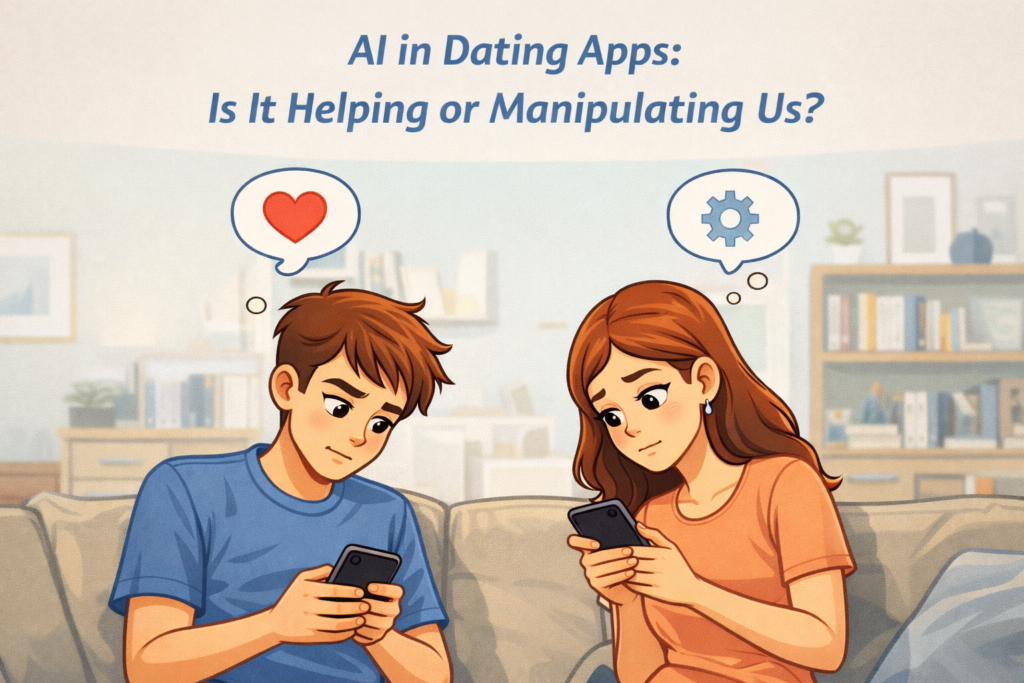
Artificial intelligence is now deeply embedded in modern dating apps. From who you see in your feed to which matches feel “perfectly timed,” AI quietly shapes almost every part of the dating experience. But an important question remains: is AI actually helping us find better connections — or is it subtly manipulating our emotions and behavior?
This article explores how AI works in dating apps, where it genuinely helps users, where it crosses ethical lines, and what this means for the future of dating.
Psychologists have long studied how digital environments influence human behavior, motivation, and emotional responses. Research in behavioral science shows that variable rewards and unpredictable feedback can strongly shape decision-making patterns — which is why modern dating app design has become such an important topic in psychology.
👉 Apa.org
How AI Is Used in Modern Dating Apps
Most dating apps today rely on AI-driven systems to manage massive amounts of user data. These systems analyze behavior patterns, preferences, and engagement signals to optimize the app experience.
AI is commonly used for:
- match recommendations
- profile ranking and visibility
- message prompts and suggestions
- spam and scam detection
- content moderation
Popular platforms like Tinder, Bumble, and Hinge all use machine learning models to refine how users interact with each other.
At its best, AI reduces noise and helps people connect more efficiently. At its worst, it can distort reality.
How AI Helps Users in Dating Apps
Let’s start with the positive side.
Better Matching at Scale
Without AI, dating apps would struggle to function at all. Algorithms help narrow down millions of potential profiles into a manageable set of matches based on:
- location
- preferences
- past interactions
- compatibility indicators
This saves time and reduces the randomness of early online dating.
Safety and Moderation
AI plays a crucial role in detecting:
- fake profiles
- bots
- scammers
- abusive messages
Pattern recognition allows apps to remove harmful users faster than human moderators alone could.
This is one of the most clearly beneficial uses of AI in dating.
Improved User Experience
Some AI features genuinely help users:
- suggesting conversation starters
- highlighting compatible interests
- learning what type of profiles you engage with
When used transparently, these tools can reduce friction and dating anxiety.
Where AI Starts to Feel Manipulative
The ethical concerns begin when AI is optimized not for healthy relationships, but for maximum engagement.
Engagement Over Outcomes
Most dating apps are businesses. Their success depends on:
- time spent in the app
- daily active users
- subscription upgrades
AI systems are often trained to maximize these metrics — not necessarily to help users leave the app in a relationship.
This creates a conflict of interest.
Variable Reward Loops
AI frequently uses principles similar to social media algorithms:
- inconsistent match quality
- unpredictable attention
- delayed gratification
This creates a psychological loop similar to gambling mechanics, where users keep swiping “just one more time.”
Over time, this can increase:
- dating fatigue
- emotional burnout
- dependency on the app
Artificial Scarcity and Visibility Control
Some users notice patterns like:
- sudden drops in matches
- improved results after inactivity
- better visibility after subscription offers
While companies rarely confirm these mechanisms, AI-controlled visibility strongly influences perceived desirability and self-worth.
This raises serious questions about emotional manipulation.
Are We Falling for AI-Generated Chemistry?
Another growing concern is synthetic compatibility.
AI doesn’t understand emotional depth — it predicts behavior. That means:
- matches may feel exciting but shallow
- conversations may be optimized for engagement, not connection
- “chemistry” can be algorithmically amplified
This can lead to repeated short-term interactions that feel intense but go nowhere.
Many users report matching often, chatting frequently, yet rarely forming meaningful relationships.
AI, Loneliness, and Emotional Detachment
Ironically, apps designed to connect people can increase feelings of isolation.
When AI:
- constantly presents better “options”
- encourages comparison
- keeps users in evaluation mode
it becomes harder to emotionally invest in one person.
Dating turns into browsing — and people turn into profiles.
The Rise of AI Bots and Synthetic Users
Another emerging issue is the presence of AI-generated profiles and chatbots.
Some platforms experiment with:
- AI-powered conversation assistants
- automated engagement profiles
- synthetic personalities
While these features are often framed as “support tools,” they blur the line between real and artificial interaction.
This raises ethical questions about transparency and consent.
What is an AI bot in dating apps?
One growing concern is the rise of AI-powered profiles and bots that can imitate real conversations surprisingly well. Many users don’t even realize they might be chatting with automated systems designed to keep engagement high. If you want to understand how to recognize these situations, this guide explains the warning signs in more detail:
👉 How to Know If You’re Chatting With an AI
The debate becomes more complex when algorithms are optimized mainly for engagement rather than real relationship outcomes. Some experts argue that certain design choices may influence emotions more than users realize. We explored this topic deeper in a separate analysis about emotional manipulation in dating platforms:
Are Dating Apps Using AI to Manipulate Your Emotions?
Can AI Be Used Ethically in Dating Apps?
Yes — but only with clear boundaries.
Ethical AI in dating would prioritize:
- user well-being over engagement metrics
- transparency in how matches are ranked
- limits on psychological manipulation
- tools that encourage real-world connection
Unfortunately, these goals don’t always align with profit-driven models.
How Users Can Protect Themselves
You don’t need to quit dating apps — but awareness matters.
Practical Tips:
- don’t equate matches with self-worth
- take breaks to avoid burnout
- focus on moving conversations offline
- be skeptical of “perfect” algorithmic matches
Understanding how AI works reduces its emotional power over you.
The Future of AI in Dating
AI in dating is not going away. In fact, it will likely become more sophisticated.
The key question is not whether AI will shape dating — but who it will serve:
- users seeking real connection
- or platforms seeking endless engagement
The answer depends on regulation, transparency, and user awareness.
Recent research on online dating trends shows that algorithmic matching and user engagement patterns play a major role in how people experience modern relationships online. As dating apps continue evolving, understanding the balance between technology and human connection becomes increasingly important.
👉 pewresearch.org
Final Thoughts
AI in dating apps is neither purely helpful nor purely manipulative — it’s both.
Used responsibly, AI can:
- improve safety
- reduce noise
- help people meet compatible partners
Used carelessly, it can:
- exploit emotional vulnerability
- increase loneliness
- keep users stuck in endless swiping
The most important skill in modern dating may not be charm or confidence — but digital awareness.
Understanding the system helps you use it — instead of being used by it.
FAQ
How does AI work in dating apps?
AI analyzes user behavior, preferences, and engagement patterns to suggest matches and improve recommendations.
Are dating apps using AI to manipulate users?
Some AI systems optimize engagement, which can sometimes feel manipulative if not designed ethically.
Is AI good or bad for online dating?
AI can improve safety and matching quality but may also encourage addictive usage patterns depending on how it’s implemented.