
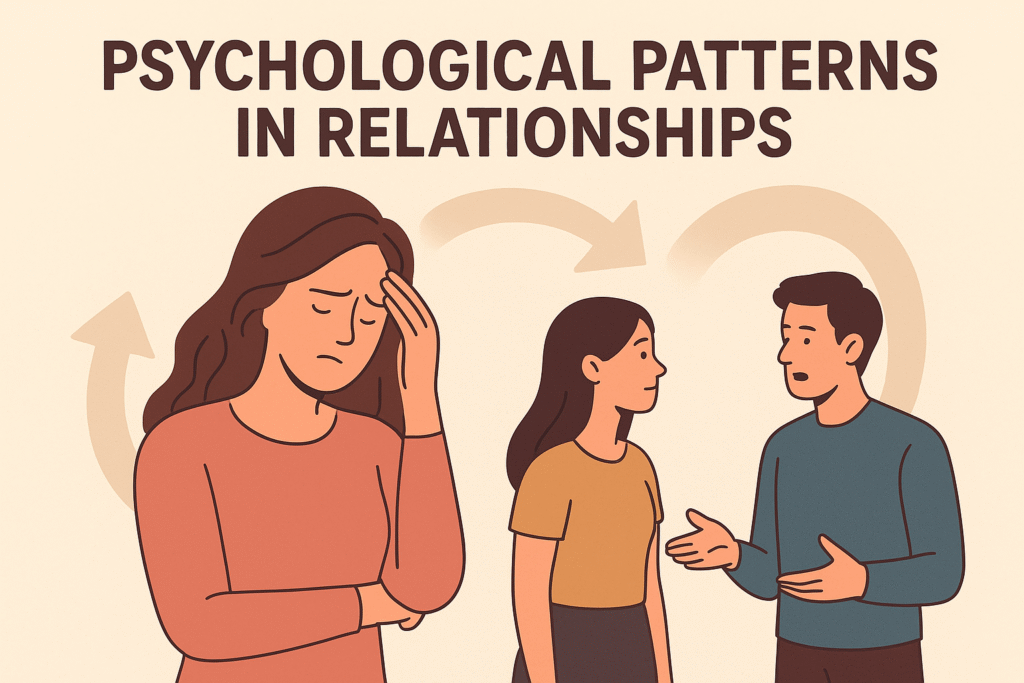
Relationships can often feel like déjà vu — different partners, but the same arguments, emotional wounds, and disappointments. Many people wonder why they continually choose emotionally unavailable partners or why stable love feels unfamiliar. The answer lies in psychological patterns formed long before adulthood.
These patterns shape who we choose, how we communicate, and what we tolerate. Understanding them is the first step toward creating a healthy, secure relationship.
What Are Psychological Patterns in Relationships?
Psychological patterns are subconscious emotional scripts created in childhood. They influence everything from your dating choices to conflict responses.
Psychologists call these internal working models — mental templates for what love “should” look like.
👉 Read more here:
Internal Working Model — Wikipedia
These emotional scripts decide:
- Who feels “attractive” to you
- Why you chase certain partners
- Why you avoid others
- Why toxic patterns repeat
They affect both offline dating experiences and online interactions, including how you behave on dating apps and international platforms.
Why We Repeat the Same Patterns With Different Partners
Many people think they have a “type,” but what they truly have is a pattern.
John Bowlby and Mary Ainsworth’s research on attachment styles explains how early emotional experiences shape adult relationships.
If love was inconsistent in childhood, you may associate inconsistency with “chemistry.”
If affection was earned, you may feel compelled to “prove” your worth in adulthood.
For deeper internal reading, see:
➡ Emotional Availability — LoveFinder.blog
Examples of how patterns form:
- A distant parent → attraction to unavailable partners
- An unpredictable parent → tolerance for hot-and-cold behavior
- A critical parent → attraction to partners who are hard to please
- A controlling parent → attraction to dominant personalities
The familiar often feels comfortable — even when it’s unhealthy.
Attachment Styles and Their Effects on Dating
Your attachment style strongly influences your dating life.
Secure
Comfortable with closeness and communication.
(Добавим внутреннюю ссылку, если ты создашь статью об этом.)
Anxious
Fears abandonment, seeks reassurance.
Avoidant
Pulls away when things become intimate.
Fearful-Avoidant
Simultaneously wants love and fears it.
👉 Good external explanation:
Attachment Styles Explained — Verywell Mind
These patterns play out both in real-life relationships and on online dating platforms.
Repetition Compulsion: Why We Recreate Old Pain
Freud described repetition compulsion as the urge to recreate unresolved childhood dynamics.
👉 External reference:
Repetition Compulsion — Wikipedia
This explains why some people repeatedly date:
- emotionally unavailable partners
- controlling personalities
- chaotic individuals
- partners they want to “fix”
Your brain unconsciously tries to “win” a fight from your childhood — using adult partners as stand-ins.
Trauma Bonds: Why Toxic Relationships Feel Addictive
Trauma bonding happens when intense emotions combine with unpredictability.
People become attached not to the partner, but to the cycle.
👉 External source:
Trauma Bonding — Verywell Health
Signs include:
- emotional highs and lows
- difficulty leaving even when unhappy
- confusion between passion and anxiety
- feeling addicted to a person
This is common in toxic relationships.
How These Patterns Show Up in Online Dating
Online environments emphasize certain psychological patterns.
Examples:
- Chasing partners who reply inconsistently
- Feeling “spark” only with emotionally unavailable matches
- Over-idealizing someone you barely know
- Getting attached after minimal communication
- Interpreting mixed signals as interest
International sites can be a legitimate space for meeting foreign partners, but patterns still follow you online.
For more on forming meaningful connections online, see:
➡ How to Make Friends While Traveling
Signs You Are Stuck in a Repeated Relationship Pattern
You may be caught in an emotional loop if:
✔ You’re attracted to the same unhealthy type
✔ Healthy partners feel “boring”
✔ You confuse chaos with chemistry
✔ You overextend yourself to keep someone
✔ You feel responsible for your partner’s emotions
✔ You repeatedly tolerate disrespect
✔ You stay even when they hurt you
These are signs of unresolved emotional patterns.
How to Break Unhealthy Relationship Patterns
Breaking emotional cycles requires awareness, self-compassion, and conscious action.
1. Identify Your Pattern
Start by asking:
- What type of partner am I drawn to?
- What emotional dynamic feels familiar?
- What situations cause me anxiety or overthinking?
You can add a link here when you create:
➡ “Relationship Patterns Quiz — LoveFinder.blog”
2. Understand Your Attachment Style
Start exploring your emotional blueprint here:
➡ Emotional Availability Guide
3. Choose partners who feel safe
Healthy love feels calm — not dramatic.
If calmness feels “boring,” it’s a sign you’re healing.
4. Practice healthy boundaries
Boundaries are difficult only if they were not respected around you growing up.
Boundaries include:
- Saying no
- Rejecting mixed signals
- Walking away from manipulation
- Communicating your needs clearly
5. Rewire your emotional responses
Your nervous system must learn that:
- calm ≠ boring
- consistency ≠ lack of passion
- respect ≠ weakness
This process takes time but changes everything.
6. Explore Imago Therapy
Imago Therapy helps people understand how childhood wounds show up in adult love.
👉 External reference:
Imago Therapy — Verywell Mind
7. Journal triggers & reactions
Write down:
- What triggered your reaction
- How it connects to earlier experiences
- What need wasn’t met
- What you can do differently next time
Awareness is step one in transformation.
Why Understanding Your Patterns Improves Dating Success
When you break your emotional patterns:
✨ You choose healthier partners
✨ You stop repeating toxic cycles
✨ You communicate more clearly
✨ You stop confusing intensity with love
✨ You build stable, secure relationships
This affects both offline dating and online relationships, improving the quality of potential partners you attract.
Final Thoughts
Psychological patterns have deep roots, but they are not permanent.
Once you understand your emotional scripts, you gain control over:
- who you choose
- what behaviors you accept
- the quality of relationships you build
Whether you date locally, travel, or look for love online, emotional awareness becomes your greatest dating skill.
You deserve love that feels safe, secure, consistent, and real — not a repetition of old wounds.