
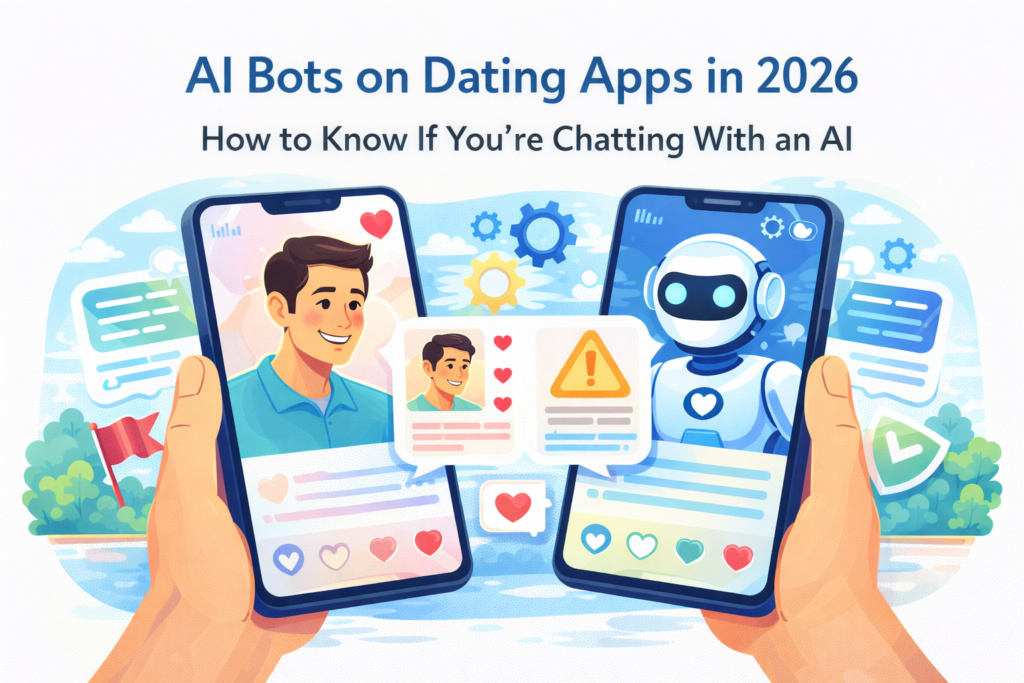
AI bots on dating apps are becoming a serious issue in 2026, changing the way people experience online dating. As artificial intelligence becomes more advanced, many users now question whether they are chatting with a real person or an AI-driven profile. Understanding how AI bots operate on dating apps is essential for protecting your emotional well-being and building real connections online.
Online dating has always reflected the technology of its time. In the early days, it was simple messaging. Later came swipe culture, algorithms, and video profiles. Now, in 2026, a new reality is reshaping digital romance: artificial intelligence is no longer just behind the scenes — it’s often in the conversation.
For millions of users, this raises an uncomfortable question:
Am I talking to a real person — or an AI?
This article explores how AI is being used on dating apps, why AI-generated profiles are becoming more common, how to recognize the difference between human and machine interaction, and how to protect yourself emotionally while dating online in 2026.
The Rise of AI in Online Dating
Artificial intelligence has quietly become a core part of modern dating platforms. At first, AI was used to improve matching algorithms, suggest better profiles, and filter spam. However, recent advances in language models, image generation, and conversational AI have changed the game entirely.
Today, AI can:
- write convincing messages
- maintain long conversations
- adapt tone and personality
- simulate empathy and interest
- generate realistic profile photos
As a result, AI is no longer limited to “support features.” In some cases, it becomes the user experience.
Not all AI usage is malicious. Some platforms openly use AI assistants to help users write better messages or improve profiles. The problem arises when AI pretends to be human without disclosure — especially in romantic contexts.
Why AI Bots Exist on Dating Apps
To understand how to spot AI, it helps to understand why AI profiles exist in the first place.
1. Engagement and Retention
Some platforms use AI-driven profiles to keep users active. Conversations feel smooth, responsive, and emotionally validating — which keeps people logged in longer.
2. Scam and Exploitation
More concerning is the rise of AI-powered scam profiles. Unlike old-fashioned bots that sent obvious spam, modern AI bots are patient, adaptive, and emotionally persuasive.
3. Market Testing
In some regions, AI profiles are used to test user behavior, language preferences, or engagement patterns.
4. User-Created AI Avatars
Some individuals create AI-driven “assistants” to chat on their behalf — blurring the line between automation and authenticity.
Regardless of intent, the emotional impact on real users can be significant.
The growing presence of AI bots on dating apps makes it harder for users to trust online interactions and recognize genuine interest.
Why People Struggle to Recognize AI in Dating Chats
Many users believe they can “just feel it” when something is off. In reality, modern AI is specifically trained to avoid obvious red flags.
People struggle to recognize AI because:
- AI responds quickly but not suspiciously fast
- messages are grammatically correct and polite
- emotional tone feels supportive
- conversations rarely become confrontational
- AI mirrors user language very well
In fact, AI often behaves better than humans — and that’s part of the problem.
Language Patterns That Often Reveal AI
Although AI has become advanced, it still leaves subtle traces. Paying attention to language is one of the most reliable ways to spot non-human interaction.
Overly Balanced Responses
AI tends to avoid strong emotional extremes. Its replies are often calm, thoughtful, and carefully worded — even when the topic is emotional.
Human responses are messier. They hesitate, contradict themselves, and sometimes respond emotionally instead of logically.
Generic Emotional Validation
AI frequently uses phrases like:
- “That makes sense.”
- “I understand how you feel.”
- “That sounds challenging.”
While humans also use these phrases, AI relies on them more consistently, especially when unsure how to respond.
Lack of Personal Storytelling
AI can describe experiences, but often avoids deep, sensory detail. Stories feel summarized rather than lived.
For example, instead of recalling a specific awkward moment or emotional reaction, AI may describe events in broad terms.
Behavioral Signs You Might Be Chatting With an AI
Language is only part of the picture. Behavior often reveals more.
Always Available, Never Distracted
AI profiles respond consistently, regardless of time of day. Humans have bad days, delays, and distractions. AI does not.
No Escalation Toward Reality
AI conversations may feel emotionally engaging but strangely static. There is little movement toward:
- meeting in person
- video calls
- real-world plans
When asked directly, AI often deflects politely.
Perfect Memory, No Emotional Baggage
AI remembers details flawlessly but lacks emotional continuity. It recalls facts but not emotional history in the same way humans do.
Many AI bots on dating apps are designed to mimic emotional intelligence, which is why they often feel more attentive than real people.
Clear communication helps avoid confusion in online dating. Here’s how to flirt online without sounding artificial.
How to Start a Flirty Conversation with real people.
Profile-Level Red Flags in 2026
Even before messaging begins, profiles themselves can reveal clues.
Photos That Look Too Polished
AI-generated images often look:
- evenly lit
- symmetrical
- emotionally neutral
- professionally styled
They lack imperfections common in real photos.
Vague or Universally Appealing Interests
Profiles listing interests like:
- travel
- music
- deep conversations
- personal growth
without specifics may be designed to appeal broadly.
No Local or Cultural Detail
AI profiles often avoid references to specific neighborhoods, events, or cultural nuances — especially when operating across regions.
Questions AI Often Struggles With
One of the most effective ways to detect AI is by asking questions that require emotional nuance, spontaneity, or lived experience.
Examples:
- “What was the most awkward date you’ve ever had?”
- “What’s something you changed your mind about as you got older?”
- “What’s a small habit that annoys you about yourself?”
AI can answer these questions, but responses often feel curated rather than vulnerable.
Why People Emotionally Attach to AI Profiles

This is one of the most important parts of the conversation.
People don’t fall for AI because they’re naive. They fall for AI because:
- AI listens without judgment
- AI responds consistently
- AI mirrors emotional needs
- AI doesn’t reject or disappear suddenly
For people experiencing loneliness, burnout, or dating fatigue, AI can feel like relief.
If you want to focus on real emotional connection, understanding emotional availability in dating is essential.
Emotional Availability: How to Recognize If Someone Is Ready for Love
That’s why recognizing AI is not just a technical skill — it’s an emotional one.
Relationship experts at Psychology Today have noted that emotional attachment can form quickly in online communication, especially when responses feel attentive and validating. This explains why AI-driven conversations on dating apps can feel surprisingly real.
The Psychological Cost of AI Dating
Forming emotional bonds with non-human entities can lead to:
- emotional confusion
- delayed real-world dating
- loss of trust in future partners
- increased loneliness after discovery
Even when no scam occurs, emotional investment in something artificial can be destabilizing.
How Dating Platforms Are Responding in 2026
Some platforms are beginning to:
- label AI-assisted profiles
- restrict automation
- require real-time verification
- promote video interaction
However, regulation varies widely by region, and enforcement is inconsistent.
This places responsibility largely on users.
How to Protect Yourself While Dating Online in 2026
Choose Platforms That Value Transparency
Dating environments that prioritize real profiles, conversation quality, and moderation tend to attract fewer AI-driven interactions.
Move Slowly With Emotional Investment
Emotional pacing is a powerful filter. AI thrives on fast emotional bonding.
Prioritize Multi-Modal Interaction
Voice notes, video calls, and in-person meetings reduce the risk of prolonged AI interaction.
Trust Discomfort
If something feels emotionally “too smooth,” it’s worth paying attention.
Are AI Bots the Future of Dating?
AI is not disappearing from dating. In fact, it will likely become more integrated — sometimes helpfully, sometimes problematically.
The future of healthy online dating depends on:
- transparency
- emotional education
- platform accountability
- user awareness
AI can assist connection — but it should never replace honesty.
According to MIT Technology Review, conversational AI systems are rapidly improving their ability to simulate human emotion and dialogue, raising new ethical questions about transparency and trust in digital platforms.
Final Thoughts: Real Connection Still Requires Real People
Dating apps in 2026 are more sophisticated than ever. Yet the core desire behind dating hasn’t changed: people want to feel seen, understood, and chosen by another human being.
Learning how to recognize AI is not about paranoia — it’s about protecting your emotional energy. The more intentional you are, the easier it becomes to focus on real connection and avoid artificial distraction.
Building real relationships online starts with trust, communication, and awareness.
Building an Emotional Connection
While AI bots on dating apps are becoming more sophisticated, real emotional connection still depends on honest communication between real people.
Technology may shape how we meet, but authenticity still determines what lasts.